


The usual diagnosis is the anti-bot stack. It is usually arithmetic instead. Portugal's consumer address space is small enough to count, and most providers resell overlapping slices of the same three networks, which is why ranking the best Portugal proxy servers in 2026 on pool size and price gets the answer wrong.
This comparison starts at the AS level and works upward.
Portugal's Entire Eyeball Space Fits Inside Three Autonomous Systems
When a provider advertises Portuguese residential proxies, the addresses come from Portuguese ISP subscribers. There is a hard ceiling on how many of those exist, and it is public information in the RIPE database.
ASN | Operator | Announced IPv4 | IPv4 prefixes | Practical note |
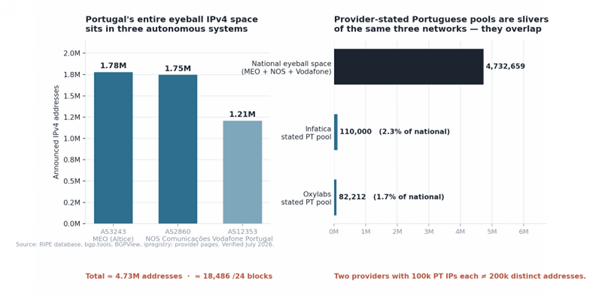
AS3243 | MEO (Altice) | ~1.78M | — | RIPE as-name: MEO-RESIDENCIAL; the incumbent's consumer network |
AS2860 | NOS Comunicações | ~1.75M | 127–129 | Ranked first for estimated eyeballs in Portugal; 1–5 Tbps |
AS12353 | Vodafone Portugal | ~1.21M | 29 | Only 29 prefixes, so subscribers concentrate into few blocks |
Roughly 4.7 million IPv4 addresses across the three, or about 18,500 /24 blocks for the whole country. Not every one of those is a live residential subscriber, and only a fraction of subscribers ever end up in a proxy pool.
Now compare that ceiling against the claims on vendor pricing pages. Oxylabs publishes 82,212 Portuguese IPs. Infatica advertises over 110,000. Those are 1.7% and 2.3% of the national eyeball space respectively, drawn from the same three ASNs, which means they are not independent supply. They overlap. Two proxy providers with 100,000 Portuguese IPs each do not give you 200,000 distinct addresses, and buying from both to widen diversity delivers far less than the headline numbers imply.
Best Portugal proxy servers in 2026: MEO, NOS and Vodafone announce roughly 4.7 million IPv4 addresses between them, and provider-stated Portuguese pools are overlapping slivers of that space
This is why per-country pool size is a weak signal when comparing Portugal proxies, and /24 diversity is the strong one. A proxy pool of 10,000 addresses spread across 400 distinct /24s behaves nothing like 10,000 addresses concentrated in 40. Vodafone's 29 prefixes are the sharpest version of the problem: subscribers there cluster tightly, so a target that has started scoring reputation at the subnet level treats one flagged neighbour as a signal about your session too.
Providers rarely publish subnet distribution. Sample a few hundred exit IPs, collapse them to /24s, and count the distinct values yourself. Ten minutes of work tells you more than the pool figure on the pricing page.
A "Portuguese" IP Is a Database Claim, Not a Location
The second Portugal-specific problem is that datacenter supply inside the country is genuinely thin, and the market papers over that with geolocation records.
GigaPIX, the national exchange run by FCT|FCCN and the oldest and largest IXP in Portugal, carries about 280 Gb/s of average daily traffic across 65 active members and five facilities, three in Lisbon and two in Porto. Google, Cloudflare and Akamai peer there at 30G, 20G and 20G respectively. That is a healthy exchange for a market this size, and it is also perhaps two percent of what DE-CIX Frankfurt moves. Portugal is an eyeball market, not a hosting market.
So when a proxy service lists "Portugal datacenter IPv4," ask what that means physically. The country: field in a RIPE inetnum is an administrative attribute filled in by the resource holder. It is not verified, it is not a geolocation guarantee, and a block registered country: PT can terminate in Madrid, Frankfurt or Amsterdam. Commercial geolocation databases frequently inherit that claim. The IP then reads as Portuguese to MaxMind, to your own checks, and to the target site, right up until the target correlates it against latency or a CDN edge assignment and concludes otherwise.
The consequence for market research is not a block. It is quiet data corruption: prices, delivery estimates and search results rendered for the wrong market, collected at a healthy success rate, and merged into your dataset without an error to alert you.
Verifying takes four steps and is worth doing before you sign anything:
Triangulate by RTT. Ping the candidate IP from probes in Lisbon, Madrid and Frankfurt. Light needs roughly 5 ms per 1,000 km round trip in fibre, so an address that answers Frankfurt in 6 ms and Lisbon in 30 ms is in Germany, whatever the database says.
Read the reverse DNS and the ASN. Hostnames leak PoP codes. An address on a hosting ASN with no Portuguese presence in PeeringDB is not in Portugal.
Cross-check three geolocation sources. Where MaxMind, IP2Location and IPinfo disagree on the country, the record is inherited rather than observed.
Render a known page. Fetch a Portuguese retail product page and confirm euro pricing, pt-PT copy and a domestic delivery estimate. This is the only test that measures what you actually care about.
Best Portugal Proxy Servers in 2026: Provider Comparison
Prices below are published entry rates as of July 2026 and shift with volume tiers and promotions. Pool figures are self-reported by each proxy provider and, per the section above, should be read as overlapping claims on the same ~4.7M addresses rather than as independent inventory.
Provider | Portugal offering | Entry price | Targeting granularity | Constraint worth knowing before you buy |
Proxys.io | Rotating residential only | from $1.50/GB | Country, region, city; rotation timer 2–60 min | No Portuguese static IPv4 or ISP product. PT is residential-or-nothing |
Proxy-Seller | IPv4, ISP, residential, mobile | IPv4 from $0.49/IP; residential from $1.30/GB | Country; city-level claimed | Broadest PT lineup, but verify the IPv4 blocks terminate in-country |
DataImpulse | Residential + PT mobile | $1/GB residential; $2/GB mobile | Country included; city and ASN are paid add-ons | Cheapest per GB; ASN targeting behind a paywall matters here specifically |
Oxylabs | Residential + datacenter | ~$8/GB standard | Country, city | 82,212 stated PT IPs; enterprise pricing and procurement friction |
IPRoyal | Residential; ISP elsewhere | $7.00/GB at 1 GB, $1.75/GB at bulk | Country, region, city, ISP | ISP product covers 31+ countries and Portugal is not reliably among them |
Webshare | Datacenter + residential | DC from $0.029/IP; residential ~$7/GB | Country; city on higher tiers | Cheapest datacenter entry; datacenter is the wrong tool for PT retail |
Bright Data | Residential | ~$8/GB standard | Country, city, ASN | Deepest pool in thin markets; heaviest compliance and onboarding overhead |
Reading That Table Against Your Actual Workload
The price spread across these Portugal proxy servers is 8x, and it does not correlate with success rate on Portuguese targets the way you would expect.
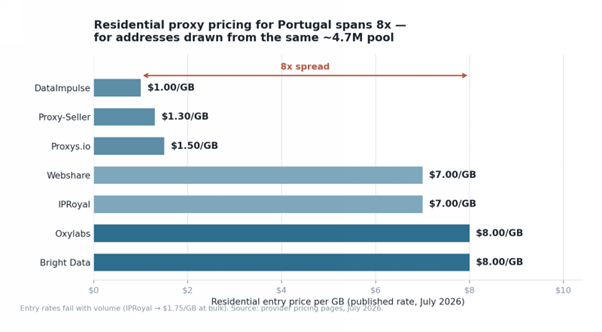
Residential entry price per GB for Portugal proxies across seven providers, ranging from $1.00 to $8.00 for addresses drawn from the same national pool
DataImpulse at $1/GB is the cheapest accurate data point on paper, with the caveat that ASN targeting sits behind an add-on. In a market where three ASNs hold everything, the ability to pin sessions to a specific ASN, or to distribute deliberately across all three, is not a luxury feature. It is the main lever you have.
The enterprise tier earns its ~$8/GB in exactly one scenario: when pool depth in a thin market is your binding constraint. If you are pulling a few hundred thousand pages a month from Portuguese retail, it usually isn't, and you are paying eight times the rate for headroom you never touch. If you are running high concurrency against the hardest targets in the country, the depth is real and the premium is rational.
The most interesting row is Proxys.io, and for an unflattering reason. Their static IPv4 lineup covers 24 countries and their ISP proxies cover 17, including Spain, France and Poland. Portugal appears in neither. Portuguese coverage is the rotating residential pool alone, drawn from a 100M+ IP network across 195 countries at $1.50/GB, with rotation configurable from 2 to 60 minutes and HTTP and SOCKS5 live on the same credentials.
That gap is worth more than it looks. Any proxy provider selling Portuguese static IPv4 is either genuinely hosting in Portugal, which is rare and expensive given what GigaPIX tells us about the market, or selling you an inetnum with country: PT that lands in Madrid. Declining to offer the product is the more honest position, and it happens to point at the only IP class that reliably works for Portuguese retail and SERP data anyway.
Which Proxy Type Fits Which Portuguese Target
Datacenter proxies have a narrow but real place here: internal endpoints, APIs you are authorised against, uptime and response-time checks, and any target that does not localise by IP. It is fast, it is cheap at three cents an address, and against Portuguese retail it is the wrong tool. Those platforms segment on IP class early, and a datacenter range gets classified long before the price data lands.
ISP proxies are the natural fit for long sessions on a fixed identity, which is why the gap in Portuguese availability is frustrating rather than trivial. Almost nobody sells genuine Portuguese ISP proxies, and the services advertising them warrant the four-step verification above before purchase.
Rotating residential proxies are the default for Portugal and, for most compliant workloads, the only defensible choice. Real subscriber addresses on MEO, NOS or Vodafone render Portuguese retail correctly because they are what the site is built to serve. The trade-off is throughput and latency variance: you are traversing a consumer last mile, so p50 looks fine and p99 does not, and your timeout budget needs to reflect that rather than the datacenter numbers in your head.
Mobile proxies are the tier above, priced accordingly, and justified when a target is carrier-aware or you need mobile-specific rendering. For price intelligence and SERP monitoring it is usually overkill.
What Actually Moves Success Rate
Concurrency discipline beats pool size in this market. Portugal's address space is small enough that hammering it with 200 threads walks you through the available /24s fast and burns reputation across the pool you will need next week. Throttle to what a plausible visitor volume looks like for a country of ten million.
Distribute across all three ASNs deliberately rather than accepting whatever your proxy rotation hands you. Sessions clustered on one operator produce a traffic signature no real Portuguese audience matches.
Match the transport to the content. A Portuguese exit with Accept-Language: en-US is a contradiction the target can read, and it will sometimes serve you a different page rather than block you, which is worse.
Use sticky sessions for anything multi-step. Search, category, product and cart flows that rotate IP mid-sequence produce abandoned sessions and partial data. Proxys.io exposes this as a rotation timer rather than a session ID, so set the interval above your longest flow rather than trying to pin per-request.
Finally, measure the thing that matters. Success rate is a vanity metric if the successful responses carry the wrong market's prices. Instrument a currency-and-locale assertion on every parsed record and alert on drift, because the failure mode described earlier is silent by construction.
When Switching Providers Is Worth the Migration Cost
Migration costs real engineering hours, so the bar should be high. Three signals clear it.
The first is subnet exhaustion: your /24 diversity sample comes back thin, your block rate climbs over weeks rather than spiking, and no amount of throttling recovers it. That is a supply problem and only a different pool fixes it.
The second is geolocation drift. If your locale assertions start failing on a proxy pool that used to pass, the provider has re-sourced addresses and inherited someone's country: claim. That is not a bug you can throttle around.
The third is simple unit economics. If you are on an enterprise contract at $8/GB and your concurrency profile never touches the depth you are paying for, you are subsidising headroom. A Portugal proxy server at $1.50/GB from a mid-market provider delivers the same Portuguese residential addresses from the same three ASNs, because there is nowhere else for them to come from.
The counter-argument is worth stating: enterprise proxy providers buy you compliance documentation, an SLA and a support path that resolves incidents rather than acknowledging them. If your legal team needs a DPA and a named contact, that is what the premium purchases, and it is a legitimate reason to stay.
For teams that want to test the difference without a procurement cycle, the practical move is to request a trial proxy, sample a few hundred exits from the rotating residential pool, collapse them to /24s, and run the four-step verification against your own targets. The data answers the question faster than any comparison table, including this one.
Portugal punishes the assumption that a bigger pool is a better pool. The country has roughly 4.7 million eyeball addresses across three ASNs, one meaningful exchange and almost no native hosting, which means every provider is selling the same scarce supply at different margins, with different degrees of honesty about what the country: field means. Rank Portugal proxies on subnet diversity and geolocation integrity, verify both against your own targets before you commit, and the price question mostly answers itself.
 Add as a preferred source on Google





 Portugal Handbook
 English
 Nederlands
 Deutsch
 Français
 Español
 Italiano
 Svenska
 Pусский
 中文
中文 Türkçe
 Português
 Czech
Czech Hungarian
 Polski
 عربي
عربي Suomi
Suomi עִברִית
 Português (Brasil)
Follow us on social media