


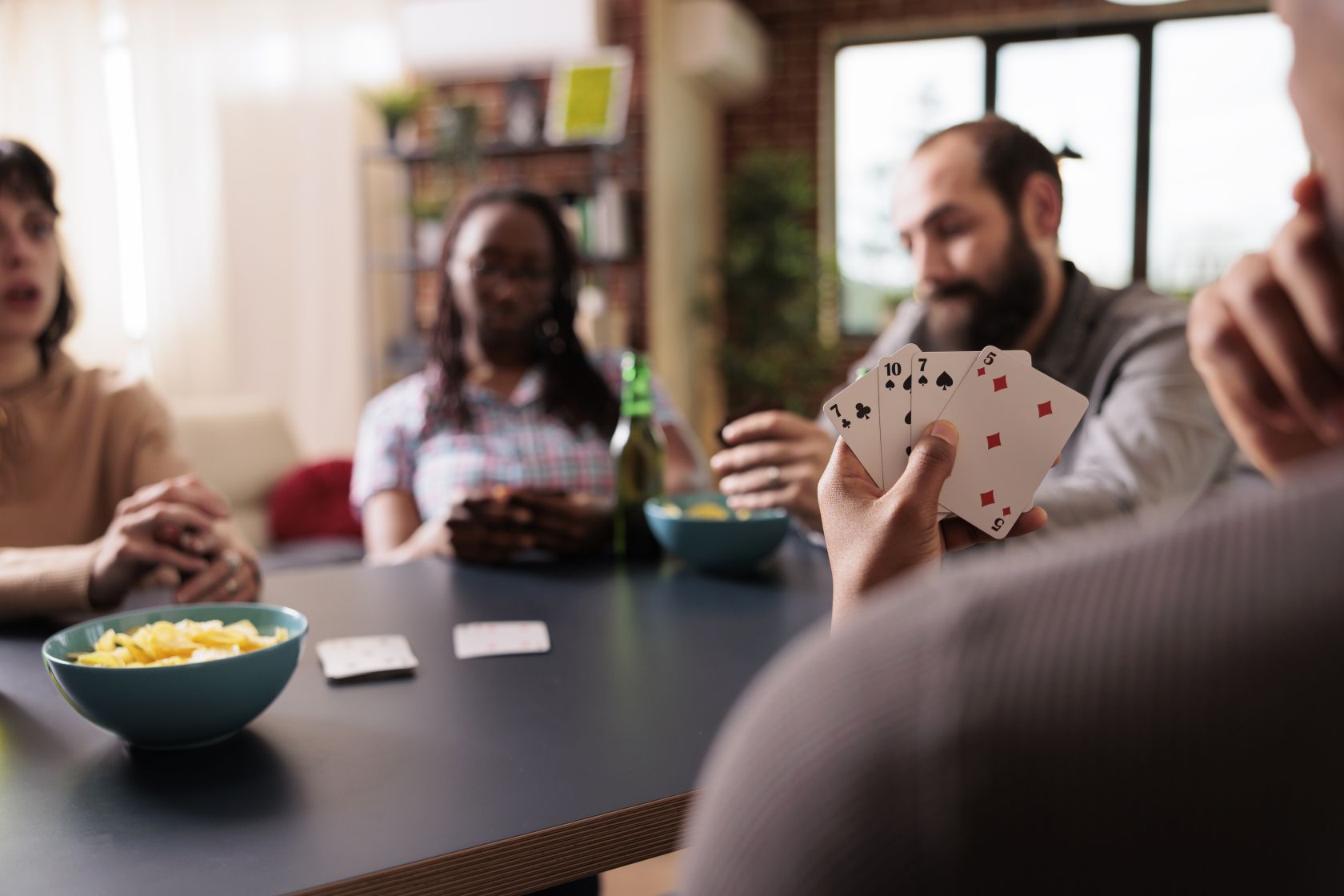
The appeal isn't nostalgia. It's about what this category of activity actually asks of you.
An Editorial Angle Worth Paying Attention To
The editorial team at Poker Guru has spent considerable time observing how skill-based card games occupy a distinct category in adult leisure. Two things stand out from that vantage. First, games like poker and bridge engage probability assessment, working memory, pattern recognition, and opponent-modelling at the same time — a kind of cognitive demand that passive entertainment doesn't come close to placing on you. Second, and more structurally, a skill-based game differs from a pure-chance game in a specific way: your decisions materially influence outcomes over time, which means improvement is both possible and measurable.
That distinction matters to how these games get learned. Poker learning communities have organised themselves around language and national market, and PokerGuru LT is one such platform, built to walk Lithuanian-speaking players through the mathematics and psychology of the game in their own language. The trend reflects a broader reality: serious players want structured resources, not just a seat at the table.
What Strategy Card Games Actually Do to Your Brain
Streaming a series and playing a hand of poker may both happen on a Tuesday evening, but they're asking very different things of you. Passive entertainment is primarily reactive — the content arrives, you receive it. Strategy card games demand continuous decision-making. Every hand is a calculation, a memory exercise, and an exercise in reading another person, all running simultaneously.
That kind of active mental engagement matters across adulthood. Sustained involvement in activities that require real decision-making is widely associated with maintaining cognitive sharpness, whereas passive consumption offers little of that. The specific functions recruited during a game — probability assessment, pattern recognition, modelling what an opponent might hold — are exactly the ones that benefit from regular exercise. Adults who build this kind of thinking into their leisure time consistently report higher satisfaction from it than those whose free time runs on passive formats alone.
The Social Infrastructure That Card Games Build
One of the more underappreciated things about regular card nights is what they create around themselves. A recurring game becomes infrastructure. Players show up weekly or fortnightly, learn each other's tendencies, develop rituals, and build something that looks a lot like community — not because anyone planned it, but because the game structure demands it.
That social dimension is especially relevant in Portugal, which hosts one of Western Europe's larger international resident communities. When you're in a room with people who don't share a first language or a home culture, a card game with clear shared rules does something quietly powerful. The table talk, the real-time opponent-reading, the shared vocabulary of the game — all of it creates common ground that small talk often can't. Informal clubs, weekly leagues, and dedicated game nights have sprung up across expat communities for exactly this reason. They're practical as much as they are social.
Entry Points, Learning Curves, and Staying Power
One concern people raise before picking up a skill-based card game is the learning curve. That concern is real, but it's framed backwards. The curve is part of why these games hold adult attention over years rather than weeks.
Pure-chance games have no progression. You play, outcomes happen, and your skill level at the end of the session is the same as at the start. Skill-based games work differently. Moving from beginner to competent to genuinely good takes time, and that path is visible as you travel it. You can measure your improvement. You can identify the specific gaps in your game and work on them. That explicit progression keeps players returning long after the novelty has faded, and it's a primary reason so many people maintain the habit for decades.
The practical entry point is lower than most newcomers expect. You don't need to be good to start — you need to be curious. A basic grasp of the rules, a willingness to lose a few hands while you learn, and access to others playing at a similar level is enough to begin.
Poker as the Deepest Expression of Skill-Based Play
No skill-based card game has been studied, written about, or systematically taught as thoroughly as poker. It sits at an unusual intersection: pure mathematics on one side, applied psychology on the other, with strategic decision-making under genuine uncertainty holding the two together. That combination gives it a depth that very few leisure activities can match.
What makes poker particularly compelling for adults looking for long-term engagement is the volume of structured learning available to them. The analytical literature around the game is unusually rich and publicly accessible — strategy guides, probability frameworks, hand-history analysis, and community discussion exist in enormous quantity. A player who wants to improve systematically has more material to work with here than in almost any comparable game.
For anyone in Portugal's English-speaking community weighing where to direct serious leisure time, that depth is a genuine argument in poker's favour. The skills are learnable. The community, both locally and internationally, is already there and has been for a long time.
Set The Portugal News as your preferred source for news on Google
 Add as a preferred source on Google


 Portugal Handbook
 English
 Nederlands
 Deutsch
 Français
 Español
 Italiano
 Svenska
 Pусский
 中文
 Türkçe
 Português
 Czech
 Hungarian
 Polski
 عربي
 Suomi
 עִברִית
 Português (Brasil)

Follow us on social media