


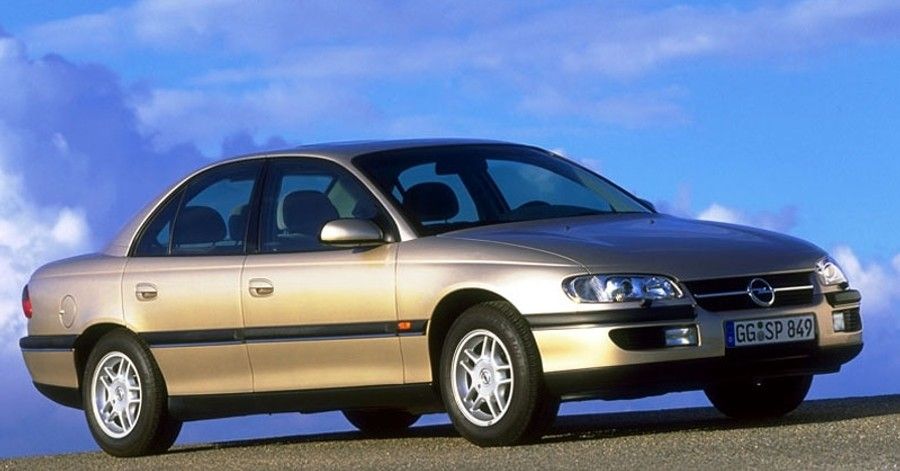
I give you the Omega: During the 90s, automotive marketing was unashamedly simple. It was all about pecking orders.
People bought a Cavalier if they were doing reasonably well, a Carlton if they were doing very well and an Omega if they'd reached the point where leather seats, walnut-effect trim and a six-cylinder engine were appropriate rewards for surviving another year of tedious “business" gatherings.
In 1994, Vauxhall launched the Omega. It was a large, comfortable saloon designed to take on the Germans. As it turns out, the Omega was the final luxury barge from the Vauxhall/Opel stable. And, in retrospect, it was also the last gasp of an entire automotive ecosystem.
The Omega name had already appeared on the continent in 1986. The first-generation became the Opel Omega in Europe and the Vauxhall Carlton in Britain. The Carlton, particularly in sporting GSi form, developed a reputation for being a rather serious piece of kit, until we got to see the Lotus Carlton with its twin-turbocharged 3.6-litre straight-six producing around 377bhp.
Traditional formula
The Omega B, launched in 1994, replaced both the Carlton and Senator ranges in one hit. It was a more modern, rounded, aerodynamic machine, but it retained the traditional executive-car formula. It was also available as an estate.
The Omega’s engine range was extensive. At launch, the entry point was a 2.0-litre four-cylinder petrol engine, offered in both eight-valve and 16-valve forms depending on specification. The 16-valve version produced around 134bhp. It was perfectly adequate, although “adequate” was not generally a word people wanted to associate with a large executive saloon. The more appealing petrol options were the 2.5-litre and 3.0-litre V6s.
Diesel buyers weren't forgotten either. The early 2.5-litre turbo-diesel straight-six, sourced from BMW, was a particularly notable choice. It was smooth, refined and well suited to long-distance work. Later, a 2.0-litre turbo-diesel arrived, followed by a direct-injection diesel. There was also a 2.2-litre petrol engine, introduced with the facelift, which replaced the 2.0-litre petrol in the range. The facelift of 1999 brought revised styling, a new interior and a more modern engine line-up.
The sporty MV6 was the enthusiast’s choice. It wasn't a snarling, track-focused monster in the manner of a modern performance saloon. Instead, it was more like a business suit with a concealed switchblade. It retained the Omega’s long-legged comfort but added sharper handling.
And, for those who appreciate automotive what-iffery, there was an even more tantalising possibility. The Omega V8. This was the one that got away. Opel developed an Omega powered by the 5.7-litre Chevrolet LS1 V8, producing approximately 311bhp. The plan was to create a discreet, understated performance saloon capable of reaching 62mph in under seven seconds and topping out at around 155mph. The prototype was announced, but the production version never arrived. A shame, really. Imagine your sensible Vauxhall having a burbling V8 Corvette lump.
A practical vehicle
The Omega’s greatest achievement was not its top speed. It was the way it travelled. The ride was supple without being hopelessly soggy. The interior was spacious, the seats were supportive, and the boot was large enough to swallow luggage for a family holiday without requiring Tetris skills.
Equipment levels ranged from the fairly modest Select and GLS through CD, CDX and the range-topping Elite. Depending on year and specification, buyers could enjoy air-conditioning, leather, cruise control, electric seats, a rear-window blind, automatic transmission, navigation and enough buttons to make the dashboard resemble a NASA control room.
The estate was especially impressive. It was a proper load-lugger, but without the driving dynamics of a van. A large dog could travel in it, a caravan could be towed behind it, and the owner could still arrive at a hotel looking as though he had made an effort in life.
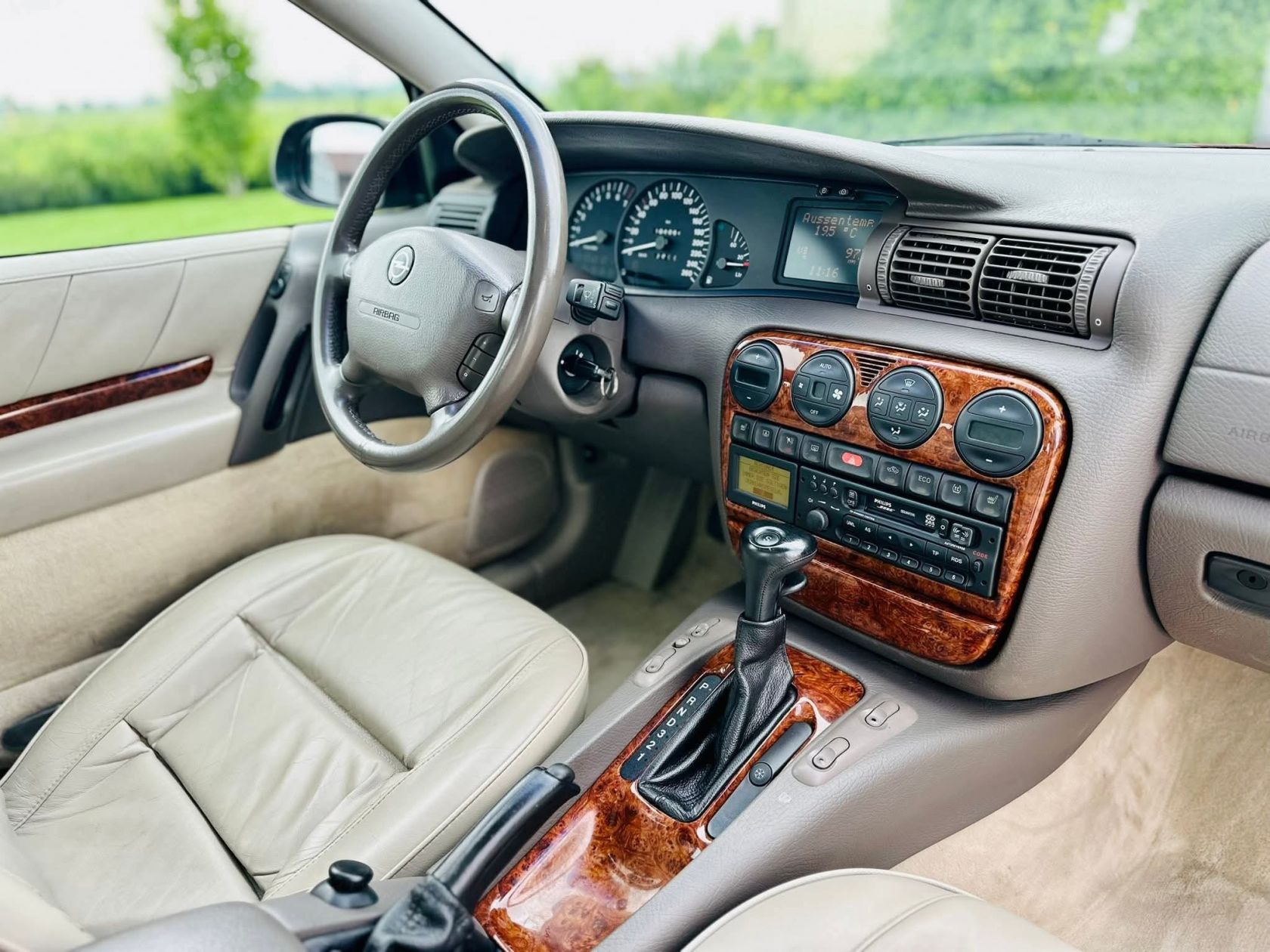
The Omega also became popular with police forces, particularly in V6 form. It had the performance, space and road manners. It was also a favourite among caravan owners, which is perhaps the ultimate endorsement of its practicalities.
So, why did Vauxhall stop making it? The reason was not that it had suddenly become a bad car. Quite the opposite. The problem was that the market it occupied was rapidly disappearing.
Mainstream manufacturer
In the 1980s and early 1990s, a large executive car from a mainstream manufacturer made perfect sense. Ford had the Granada and Scorpio, Rover had the 800, Peugeot had the 605, and Vauxhall had the Carlton and Omega. But by the late 1990s, buyers increasingly wanted a premium badge. BMW, Mercedes-Benz and Audi had become more dominant in the company-car and executive markets. The rise of the “user chooser” company-car scheme meant that many drivers were no longer selecting a car based simply on price, comfort and reliability. They wanted the badge too.
The Omega was caught between two worlds. It was too expensive to be a conventional family car, but not prestigious enough to tempt buyers away from established German brands. Sales declined significantly, and the business case for replacing it became increasingly difficult to justify.
Today, the Omega looks almost offensively extravagant. A 3.2-litre V6 executive saloon, weighing well over 1.5 tonnes, with an automatic gearbox and a thirst that could easily prompt environmentalists to start waving placards on your driveway.
And yet, there is something refreshing about it. The Omega was built in an era when engineering a car meant making it comfortable, durable, capable and pleasant to drive. It wasn't designed around the latest app, the largest touchscreen or the number of grams of recycled plastic in the dashboard. Of course, it consumed more fuel than a modern hatchback, but it was also a car that could carry its passengers over huge distances in sublime comfort.
Future classic
I don't think the environmental angle was ever quite as simple as “large car bad, small car good”. Although, try explaining that to someone who has just bought a battery-powered SUV the size of a garden shed. The Omega belongs to a time when cars were allowed to be cars. They could be luxurious without being ostentatious, powerful without having six selectable driving modes.
Could the Omega be a “future classic”? Today, a good Omega, particularly a 3.0 V6, a 3.2 V6, or a well-equipped Elite, is increasingly appreciated by enthusiasts. It's a car that represents the end of an era. A machine built to serve its owners rather than to monitor them. A good example will never command the prices of a BMW E39 or a Mercedes W124. But that's part of the Omega's charm. You can still buy one without selling a kidney, although finding a really good example is becoming increasingly difficult.
The Vauxhall Omega was never glamorous. It just didn't have the badge, the marketing or therefore the fashionable image. But it was a thoroughly capable executive car. It was perhaps the last car to prove that luxury motoring didn't need to come wrapped in premium German packaging.
Set The Portugal News as your preferred source for news on Google
 Add as a preferred source on Google







 Portugal Handbook
 English
 Nederlands
 Deutsch
 Français
 Español
 Italiano
 Svenska
 Pусский
 中文
 Türkçe
 Português
 Czech
 Hungarian
 Polski
 عربي
 Suomi
 עִברִית
 Português (Brasil)

The Omega was always better than its reputation, and although the contemporary Merc W210 and BMW E39 were the class best, the Omega was about 90% as good while costing 70% as much. Definitely Opel's peak.
Keep on the great articles coming!
By Carlos Matias from Alentejo on 18 Nov 2026, 12:10