


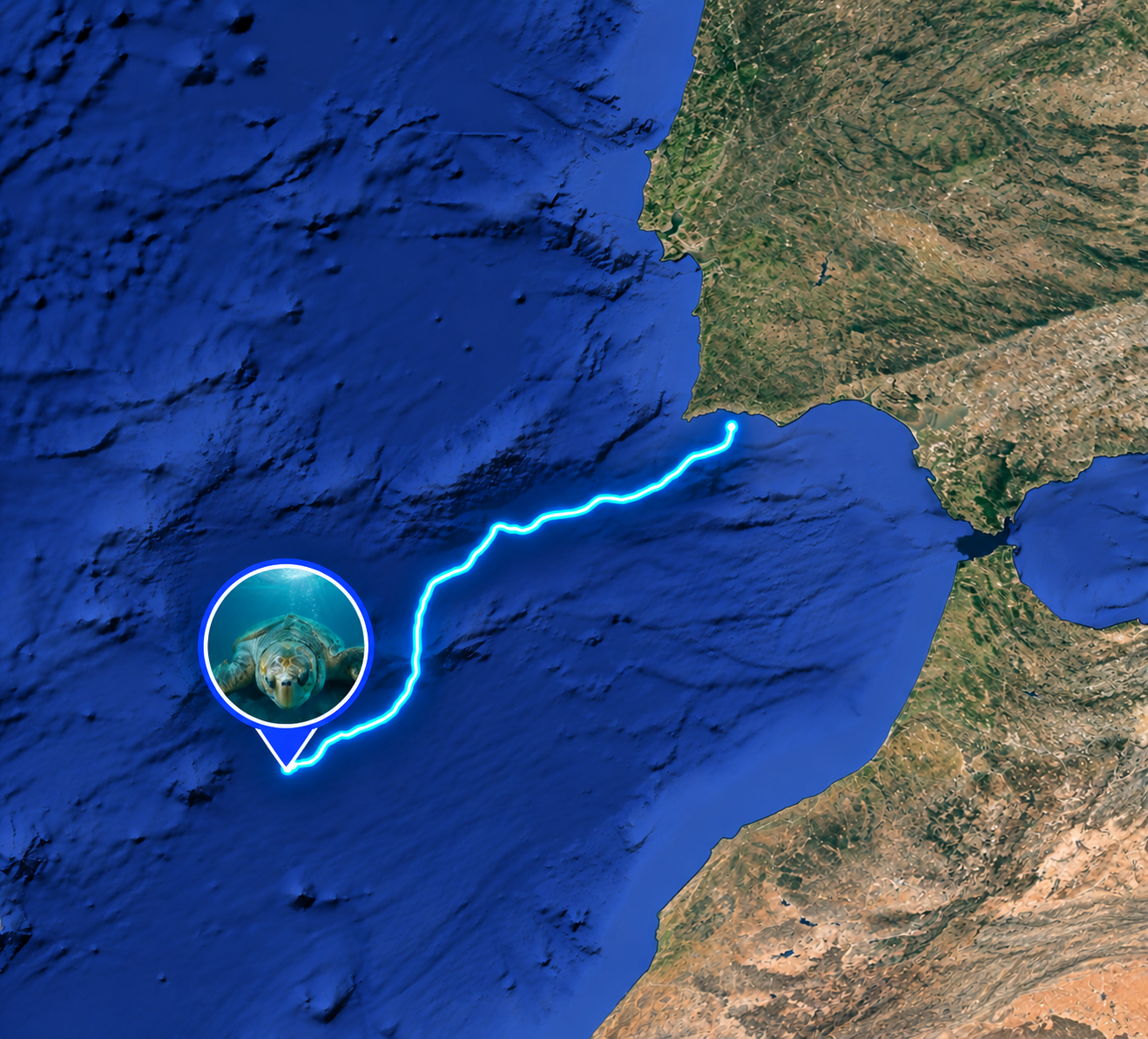
Molly, a 120 kg loggerhead sea turtle released into the Atlantic off the Algarve on 28 October, has travelled approximately 640 kilometres in 27 days, according to new tracking data released by Zoomarine.
The turtle, which spent around two decades in human care after being rescued in Ireland, is now in open water southwest of the Algarve and heading towards Madeira.
Her movements are being recorded by a satellite transmitter attached to her shell, allowing researchers to monitor her return to the wild following rehabilitation at Zoomarine’s Porto d’Abrigo centre.
Steady progress across the Atlantic
According to Zoomarine, Molly has maintained a relatively consistent course and diving pattern since her release, travelling more than 20 kilometres per day on average.
The early results suggest she is adapting to life at sea, although researchers caution that it is too soon to establish whether her current direction represents a longer-term migration route.
Her journey bears similarities to that of Calantha, another loggerhead turtle which, after 25 years in human care, travelled from the Algarve coast to the Caribbean.
Molly’s release on 28 October was carried out with support from the Portuguese Navy.
A long road back to the ocean
Molly was originally rescued in Ireland with injuries to both front flippers. She remained at Dingle Oceanworld Aquarium because a return to the ocean was initially considered unfeasible.
In May 2026, she was transferred to Zoomarine Algarve’s Porto d’Abrigo rehabilitation centre in Guia, where specialists assessed and strengthened the skills needed for independent survival.
The programme focused on feeding without assistance, swimming and exploring her environment. Her eventual release provided an opportunity to study how a turtle accustomed to human care for many years responds to open-ocean conditions.
João Neves, Zoomarine Algarve’s Director of Science and Conservation, said the tracking project allows the team to follow Molly’s adaptation while gathering information that could improve future rehabilitation efforts.
He explained that the connection between rehabilitation, monitoring and research is central to the conservation value of such projects.
Tracking could help protect other turtles
Molly belongs to the loggerhead species, Caretta caretta. Information transmitted from her shell may help researchers understand movement patterns, areas where turtles spend time and possible risks linked to human activity.
Tracking is particularly valuable in Molly’s case because of the unusually long period she spent outside her natural habitat.
The data gathered so far are encouraging, but they cannot yet confirm her long-term survival or eventual destination.
Founded in 2002, Porto d’Abrigo was Portugal’s first marine species rehabilitation centre, according to Zoomarine. It reports having carried out more than 742 interventions by the end of 2025.
Molly’s continuing journey provides an opportunity to observe what happens after a long-term rehabilitation patient returns to the Atlantic.
Set The Portugal News as your preferred source for news on Google
 Add as a preferred source on Google







 Portugal Handbook
 English
 Nederlands
 Deutsch
 Français
 Español
 Italiano
 Svenska
 Pусский
 中文
 Türkçe
 Português
 Czech
 Hungarian
 Polski
 عربي
 Suomi
 עִברִית
 Português (Brasil)

Follow us on social media