


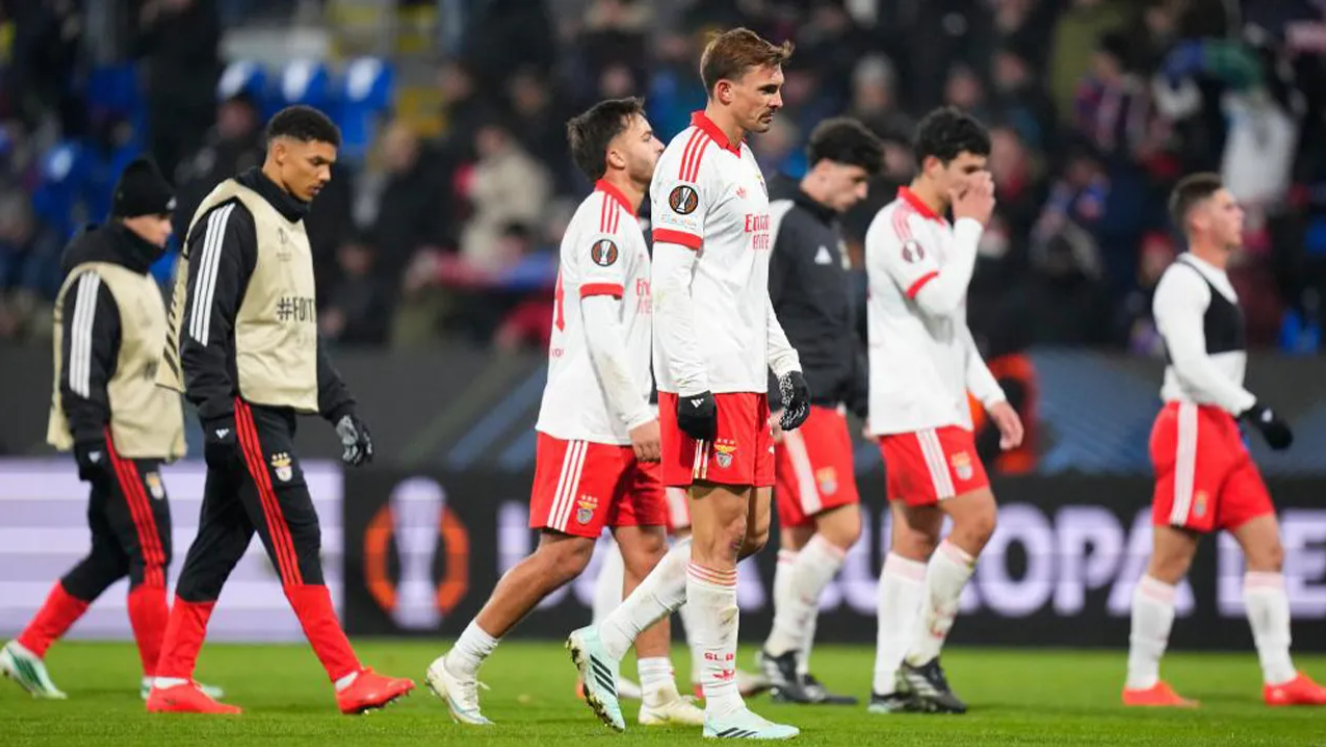
It was not simply a defeat. It was another damaging chapter in Benfica's recent European history. Coming into the match with four wins from their opening five Europa League fixtures, Benfica had an excellent opportunity to strengthen their position near the top of the standings. Instead, they delivered one of their poorest performances of the season, conceding four goals and barely offering any meaningful attacking threat throughout the night.
What makes the result particularly alarming is that many of Benfica's problems were not new. The warning signs have been visible for months. From the beginning of the season, questions have been raised about the team's defensive organisation. Too often, Benfica have looked vulnerable when opponents attack quickly, and too often they have relied on individual quality rather than collective structure to solve problems. Against Plzen, those shortcomings were brutally exposed.
The Czech side needed only a handful of dangerous moments to completely dismantle Benfica's back line. Patrik Hrosovský opened the scoring after half an hour before Prince Adu doubled the advantage shortly before half-time. Then came the decisive blow. Two goals in quick succession from Christopher Kabongo, one before the break and another seconds after the restart, effectively ended the contest before Benfica had any opportunity to react.
The most concerning aspect was how easily Plzen created problems. On paper, Benfica dominated possession with 69 percent of the ball and completed more than twice as many passes as their opponents. Yet those statistics only served to highlight the difference between having possession and controlling a football match. Benfica had the ball, but Plzen had the chances, the intensity and the cutting edge. The hosts generated an expected-goals figure of 2.06 compared to Benfica's meagre 0.52 and created all of the game's major opportunities.
Supporters have seen this story before. Over the last decade, Benfica have produced memorable nights in Europe, but they have also suffered a series of damaging defeats that have undermined efforts to establish themselves consistently among the continent's elite clubs. The humiliation in Plzen now joins a growing list of European disappointments that supporters would rather forget.
Perhaps the biggest frustration is that this squad possesses genuine quality. Players such as Vangelis Pavlidis, Georgiy Sudakov, Tomás Araújo and Andreas Schjelderup are more than capable of performing at this level. Yet quality in possession means little if a team cannot defend transitions, deal with pressure or maintain concentration in key moments.
The result should also serve as a warning ahead of the most important months of the season. Domestic title races and European knockout football are often decided by defensive reliability. At the moment, Benfica simply do not look reliable enough. The attack continues to produce moments of brilliance, but those moments are repeatedly being cancelled out by defensive lapses. Against stronger opposition later in the campaign, those mistakes could prove fatal.
There is still no reason for panic regarding Benfica's overall European ambitions. One defeat does not erase the excellent work done in the previous Europa League matches. Benfica remain well placed to advance and still possess one of the competition's strongest squads.
However, Thursday's performance should remove any illusion that the team is close to where it wants to be. If Benfica hope to compete seriously for European honours, they must address the defensive weaknesses that continue to surface whenever the level of opposition rises or the match becomes chaotic. Because possession alone does not win European football matches. Organisation does. And in Plzen, Benfica looked alarmingly short of it.
Set The Portugal News as your preferred source for news on Google
 Add as a preferred source on Google







 Portugal Handbook
 English
 Nederlands
 Deutsch
 Français
 Español
 Italiano
 Svenska
 Pусский
 中文
 Türkçe
 Português
 Czech
 Hungarian
 Polski
 عربي
 Suomi
 עִברִית
 Português (Brasil)

Follow us on social media