


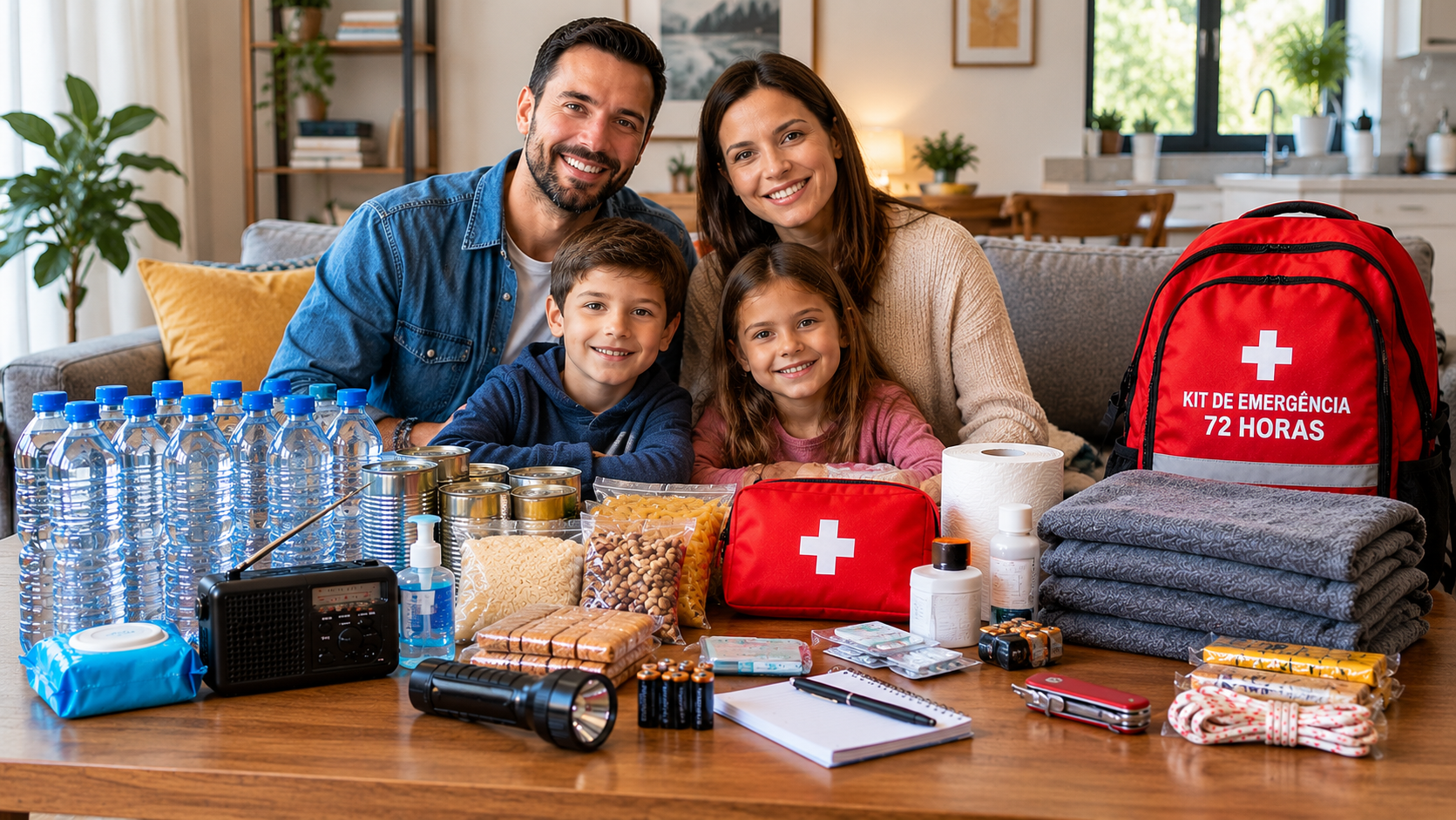
From unexpected power cuts to severe weather, Portuguese authorities are encouraging households to take a few simple precautions. For international residents, understanding how the country’s emergency systems work can provide additional peace of mind.
Living in Portugal offers many advantages, from its welcoming communities and pleasant climate to its high quality of life. However, wherever we choose to live, unexpected events can occasionally interrupt our daily routines.
An electricity outage, a period of severe weather or a disruption to telecommunications can temporarily affect the services we rely on.
That is why Portuguese authorities, alongside the European Union, have been encouraging residents to prepare a basic emergency kit and develop a simple household emergency plan.
The recommendation is not a warning that a particular emergency is about to happen. Instead, it is part of a wider effort to help households become more resilient and better informed.
Why 72 hours?
In March 2025, the European Commission introduced its Preparedness Union Strategy, which promotes greater readiness for different types of emergencies.
One of its central recommendations is that households should aim to be self-sufficient for at least 72 hours during a disruption.
This means having enough essential supplies to manage basic needs for three days, without necessarily depending on immediate access to shops, electronic payments or other everyday services.
The 72-hour recommendation is a practical planning benchmark, rather than a prediction of how long any emergency might last.
For many households, preparing for this period can be surprisingly straightforward.
A few bottles of water, non-perishable food, essential medication, a torch and a battery-operated radio can provide a useful starting point.
Portugal’s own preparedness initiative
Portugal’s Escola Nacional de Bombeiros, or National Firefighters School, has been actively promoting emergency preparedness throughout 2026.
In March, it launched a public awareness campaign focusing on emergency kits and family emergency plans.
This was followed in September by the publication of a Family Emergency Plan template designed to help households prepare for unexpected situations.
The plan encourages families to identify risks relevant to their location, agree on meeting points, establish emergency contacts and decide what they would take if they needed to leave their home.
Importantly, it also encourages households to discuss their arrangements in advance.
For international residents, this can be especially helpful, particularly when family members live in different countries or when Portuguese is not their first language.
Lessons from the Iberian blackout
The widespread electricity outage affecting Portugal and Spain in April 2025 demonstrated how quickly everyday routines can change when power supplies are interrupted.
During an electricity failure, familiar activities such as making electronic payments, accessing the internet, using lifts or contacting people can become more difficult.
While large-scale outages are unusual, the experience reinforced the value of having a few practical alternatives available.
A battery-powered radio, for example, may provide information when internet access is unavailable.
A charged power bank can help keep a mobile phone operating, while some cash can be useful if electronic payment terminals are temporarily out of service.
The aim is not to anticipate every possible difficulty, but to reduce unnecessary inconvenience and uncertainty.
Different homes, different needs
Not every household in Portugal faces the same circumstances.
Residents living in rural areas may need to consider wildfire risks or access to emergency services, while those in low-lying areas may wish to familiarise themselves with local flood information.
Apartment residents might consider how they would manage without lifts or electrically operated garage doors.
People with medical equipment requiring electricity should have a specific contingency plan developed with their healthcare provider.
Families with young children, elderly relatives or pets may also need to make additional arrangements.
The most effective emergency plan is therefore one tailored to the people, property and location concerned.
A shared responsibility
Portugal’s emergency services provide essential assistance during serious incidents, but individual preparedness can help reduce avoidable difficulties.
Knowing where to find reliable information, understanding whom to contact and keeping a few basic supplies at home can make a meaningful difference.
Preparedness also extends beyond individual households.
Checking on elderly neighbours, helping someone who does not speak Portuguese and sharing accurate information can all contribute to a stronger community.
For international residents, learning how Portugal’s emergency services operate is another useful step towards feeling confident and settled in the country.
Ultimately, having an emergency kit is no different from keeping a first-aid box at home or ensuring that a vehicle has the necessary safety equipment.
It is a sensible precaution that most people hope they will never need.
And perhaps that is the most important message: being prepared is not about living in fear. It is about living with greater confidence.
Source basis: Escola Nacional de Bombeiros, Family Emergency Plan, 16 September 2026, and emergency preparedness campaign, 1 March 2026.
Set The Portugal News as your preferred source for news on Google
 Add as a preferred source on Google






 Portugal Handbook
 English
 Nederlands
 Deutsch
 Français
 Español
 Italiano
 Svenska
 Pусский
 中文
 Türkçe
 Português
 Czech
 Hungarian
 Polski
 عربي
 Suomi
 עִברִית
 Português (Brasil)

Follow us on social media