


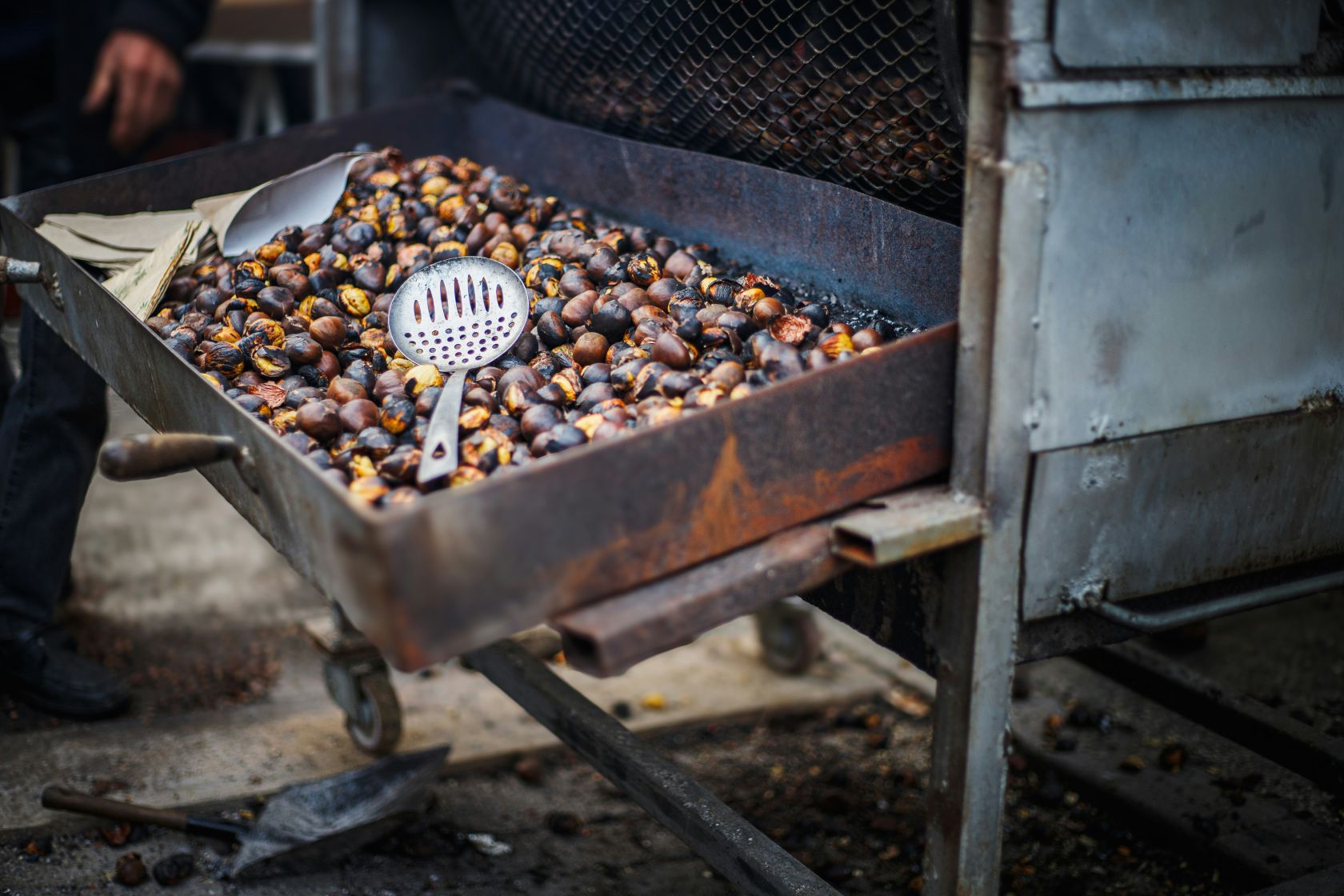
The streets and courtyards of Algarvian villages are filled with the thick, fragrant smoke from roasting chestnuts, which marks the arrival of St. Martin’s Day. This day, which takes place on 11 November, is one of the region’s most valued community events, combining its religious heritage with secular harvest celebrations.
The festivity can be traced back to the well-known legend concerning the Roman soldier Martin of Tours. According to the story, on a cold, rainy winter day, Martin came across a beggar who was shivering and, without delay, cut his cloak in two with his sword to cover the man. At that instant the storm ended, and the sun shone brightly. This event, still referred to today as “St. Martin’s Summer”, is the common explanation for the mild, sunny days that frequently occur at the beginning of November.
In the Algarve, the festivity focuses on the traditional magusto (roasted chestnuts). Families and their neighbours come together around a bonfire and roast the chestnuts over a bed of pine needles which have been scattered with coarse salt. As part of the ritual, the chestnuts must be scored in advance to prevent them from bursting in the fire, in which case they leave a charred shell and a soft, velvety interior.
During the gathering, it is customary to smear soot from the roasted chestnuts onto one’s face, a fun tradition passed down from generation to generation.
The magusto, which is the traditional roast of chestnuts, is not merely determined by the chestnuts themselves. According to folk wisdom, the saying “On St. Martin’s Day go to the cellar and taste the wine” has been made immortal, and the Algarve carries out this custom exactly.
This is the official time to taste the new wine, freshly fermented from the late-summer grape harvest.
Alongside the new red wine, various traditional and warming drinks are offered at tables all over the Algarve in order to counteract the cold of the cooler nights. Prominent among these are água-pé, a low-alcohol drink prepared by pouring boiling water into grape pomace, and jeropiga, a sweet and full-bodied liqueur made by adding aguardente (grape spirit) to grape must to stop fermentation. In the hilly region, running from Monchique to Alcoutim, festivities are usually brought to a close with a small glass of medronho, the famous local spirit distilled from the fruit of the strawberry tree, which is picked and processed at this time of year.
At community fairs and when families come together at the farmhouses in Barrocal, St. Martin’s Day in the Algarve is an opportunity to share and socialise, a festival in which the simple chestnut and the generosity of new wine keep the soul of the region alive.
Set The Portugal News as your preferred source for news on Google
 Add as a preferred source on Google







 Portugal Handbook
 English
 Nederlands
 Deutsch
 Français
 Español
 Italiano
 Svenska
 Pусский
 中文
 Türkçe
 Português
 Czech
 Hungarian
 Polski
 عربي
 Suomi
 עִברִית
 Português (Brasil)

Follow us on social media