


With over $425 million raised in presale funds and a rapidly expanding ecosystem of 3 million miners and 4,500 developers, BlockDAG is emerging as one of the most closely followed blockchain projects in years. Market analysts suggest that its token, priced at just $0.0015 during presale, could chart a path toward the elusive $1 mark by the end of the next bull run, an ambitious but increasingly plausible trajectory given the data.
The Case for BlockDAG’s Ascent
Unlike typical speculative hype cycles, analysts cite measurable fundamentals in the BDAG story. At its core lies a hybrid DAG-PoW consensus, designed to process transactions in parallel rather than sequentially. This means scalability improvements without compromising decentralization or security, a long-standing blockchain challenge.
BlockDAG’s technical foundation also integrates EVM compatibility, enabling Ethereum developers to port smart contracts directly, and planned WASM support, which will soon let developers build in Rust, C++, or other mainstream languages. This dual compatibility gives BlockDAG a rare advantage of access to both Ethereum’s massive developer base and a new wave of builders using modern programming frameworks.
From Concept to Community: Real Growth Indicators
Perhaps the most compelling element of BlockDAG’s growth story is its on-chain community expansion. The X1 mobile mining app, available on iOS and Android, has transformed smartphone users into active participants in network validation. This “Proof-of-Engagement” model, a lightweight mining protocol that rewards activity rather than computing power, has already attracted millions of miners across 160+ countries.
By making mining accessible without specialized hardware, BlockDAG has effectively democratized the early participation process, something rarely seen in PoW networks. Analysts view this inclusionary model as a key reason for the project’s momentum. It’s a community-first expansion approach that mirrors the grassroots growth of early Bitcoin and Dogecoin ecosystems, but this time, built on scalable infrastructure.

At the developer level, 4,500 active contributors are currently testing dApps and utilities on BlockDAG’s Primordial Testnet, ahead of its scheduled mainnet launch. These numbers place BlockDAG among the most active pre-mainnet ecosystems in crypto, signaling genuine development activity beyond marketing headlines.
Strategic Partnerships and Institutional Interest
BlockDAG’s strategic partnerships have also fueled its credibility. Collaborations with Inter Milan, BWT Alpine F1 Team, and developer platform HackerEarth have amplified visibility while embedding the brand in diverse global communities. Through HackerEarth alone, BlockDAG expects to host hackathons involving 10,000–15,000 developers, a crucial pipeline for dApp creation and talent recruitment.

This blend of cultural exposure and technical engagement is increasingly seen as a hallmark of maturing blockchain projects. Institutional investors, often skeptical of retail-driven token stories, are reportedly monitoring BDAG’s presale trajectory closely. Its ongoing rise, among the largest in the past seven years, positions it alongside historical heavyweights like Cardano’s 2017 ICO and Filecoin’s record-setting presale.
A Rational Forecast: Can BDAG Really Reach $1?
For analysts, projecting BDAG’s path to $1 isn’t mere optimism; it's a function of comparative modeling. If the project sustains its current pace of growth and executes its post-launch roadmap, including multiple exchange listings, decentralized finance integrations, and a $600 million presale cap, its implied market capitalization could rival early-stage Solana by mid-2025.
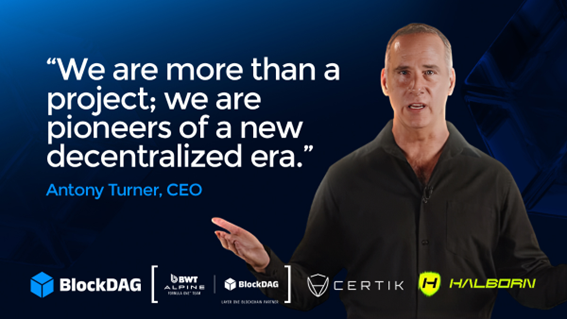
That trajectory assumes broad adoption, consistent validator participation, and continued developer expansion. Should the network deliver on its WASM integration and mainnet performance benchmarks, analysts estimate BDAG could realistically hit $1.00 by the end of the cycle, depending on overall market conditions.
The Broader Market Context
Macro trends also favor new infrastructure projects like BlockDAG. As institutional capital reenters the market and Layer-1 diversification gains importance, investors are seeking credible alternatives to Ethereum’s high fees and Solana’s occasional outages. BDAG’s hybrid architecture positions it squarely in this gap as a performance-driven network that retains Proof-of-Work’s credibility while introducing DAG’s scalability.
In many ways, this echoes prior cycles: Ethereum thrived on smart contract innovation, Solana on transaction velocity. If 2025’s rally is defined by scalable, energy-efficient Layer-1s that bridge Web2 usability and Web3 decentralization, BlockDAG’s profile fits the mold perfectly.
For all the excitement surrounding BDAG, the data behind its growth remains its strongest narrative. A $425M+ presale, millions of miners, and thousands of developers form tangible proof of traction, not just speculative promise.
As the network prepares for its mainnet debut, industry watchers suggest that BlockDAG could serve as a litmus test for how far hybrid consensus models can push blockchain scalability in real-world conditions. Whether it reaches $1 or not, its influence on the 2025 Layer-1 race appears inevitable.

Presale: https://purchase.blockdag.network
Website: https://blockdag.network
Telegram: https://t.me/blockDAGnetworkOfficial
Discord: https://discord.gg/Q7BxghMVyu






 English
 Nederlands
 Deutsch
 Français
 Español
 Italiano
 Svenska
 Pусский
 中文
中文 Türkçe
 Português
 Polski
 عربي
عربي Suomi
Suomi עִברִית
 Português (Brasil)
Follow us on social media