


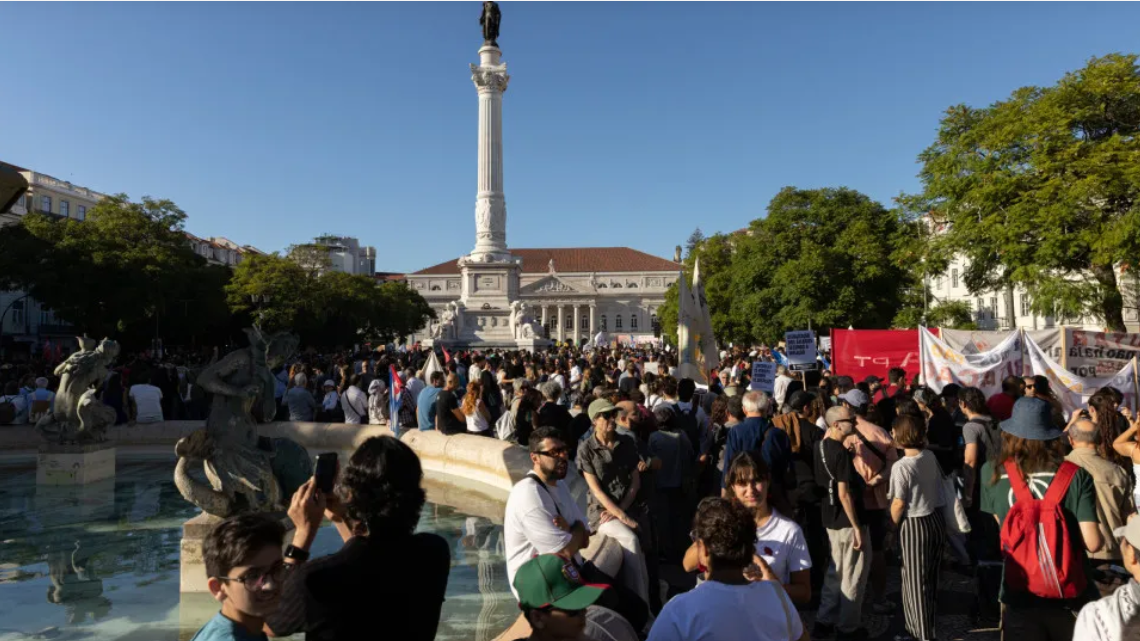
Luís Montenegro said on Tuesday that he does not underestimate the housing protests, but that the right to demonstrate must be balanced against the right to “order” and “peace and quiet,” urging protesters not to adopt “violent protest models,” ECO News reports.
The Prime Minister, who also announced that he will meet with the leaders of the Socialist Party and Chega, hopes “that everyone knows how to interpret” the Lisbon Administrative Court’s ruling in favour of a protester, as well as “the entire legal and constitutional framework” of the country.
Right to protest
In a statement addressing the country, Montenegro said: “There is no reason in Portugal to import violent protest models.”
This statement follows weeks of demonstrations and so-called encampments in Lisbon and Porto over the cost of housing, during which police have carried out several charges.
While emphasising that Portugal is a “peaceful country where everyone can have their rights respected,” Montenegro said that he does not “devalue or underestimate demonstrations of political positions, which are sometimes supportive and sometimes in disagreement with the Government’s decisions,” or “what is happening in the streets, particularly in Lisbon and Porto.”
However, Montenegro argued that the right to demonstrate must be balanced against other rights, such as freedom of movement and public health.
He also addressed the ruling of the Lisbon Administrative Court, which found that the 00:30 limit for demonstrations is not “absolute and automatic,” authorising a demonstrator to remain in Lisbon’s Rossio Square with a tent during the early hours of the morning.
“I hope everyone understands how to interpret not only the ruling, but the entire legal and constitutional framework of the country, which makes Portugal a safe and peaceful nation,” Montenegro said.
Housing legislation
The Prime Minister will meet with Chega leader André Ventura and Socialist Party (PS) leader José Luís Carneiro in São Bento next Thursday to hear their proposals on housing.
Luís Montenegro said that the broadest possible consensus is needed to ensure the rent law is approved and remains in effect. “Therefore, rapprochement with the major opposition parties is highly desirable,” he said, stressing that the three parties do not need to agree on everything.
Montenegro has tasked the Minister of State and Finance, Joaquim Miranda Sarmento, and the Minister of Infrastructure and Housing, Miguel Pinto Luz, with working alongside the Minister of the Presidency, António Leitão Amaro, and the Minister of Parliamentary Affairs, Carlos Abreu Amorim, to establish “equal dialogue with the other political parties with parliamentary representation.”
“The political dialogue on housing is not new, but it is now taking shape following the legislative process on rental housing, which is under consideration in Parliament, and also the multiple partisan interventions that have been made in the context of the public debate that the topic has generated and continues to generate in Portuguese society,” Montenegro said.
Criticism over silence
The Prime Minister also dismissed as unfair criticism of his silence during the recent protests. “I have the right and the duty to govern. I am not a commentator, nor a media-savvy politician. What the country expects from me is not to give my opinion every day. What is expected of the Prime Minister is that he does not stop listening and that he carries out the mission for which he was chosen,” he said.
Montenegro argued that the Prime Minister is not simply a party leader, but an official responsible for implementing an approved government programme. He used this distinction to explain why he had addressed the issues only four times during the demonstrations.
“The criticism that there is silence is unfair, and the criticism that the prime minister doesn’t speak about what is important to people is even more unfair,” he said.
Montenegro also stressed that “the Portuguese people have demonstrated more than once that they believe in the Government,” and that policies take time to produce the desired results, while maintaining that “decisions are indeed being made.”
The Prime Minister stated that the Government will invest €10 billion in public housing by 2030, while noting that there are no “free” decisions or “free” public policies, according to ECO News. “There are choices,” Montenegro emphasised.
“Anyone who sells the illusion that all this can be accomplished without a sense of responsibility, without a sense of coordination with other public policies, will not contribute to the future of the country,” Montenegro said.
Set The Portugal News as your preferred source for news on Google
 Add as a preferred source on Google


 Portugal Handbook
 English
 Nederlands
 Deutsch
 Français
 Español
 Italiano
 Svenska
 Pусский
 中文
 Türkçe
 Português
 Czech
 Hungarian
 Polski
 عربي
 Suomi
 עִברִית
 Português (Brasil)

Follow us on social media