


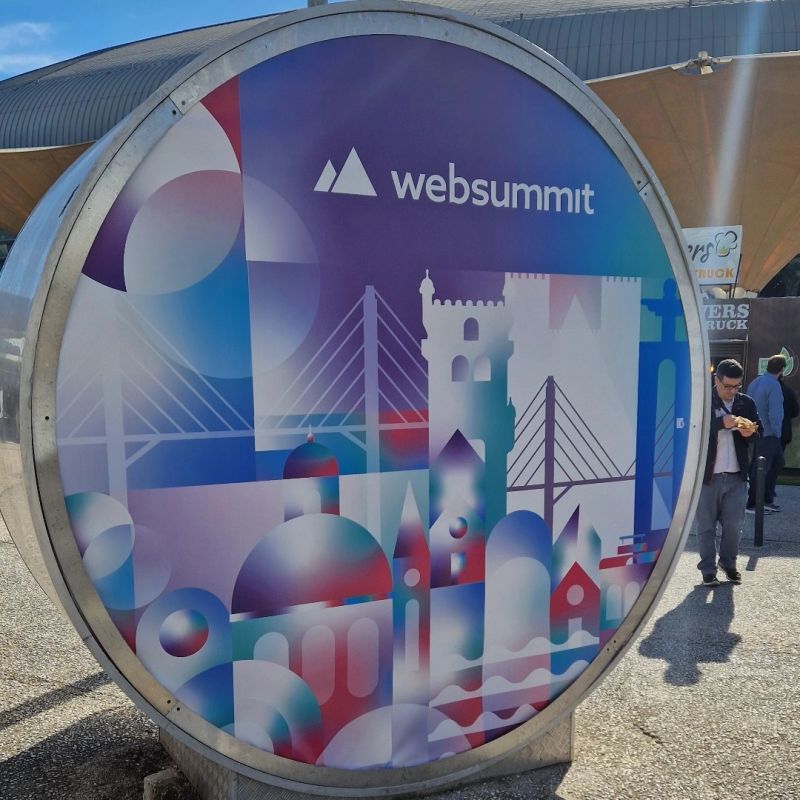
Web Summit Lisbon, the annual global technology event, attracts 70,000 attendees to Lisbon every November, bringing founders, entrepreneurs, business leaders, and investors to connect and exchange ideas about the technologies and trends shaping the world.
Since 2009, Web Summit’s portfolio, including Web Summit in Lisbon, Web Summit Rio in South America, Web Summit Vancouver in North America, and Web Summit Qatar in the Middle East, has attracted more than a million participants.
The event generates economic activity through visitor spending, increased foreign investment and accelerating the growth of Portuguese startups.
The impact is calculated by EY as €2,492,000,000 over the past decade, with the data suggesting that, after the cost of hosting Web Summit, Portugal benefits from the event’s presence by more than €230m every year.
Economic contribution
The overall economic boost of €250m a year is brought about by a combination of direct spending, enhanced job creation and rising wages, the EY report shows.
Web Summit has also led directly to increased tax revenues, which are available to spend on public services: in 2025 alone, the report found that €50m was generated in taxes as a result of the event’s presence in Lisbon.
The report also shows the global effect Web Summit has had on Portugal’s reputation, detailing how the event has driven $3bn in advertising value equivalency from international media coverage.
“Repeated event-driven exposure has accumulated some 114,000 global mentions and $3B in advertising value equivalency between 2016 and 2026, with search interest showing a sustained upward trend internationally, particularly in the USA and Canada,” the report finds.
Startup ecosystem
Portugal’s own startup ecosystem has also benefitted from the event, driving an increase in jobs for local people, as well as increasing exports and wages.
The number of startups in Portugal doubled from 2016 to 2025. By the end of 2025, Portuguese startups employed the equivalent of 28,000 full-time staff.
Annual revenue among Portuguese startups has more than doubled from €1.23bn to €2.85bn, while their exports have also more than doubled from €673m to €1.57bn, and overall Portuguese GDP increased from $206bn in 2016 to $347bn in 2025.
The EY report also found that Portuguese startups exhibiting at Web Summit were more likely to experience business growth, with significant and long-lasting increases in both revenue and job creation associated with participation, the data show.
“Participation is associated with large post-event performance uplifts, including sustained balance-sheet expansion and exceptionally strong cumulative turnover and employment effects,” the authors found.
The EY authors also explained the wider effect of Web Summit on the Portuguese startup ecosystem, saying: “Web Summit plays a structural role in the development of startup ecosystems, acting as a hub for technology demonstration, capital mobilisation, and partnership creation.
“The event enhances strategic visibility and accelerates internationalisation by connecting startups with global networks of capital, talent, and cross-border collaboration. For founders, the conference remains a catalyst for scaling business models beyond domestic markets, strengthening investor pipelines, and engaging with international corporate innovation teams.”
Visitor spending
The EY report also shows that visitor spending alone has reached a total of €730m over the 10 years of the event, directly benefiting hotels, restaurants, transport workers and shops in the Portuguese capital.
Between accommodation, food & drink, transport and other retail spending, the report shows attendee spending averaged €73m a year, with the figure growing steadily year by year, to a high of €118m in 2025.
The €730 million in visitor spending does not include wages associated with organising and operating the event, which supports more than 3,000 jobs and prioritises Portuguese workers wherever possible. A further €76m has been pumped into Portugal’s economy through direct event-related wages alone, the report found.
International reputation
The value Web Summit brings to Lisbon and Portugal is recognised by respondents to a survey cited in the EY report, with more than nine in ten Portuguese respondents (93%) agreeing that Web Summit boosts Lisbon’s international recognition, while almost the same number (89%) say it improves the city’s global image and attractiveness. More than four in five respondents believe Web Summit enhances the capital’s reputation (84%) and support hosting the event (81%).
“Web Summit delivers short-term economic returns for Lisbon while reinforcing Portugal’s startup ecosystem over time,” the report’s authors conclude.
Paddy Cosgrave, CEO of Web Summit, said: “Everyone in Lisbon recognises the ‘Web Summit effect’, but it’s hard to measure**:** I personally believe that the actual impact could well be at least 10 times more than what can be shown in this report. How do you quantify the value of an enhanced global reputation, or the impact of Web Summit on investment decisions by multinationals? But it is satisfying to have concrete evidence that at the very least, Web Summit has given back to Lisbon over 10 times more than has been put into it.
“For me, I’m just happy to have such powerful confirmation that Web Summit has played a part in Portugal’s transformation by helping create jobs for Portuguese people, increasing their salaries and encouraging a culture of entrepreneurship,” Cosgrave added.
Set The Portugal News as your preferred source for news on Google
 Add as a preferred source on Google


 Portugal Handbook
 English
 Nederlands
 Deutsch
 Français
 Español
 Italiano
 Svenska
 Pусский
 中文
 Türkçe
 Português
 Czech
 Hungarian
 Polski
 عربي
 Suomi
 עִברִית
 Português (Brasil)

Follow us on social media