


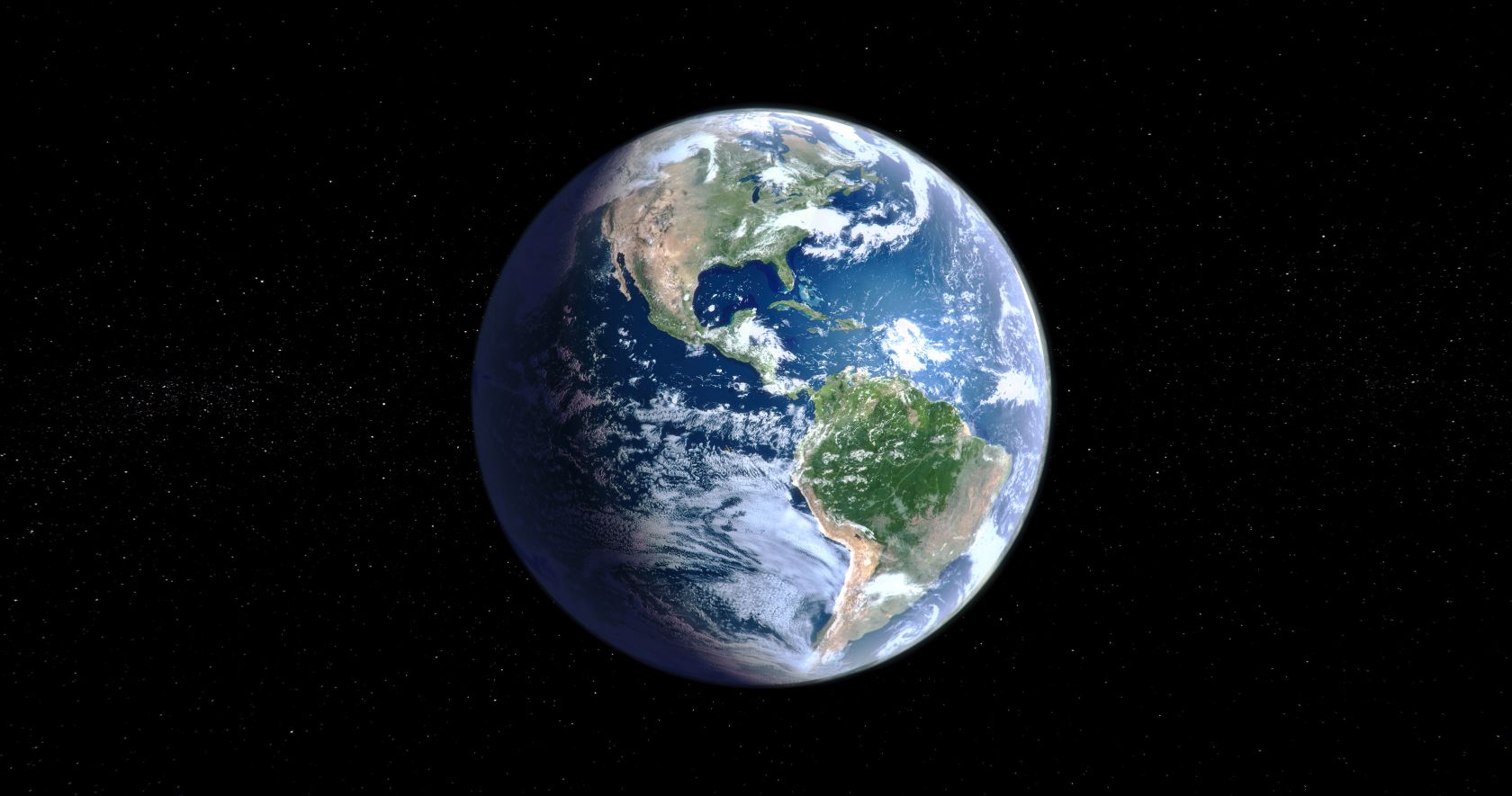
The image, taken in 1990 by Voyager 1 at Sagan’s urging, shows Earth as “a tiny speck, suspended in a sunbeam”. Less than a pixel. No borders, no armies, no markets; just a mote of dust in a vast cosmic cathedral.
More than three decades later, Sagan’s brilliantly crafted words remain culturally significant for several powerful reasons. It collapsed the human ego in a singularly amazing passage. Few pieces of writing have so efficiently punctured collective arrogance. Sagan distilled the entire human drama “every emperor, every revolutionary, every saint and tyrant” into something smaller than a grain of sand in a vast void. That’s sobering!
In an era of escalating nationalism, culture wars and online tribalism, the “Pale Blue Dot” perspective provides a corrective lens. It reminds us that the things we treat as existential divisions are invisible from even a modest cosmic distance, making these words humbling without being nihilistic. This sort of balance is rare.
Sagan’s words became a moral argument, not just a scientific observation. The passage doesn’t just stop at awe, it pivots into responsibility. Sagan happily declares that Earth is “the only home we’ve ever known and possibly the only one we will know for a very long time.” That framing has echoed through environmental movements ever since. Climate activism, conservation campaigns, and even space exploration debates frequently invoke the same logic: that this fragile dot is all we have. The “Pale Blue Dot” speech effectively fused astronomy with ethics. It turned cosmology into stewardship.
When the photograph was taken, the Cold War had only just ended. The internet wasn’t yet a household utility. Globalisation was accelerating, but we hadn’t fully realised how interconnected humanity would become. Today, pandemics, climate change, financial crises, and digital culture prove that borders are porous in profound and destabilising ways. The “Pale Blue Dot” idea anticipated this. It suggested, well before social media and 24-hour news cycles, that we are already sharing a fragile stage. Since the metaphor has only grown more relevant.
Space programs are often criticised as indulgent or extravagant. But the image from Voyager 1 reframed the value of exploration.
It wasn’t about conquest or planting flags, it was about perspective. Ironically, the most powerful space photograph ever taken doesn’t show alien worlds or cosmic fireworks. It shows us. Small, vulnerable and very much alone.
That humility has influenced generations of scientists, writers and policymakers who see space not as an escape from Earth, but as a mirror held up to it. For many people, “Pale Blue Dot” functions almost like scripture, but without dogma. It offers transcendence rooted in physics rather than theology. The vastness of the universe becomes a source of awe that doesn’t require supernatural framing. In a world where traditional religious affiliation is declining in many Western countries, Sagan’s language provides a sense of wonder that’s both rational and deeply emotional. It’s reverence without superstition.
We now live in a culture of snippets, memes and short-term virality. Sagan’s prose is rhythmic, vivid and almost poetic. Lines from the passage are endlessly shared during moments of geopolitical tension or environmental crisis. Each time a new conflict erupts or global anxiety spikes, the “look again at that dot” refrain resurfaces. It has become shorthand for perspective.
What makes the passage endure is that it walks a tightrope. On one side lies nihilism: “If we are so small, nothing really matters.” On the other lies arrogance: “If we dominate this planet, everything belongs to us.”
Sagan threads between them. He argues that our smallness doesn’t make us insignificant, but it makes human kindness more necessary. If this speck is all we have, cruelty becomes utterly absurd.
That moral logic continues to resonate in a century defined by existential risks. In times of climate instability, nuclear proliferation, artificial intelligence and biological engineering, the “dot” hasn’t grown, but humanity’s capacity for destruction certainly has.
The Message Doesn’t Change.
Since 1990, telescopes have discovered thousands of exoplanets. The James Webb Space Telescope now peers deeper into cosmic history than Sagan could ever have imagined. Astronomical knowledge has exploded, yet the core truths remain intact. That is, from a sufficient distance, Earth really is tiny and fragile.
The enduring cultural significance of “Pale Blue Dot” lies in its dual power. It shrinks us but it also enlarges our responsibility.
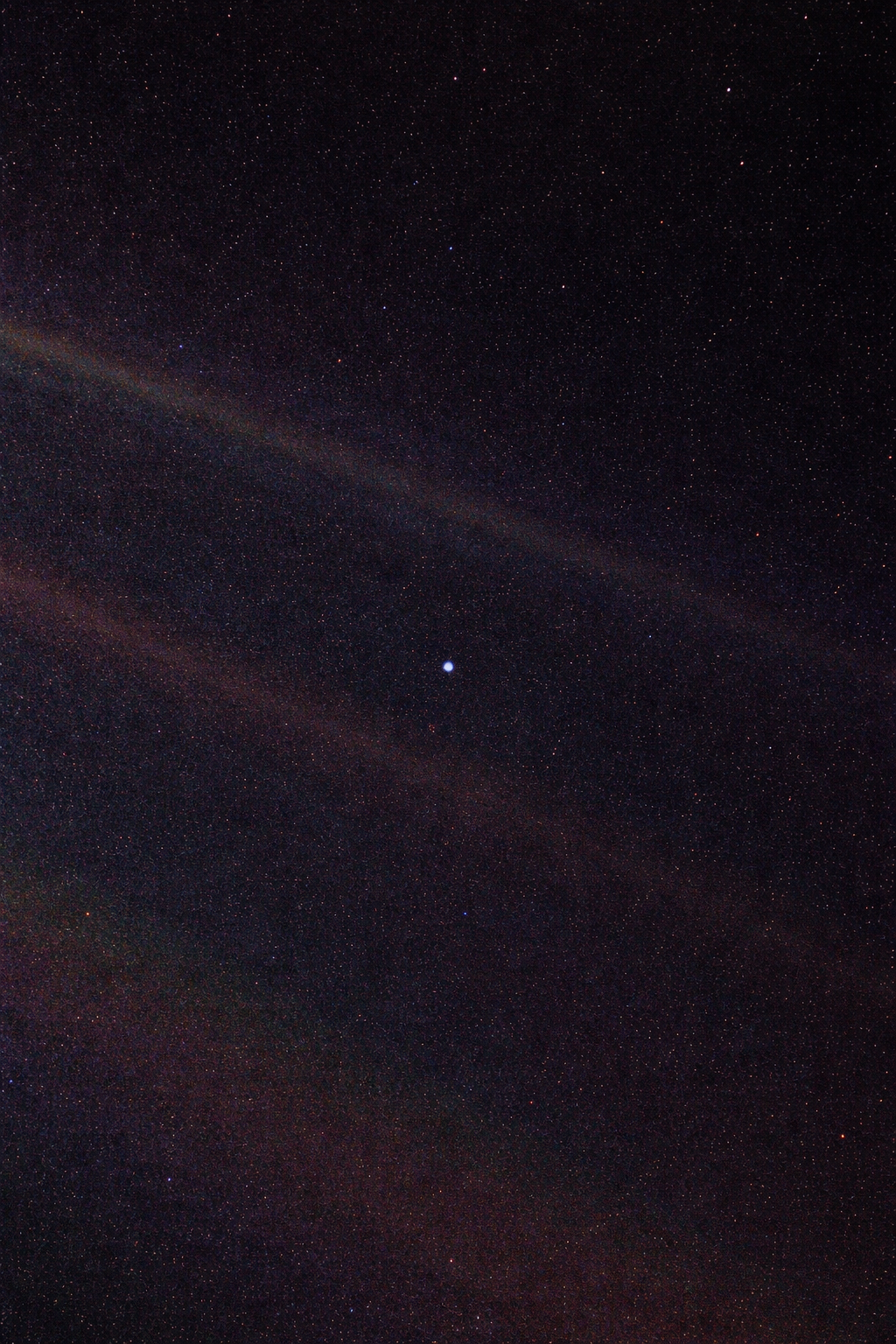
It doesn’t diminish humanity, it situates it. In an age of algorithmic outrage and constant distraction, the image and Sagan’s meditation on it offer something rare. Scale. The kind that silences hyperbole.
That tiny dot floating in a beam of light continues to ask a disarmingly simple question. If this is all we have, how should we treat one another? And that question, more than any other, is why Dr Carl Sagan’s masterful words still matter more than ever.
The Pale Blue Dot
(Dr Carl Sagan)
Consider that dot again. That’s here. That’s home. That’s us. On it, everyone you love, everyone you know, everyone you ever heard of, every human being who ever lived out their lives. The aggregate of our joy and suffering, thousands of confident religions, ideologies and economic doctrines. Every hunter and forager, every hero and coward, every creator and destroyer of civilization, every king and peasant, every young couple in love, every mother and father, hopeful child, inventor and explorer, every teacher of morals, every corrupt politician, every superstar, every supreme leader, every saint and sinner in the history of our species lived there – on a mote of dust suspended in a sunbeam.
The Earth is a very small stage in a vast cosmic arena. Think of the rivers of blood spilt by all those generals and emperors so that, in glory and triumph, they could become the momentary masters of a fraction of a dot. Think of the endless cruelties visited by the inhabitants of one corner of this pixel on the scarcely distinguishable inhabitants of some other corner. How frequent their misunderstandings, how eager they are to kill one another, how fervent their hatreds.
Our posturing, our imagined self-importance, the delusion that we have some privileged position in the universe, are challenged by this point of pale light. Our planet is a lonely speck in the great enveloping cosmic dark. In our obscurity, in all this vastness, there is no hint that help will come from elsewhere to save us from ourselves.
The Earth is the only world known so far to harbour life. There is nowhere else, at least in the near future, to which our species could migrate. Visit, yes. Settle, not yet. Like it or not, for the moment, the Earth is where we make our stand.
It has been said that astronomy is a humbling and character-building experience. There is perhaps no better demonstration of the folly of human conceits than this distant image of our tiny world. To me, it underscores our responsibility to deal more kindly with one another and to preserve and cherish the pale blue dot. The only home we’ve ever known.








 Portugal Handbook
 English
 Nederlands
 Deutsch
 Français
 Español
 Italiano
 Svenska
 Pусский
 中文
中文 Türkçe
 Português
 Czech
Czech Hungarian
 Polski
 عربي
عربي Suomi
Suomi עִברִית
 Português (Brasil)
Follow us on social media