


My last essay (TPN 14-10-2025) presented a somewhat apprehensive overview of the prospects for astonishing growth in a cyber industry which is destined to make Portugal a digital gateway to the internet of the EU.
Although certain aspects of security such as encryption, strong Wi-Fi, firewalls, guest network isolation and virtual private networks are performing reasonably well, commercial and military hackers are forever seeking new ways to break through the protective codes and investigative software developed by the CIA, Mossad and other intelligence services both national and private.
However, there has been little attention to the probability of physical attacks on and sabotage to the machinery and construction of data centres and their associated hardware. Last week such activity was brought quickly into the limelight by the counterattacks made on data centres (two in UAE and one in Bahrain) by drones and missiles launched from Iran. Only minor damage was caused by fire but this was sufficiently inconvenient to result in all local internet traffic being temporarily suspended and to demonstrate the future capability of more powerful rockets carrying highly destructive explosive or nuclear payloads.
These sorties were followed by two medium range IBMs being fired over a distance of 4,000 km. to raid the British military base at Diego Garcia in the Indian Ocean. Although unsuccessful due to interception by a U.S. warship, this development has demonstrated the ability of Iran or its allies to strike within most of the EU territories. Data centres and the like will be prime targets because of the concentration in one location of extremely expensive buiildings and machines.
At the Sines Industrial Park, construction now in progress is intended to bring by year 2030 a total investment of €25 billion by American mega corporations and telecommunication companies in the construction of a huge data centre (the StartCampus project) supported by plants for desalination, seawater cooling systems, energy production and urban developments for accommodating the work-force.
Together they will form a major hub for services connecting the Americas to the EU by means of optic fibre cables laid on the seabed. Sines will be a landing point for several of the major circuits of which EllaLink is the largest. These will be connected by the Olisipo single ocean cable to Lisbon for distribution by land routes though Spain to central European countries. The independent Equiano cable system owned by Google will land at Sesimbra and cover onward traffic to Africa and parts of the EU.
Although the core cables are protected by several skins of metal and plastic they can be damaged by seismic activity and by seabed trawling or mining. Instances have also been reported of gnawing and snout pushing by sharks, whales and other sea creatures. For that reason, a fleet of maintenance ships is kept permanently at sea so that sections may be repaired and energy sub-stations replaced speedily.
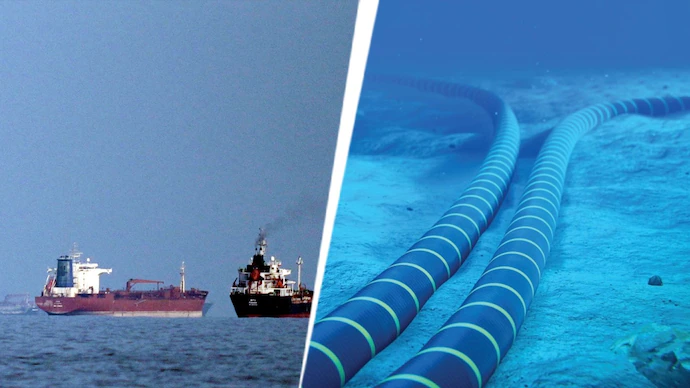
However, little preparation has been made for damage or destruction caused by enemy submersibles and underwater drones which may be launched from submarines or disguised merchant vessels. Such ships are also capable of firing short and medium range missiles to destroy easily properties that are concentrated in a small target area. The creation of a protective “iron dome” such as employed by Israel supplemented by automatic interceptors has a decreasing utility value because AI technology can pinpoint targets and carry out “obliteration” at a speed faster than human thought.
Traditional forms of sabotage on land are considered to be of low risk if the Sines zone becomes an enclave with strict control of access using the latest AI identification procedures. Most of the skilled management jobs will be allocated to personnel trained in the USA and selected / protected by its secret services. Routine maintenance work will be increasingly performed by incorruptible robots.
In all of this, there is the difficulty of identifying “the enemy”. Presently, the threat is assumed to come from Iran and its allies or one of the eastern blocs but the geopolitical world is changing so fast that present alliances such as NATO will soon be replaced by different groupings of nations. Perhaps more relevant is that mega-corporations will become more omnipotent than some of the nations which host them and thus be capable of acting independently of governance to create and protect new economies. The infamous SPECTRE criminal organization of the James Bond fantasy world may become a reality!
Warfare in the tradition of guns and bombs as used in Gaza and Ukraine will soon be replaced by the sophisticated weapons and surveillance systems being developed for the USA by the Palantir Gotham corporation. Let us hope that the Portuguese people will never see them used in our still lovely land.
An essay by Roberto Cavaleiro. Tomar. 23 March 2026






 English
 Nederlands
 Deutsch
 Français
 Español
 Italiano
 Svenska
 Pусский
 中文
中文 Türkçe
 Português
 Polski
 عربي
عربي Suomi
Suomi עִברִית
 Português (Brasil)