


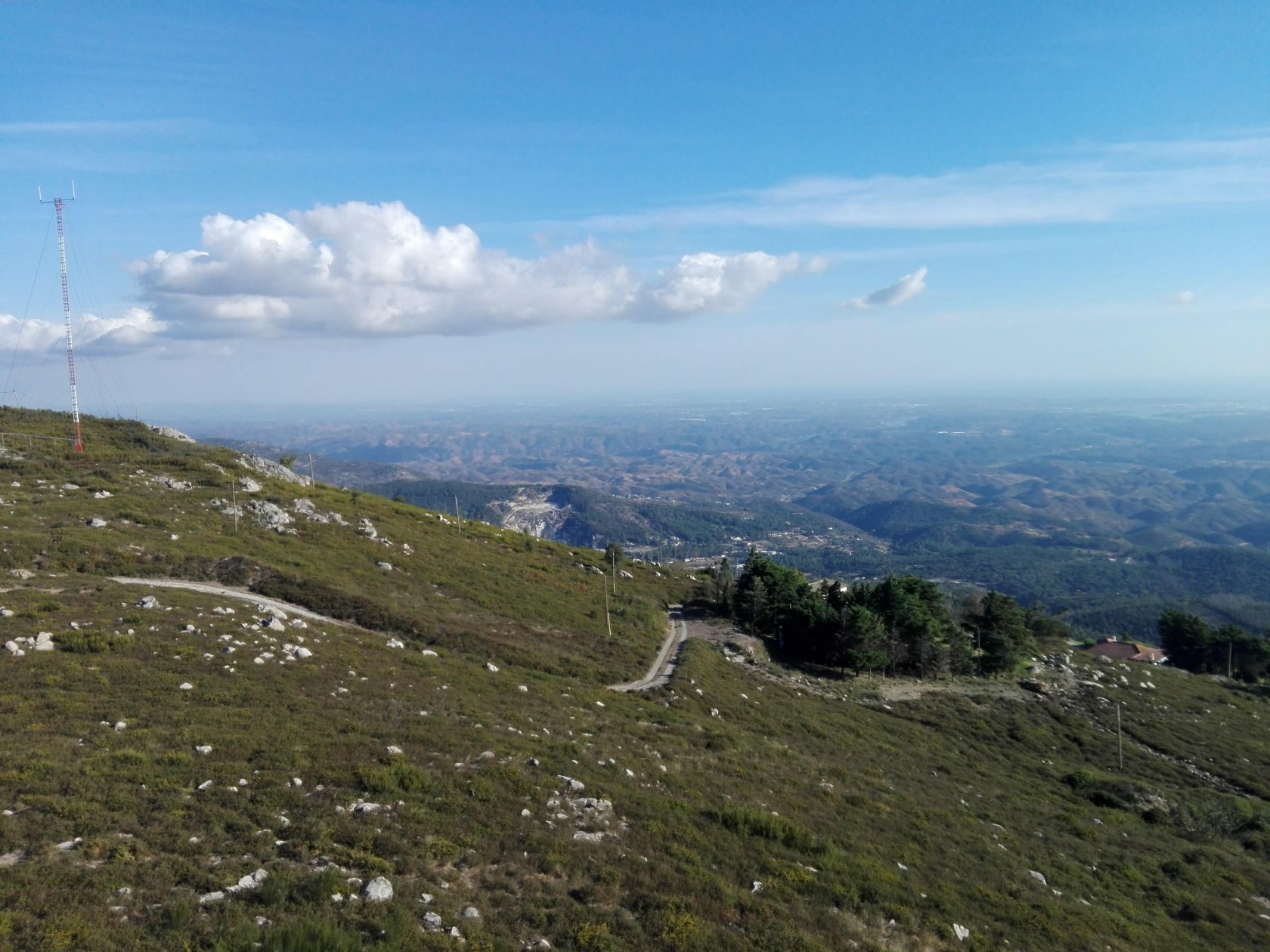
The tourist traffic fades, and the air takes on a freshness scented with eucalyptus and pine. The road curls and twists, revealing glimpses of distant hills covered with cork oaks and chestnut trees.
Monchique isn’t a place of spectacle. It doesn't dazzle in the same way as coastal resorts, nor does it possess Lisbon’s glamour. Instead, it quietly beguiles with misty mornings, a peaceful ambience and the presence of nature.
The mountain within the Algarve
The town sits at roughly 450 metres above sea level, but its spirit belongs to the heights of Fóia and Picota, the twin peaks that crown the Algarve. From Fóia, the region’s highest point, you can gaze across to the Atlantic with the distant glint of Lagos and Aljezur visible on the clearer days. To the north, the Alentejo rolls on endlessly. The contrast is part of Monchique’s allure: it is the Algarve, yet not as most of us have come to know it.
The mountain’s geology gives the area its fertile soils, feeding dense forests and rare flora. In spring, the slopes come alive with wildflowers, while autumn brings chestnut season. Monchique’s altitude also grants it a cooler microclimate. A blessing in the blistering heat of summer.
Stone, steam & spirit
Monchique itself is a tangle of cobbled alleys and whitewashed houses clinging to the hillside. Pink bougainvillaea cascades over whitewashed walls, and narrow steps lead to tiny squares where locals still linger in conversation. Life moves gently here. Enjoy a morning coffee at a local café or take a stroll past the church of Nossa Senhora da Conceição before pausing to admire the sweeping views that stretch toward the coast. These are all small pleasures that add up on a visit to Monchique.
Down the hill lies Caldas de Monchique, the thermal spa whose waters have drawn visitors since Roman times. The hot springs, rich in minerals, were once famed across Portugal for their healing qualities. In the 19th century, the spa became a fashionable retreat for the Lisbon elites. Today, they continue to exude a quiet charm, shaded by trees and framed by 19th-century architecture. Caldas feels like a fragment of another era; elegant, calm and restorative.
The spring water here is said to soothe the skin, calm the nerves and heal the body. But the real therapy, perhaps, lies in the landscape itself. The forests of Monchique seem to exude a kind of energy, a reminder of nature’s power to heal and renew. In a world of screens and schedules, that’s a rare kind of therapy.
Craft, culture & bakery goods
Monchique’s traditions are rooted in the land. Cork is stripped from oaks by hand in summer, leaving the trees glowing orange against the green slopes. Medronho, the fiery spirit of the mountain, is distilled from the berries of the strawberry tree. It remains the mountain’s most famous export. Many families still produce it in copper stills, their recipes passed down through generations. A sip burns the throat but warms the old cockles! It’s the taste of the Serra itself: raw, authentic and definitely untamed. Whoa, Meu Deus!
Local markets brim with honey, cured meats, fig cakes and cheeses. Artisans sell handmade wooden spoons, pottery and woven baskets. There is pride in local crafts alongside a quiet defiance against the homogenisation that has swept through much of modern Algarve. Monchique is not a place that tries to be something it isn’t. It celebrates the simple things, such as good food and wine.
And then there are the pastries! Especially the bolo de tacho, a dense, spiced cake baked in a traditional pot often flavoured with chocolate and cinnamon. Pair it with a strong espresso, and you have the essence of Monchique on a plate: sweet, comforting and rustic.

Fire, resilience & renewal
Life in Monchique hasn't always been easy. The region has suffered from devastating wildfires, particularly in recent years. The summer heat, compounded by changing climate patterns, turns the dense eucalyptus forests into tinder. The scars of these fires are still visible in places, with blackened trunks and patches of bare hillside, all reminders of nature’s fragility.
But out of the ashes, new green shoots emerge. The community has rallied, replanting native species, restoring trails and reimagining a sustainable future for the Serra. Local initiatives now promote eco-tourism, reforestation and organic farming. Walkers and cyclists are returning to the mountain paths, drawn by the promise of authenticity and solitude. Artists and writers find inspiration in Monchique’s silence. It's a rare, luxurious kind of silence that invites reflection.
Monchique’s story is certainly one of endurance. It has burned, rebuilt and now blossoms once more. Time after time, its people, like the cork trees that surround them, regenerate with quiet strength and resilience.
The beauty of peace
To spend time in Monchique is to rediscover a slower pace. Mornings begin with mist drifting through the valleys, dissolving as the sun warms the cobbled streets. Afternoons are for shade and conversation whilst watching swallows swoop over tiled roofs. Evenings bring the scent of woodsmoke and the rhythmic chirp of crickets. Life unfolds here with the grace of a long, unhurried walk.

In a world increasingly obsessed with immediacy, Monchique offers a different philosophy. One that says that beauty is found not in constant motion but in a certain peace. Satisfaction is not measured in accumulation but in presence. The mountain teaches patience as clouds gather and drift away, and the seasons morph in serene silence.
Lessons on a hillside
Monchique may not feature on every tourist map, but those who find it rarely forget it. It has a magnetic pull that draws people back. Perhaps it is the purity of the air, the whisper of the trees or the way light glows on the hills at dusk. Or perhaps it is something deeper, a feeling that here, among the rocks and the streams, life is a little more honest.
There is an old saying among locals: “Quem vai à serra, volta diferente”, which translates to “Whoever goes to the mountain comes back changed.” And indeed, Monchique has that quiet power to transform. To climb its slopes, to walk its paths, to breathe its air are all small acts in the tale of renewal. In a sense, Monchique is not just a place to visit, it is a place to reflect and learn about what really matters in life.
Feeling reflective?
As the day wanes and the last light glows on the distant ocean, Monchique settles into stillness. In the hush of the evening, you understand what makes this place special. It is not grand or ostentatious, not defined by resorts or glamour. Its beauty lies in its honesty, in the laughter echoing from a café, in the scent of medronho rising from a glass, and in the quiet dignity of a landscape that has endured.
Monchique is, in every sense, a refuge. A place where time loosens its grip, where the modern world feels far away and where nature reminds us that we all belong to something larger, older and infinitely more patient.
 Add as a preferred source on Google






 Portugal Handbook
 English
 Nederlands
 Deutsch
 Français
 Español
 Italiano
 Svenska
 Pусский
 中文
中文 Türkçe
 Português
 Czech
Czech Hungarian
 Polski
 عربي
عربي Suomi
Suomi עִברִית
 Português (Brasil)
Follow us on social media