


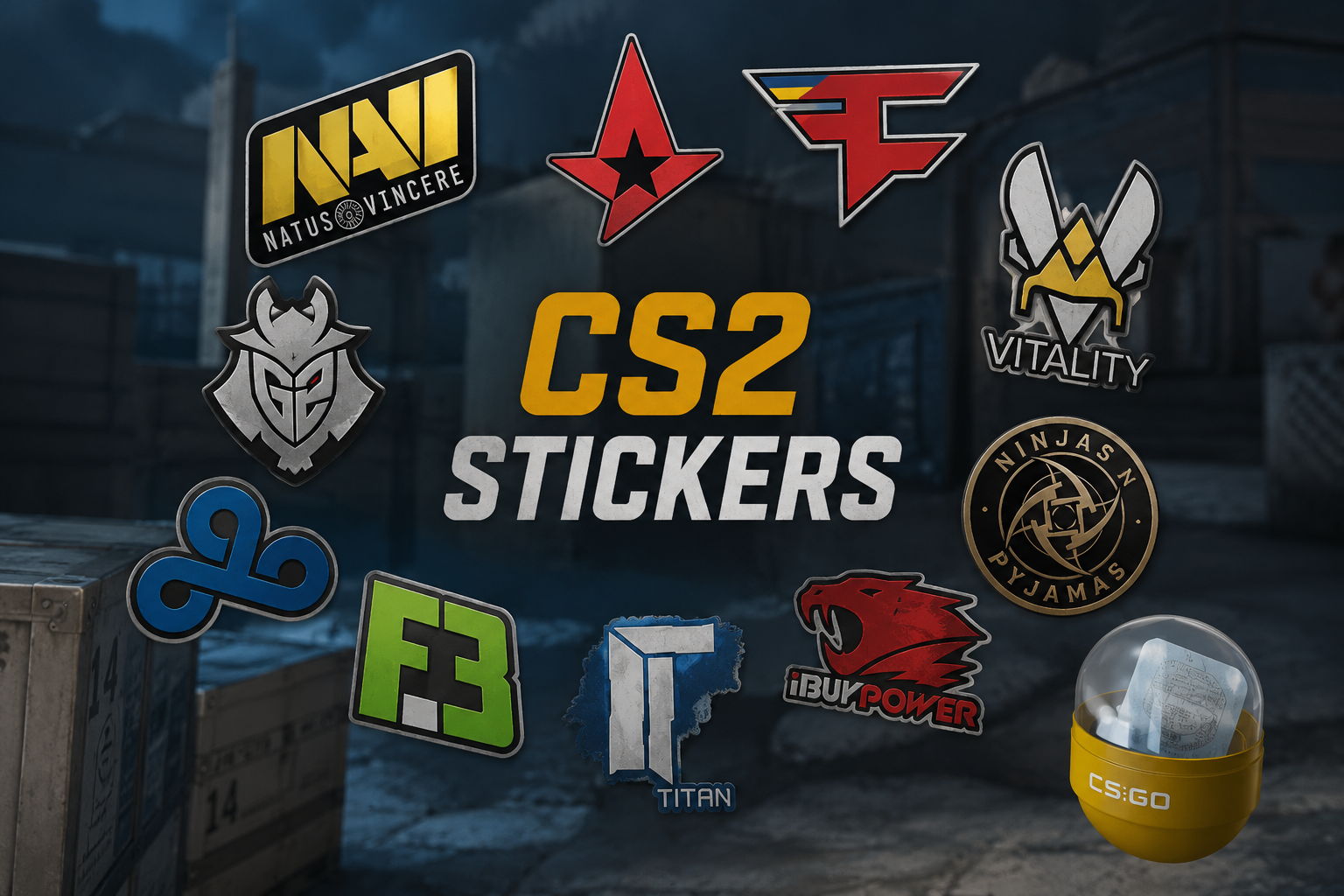
What Are CS2 Stickers?
Counter-Strike 2 is one of the world’s largest esports titles. The game also has a market for cosmetic items that change how virtual weapons look without affecting their performance. Stickers are small digital images that players can apply to those weapons, much like decals on a laptop or suitcase. Valve releases special sticker collections for Major tournaments, the game’s top official competitions. These collections include the logos of participating teams and digital versions of player signatures. A sticker provides no tactical advantage, changes no weapon statistics, and has no effect on the outcome of a match. Its purpose is visual and social. Fans can use one team logo, several player autographs, or a combination of designs to personalize a weapon and show support for a particular organization or team lineup. In that sense, a CS2 sticker serves the same role as a football scarf, only in digital form.
How Sticker Sales Finance Esports Teams
How Sticker Revenue Reaches Teams
Valve controls the Major storefront, processes purchases, and retains part of the revenue. Another portion becomes royalties for the tournament organizer, participating organizations, and registered players. Major qualification makes a club eligible for this income. It is divided between the organization and its five-player lineup. Clubs can spend the money on salaries, travel, coaching, analysts, training facilities, and team development. As a result, tournament participation creates an additional source of income through the game platform.
The Economics Behind Sticker Sales
Earlier Majors sold stickers in capsules, digital packs that produced one item from a predefined collection. Revenue from each capsule was divided equally among the teams or players in that group, so sales of a particular capsule affected each member’s payment. Paris Major participants received over $110 million in 2023, averaging about $4.5 million per team. At the Budapest Major, an organization from the lowest-ranked sticker capsule received about $600,000 before dividing the money with its players. At IEM Cologne 2026, one organization eliminated during the tournament’s opening stage reported receiving about $60,000, while its players shared another $60,000. The event introduced direct purchases, demand-based prices, and a shared royalty pool. Before the final, allocations depend on each team’s position in the Valve Regional Standings, Valve’s official ranking of professional teams. After the tournament, the final standings determine the distribution.
Why Low Prices Drive the Model
Across older Major collections and the wider CS2 market, many standard stickers trade for only a few cents, while holographic and other premium versions often cost several dollars. This price structure keeps the entry cost low and supports repeat purchases. Revenue depends on transaction volume across a large user base. A single purchase contributes little, while a high number of low-value transactions can produce substantial aggregate sales. The market also contains a separate collector segment. The Titan Holo from Katowice 2014, released during an early Counter-Strike tournament, can be valued in the tens of thousands of dollars because unused copies are scarce. Its price reflects limited supply and collector demand. Such exceptional items belong to the resale market for historical digital assets. The recurring commercial model for tournament stickers is built mainly on broad access, low unit prices, and high sales volume.
The Culture of Sticker Crafts
Within CS2, a craft is a deliberate combination of stickers placed on a virtual weapon. Players use these arrangements to preserve tournament memories, recreate a championship lineup with five signatures, or build a color scheme around the weapon’s design. Valve expanded the system in 2024 by allowing free placement, rotation, and up to five stickers on each weapon. That change turned sticker use into a more flexible design process, since position and angle can shape the final composition as much as the images themselves. Finished crafts are often shared through screenshots and community discussions, where other players compare layouts, recognize references to teams or events, and create their own versions. The result is a small creative culture built around design choices, esports history, and shared visual ideas.
A Digital Support System
CS2 stickers demonstrate how a small digital purchase can connect fan identity with recurring income for esports organizations. Their strength comes from low prices, broad participation, and distribution through the game itself. The model turns individual purchases into a stable commercial revenue stream at scale. Traditional sports organizations seeking new forms of digital revenue can draw a practical lesson from this structure, especially when building products around established fan communities.
 Add as a preferred source on Google





 Portugal Handbook
 English
 Nederlands
 Deutsch
 Français
 Español
 Italiano
 Svenska
 Pусский
 中文
中文 Türkçe
 Português
 Czech
Czech Hungarian
 Polski
 عربي
عربي Suomi
Suomi עִברִית
 Português (Brasil)
Follow us on social media