


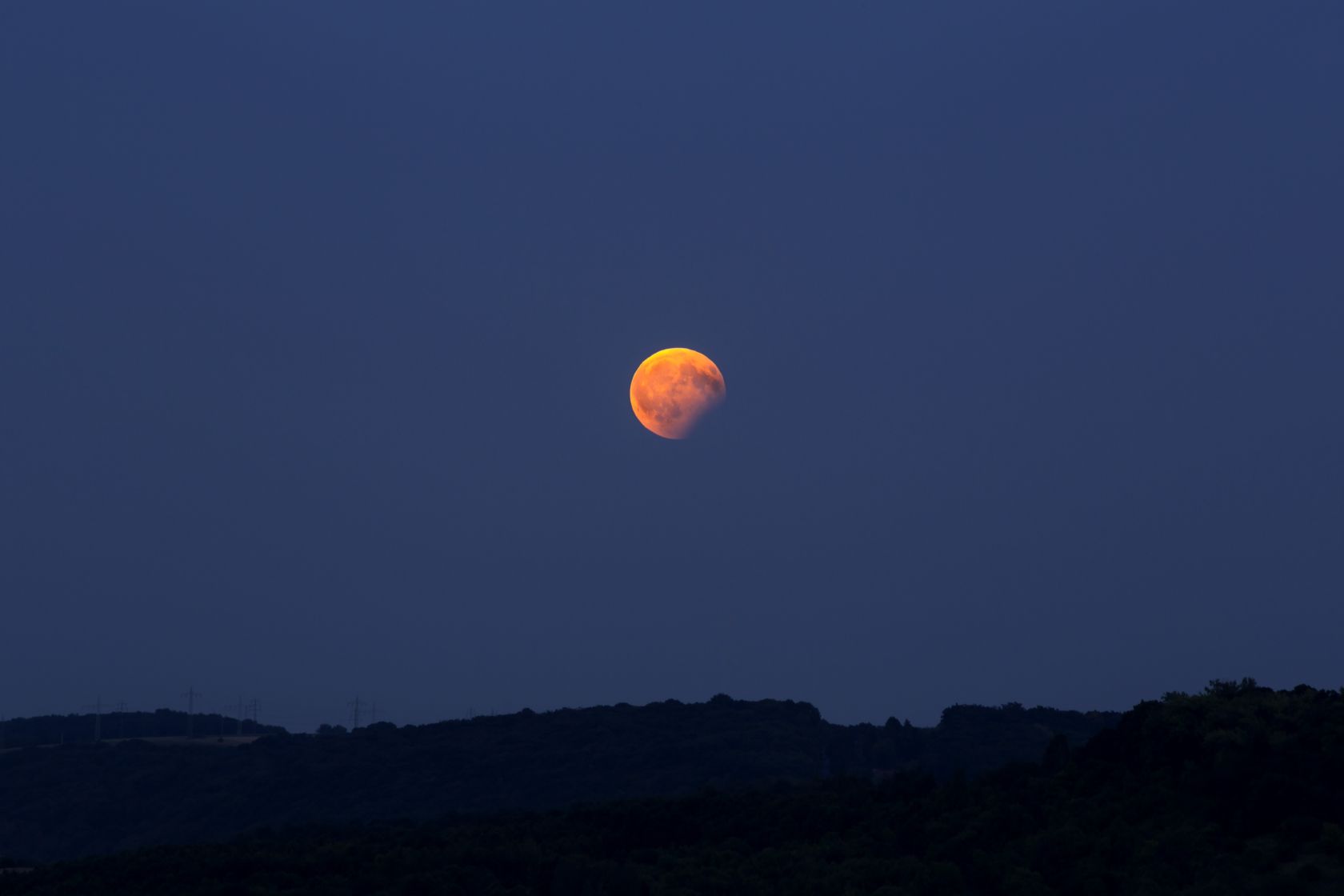
A deep partial lunar eclipse will be visible from Portugal in the early hours of 28 August, with more than 90% of the Moon entering the darkest part of the Earth's shadow at the height of the event.
The eclipse will be safe to watch with the naked eye, meaning there is no need for the protective glasses or filters required when observing a solar eclipse.
Astronomical data
Astronomical data from Timeanddate.com confirms that the partial lunar eclipse will be visible from Portugal on 28 August, including across the Algarve, Lisbon and Porto.
The eclipse will begin during the night and become increasingly noticeable as the Moon moves into the Earth's shadow. The first, more subtle stage begins when the Moon starts entering the Earth's penumbra. During this phase, the change in brightness may initially be difficult to notice.
The main part of the eclipse will take place later in the morning, as the Moon moves into the much darker central part of the Earth's shadow.
At its peak, almost all of the Moon will be covered by Earth's shadow, making this an unusually deep partial eclipse and bringing it very close to the appearance of a total lunar eclipse.
Blood moon
Space.com describes the event as an "almost blood moon", with the vast majority of the lunar surface expected to take on a reddish or orange appearance while only a small part remains brightly illuminated.
Those hoping to see the eclipse from Portugal will need a relatively clear view towards the western horizon, as the Moon will already be quite low in the sky during the later stages of the event.
The eclipse will be visible across mainland Portugal, weather permitting, although exactly how much of the event can be seen will vary slightly depending on location and the time of moonset.
Lunar surface
A lunar eclipse happens when the Earth passes between the Sun and the Moon, causing the Earth's shadow to fall across the lunar surface. It can only happen during a full Moon.
Despite the large part of the Moon that will be covered, the 28 August event is not technically a total lunar eclipse, as a small part of the Moon will remain outside the darkest part of Earth's shadow.
For anyone who missed the recent solar eclipse – or simply wants another reason to look at the sky – 28 August will bring another opportunity, although this time it will require a very early start to the day.
Set The Portugal News as your preferred source for news on Google
 Add as a preferred source on Google








 Portugal Handbook
 English
 Nederlands
 Deutsch
 Français
 Español
 Italiano
 Svenska
 Pусский
 中文
中文 Türkçe
 Português
 Czech
Czech Hungarian
 Polski
 عربي
عربي Suomi
Suomi עִברִית
 Português (Brasil)
Follow us on social media