


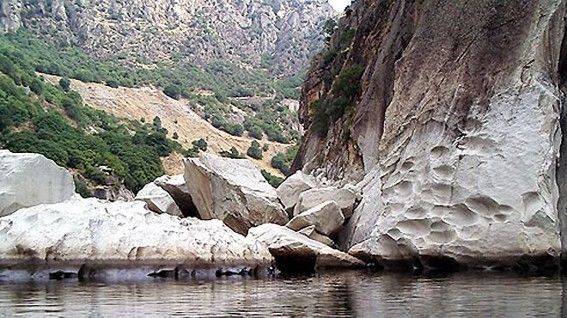
Speaking to the Lusa news agency, Miranda do Douro Mayor Helena Barril said the project comprises seven initiatives to restore natural habitats, improve trails and viewpoints, create new environmental education spaces, engage the community, and strengthen biodiversity protection.
“We want to leave behind a territory that is more resilient to climate change and better prepared for the future, while also making it more attractive to those who live in, work in, and visit Miranda do Douro and the PNDI area within our municipality,” explained the Social Democratic mayor from the Bragança district.
According to Helena Barril, one initiative focuses on the São João das Arribas area, where the goal is to protect the site by restoring paths, traditional stone walls, and native vegetation, as well as creating a firebreak and improving visitor safety.
Meanwhile, in Miranda do Douro, one planned action is to create the Nature Restoration Knowledge eCentre. Housed in the former bus station building, the centre will showcase the PNDI’s natural wealth through exhibitions, multimedia content, and educational activities.
At the same time, the pedestrian route connecting the town to the Douro River will be restored, making it safer, more accessible, and better integrated with the natural landscape.
On the Freixiosa cliffs, access to the viewpoint will be rehabilitated; this involves replacing dilapidated structures, restoring native vegetation, and installing new signage to enhance visitor safety while protecting the habitats of species crucial to this protected area.
Another project is planned for Picote, specifically in the Barrocal and Fraga do Puio areas.
“We are going to create an interpretive trail, improve access, and install signage that allows for a better understanding of the area’s natural and geological heritage. The goal is to manage visitor flow, protect the site, and showcase one of the most extraordinary locations in our territory,” explained Helena Barril.
This initiative also focuses on renaturalizing several areas; across approximately ten hectares, cypress and pine monocultures will be replaced with native species—such as cork oaks, holm oaks, strawberry trees, and other oak varieties. This shift will boost biodiversity, protect the soil, reduce fire risk, and create more resilient, sustainable ecosystems.
In Sendim, plans are in place to restore the route connecting the town to the Douro River wharf; the project involves rehabilitating the path, stabilising slopes, restoring traditional walls, planting native species, and installing signage.
“The final component of this proposal focuses on people, with the Miranda do Douro municipality aiming to involve schools, associations, researchers, residents, and visitors in protecting the Douro International protected area. We will promote environmental education activities, citizen science programs, multimedia content, events, training sessions, and awareness-raising initiatives,” it was stated.
This proposal was approved under the Portugal 2030 Program and falls within the PNDI’s co-management plans.
The PNDI is the country’s second-largest protected area; it encompasses territory where the Douro River, along with its tributary, the Águeda River, forms the border between Portugal and Spain. It spans areas within the municipalities of Mogadouro, Miranda do Douro, and Freixo de Espada à Cinta (in the Bragança district) and Figueira de Castelo Rodrigo (in the Guarda district), covering a 122-kilometre stretch and 85,150 hectares.
 Add as a preferred source on Google





 Portugal Handbook
 English
 Nederlands
 Deutsch
 Français
 Español
 Italiano
 Svenska
 Pусский
 中文
中文 Türkçe
 Português
 Czech
Czech Hungarian
 Polski
 عربي
عربي Suomi
Suomi עִברִית
 Português (Brasil)
Follow us on social media