


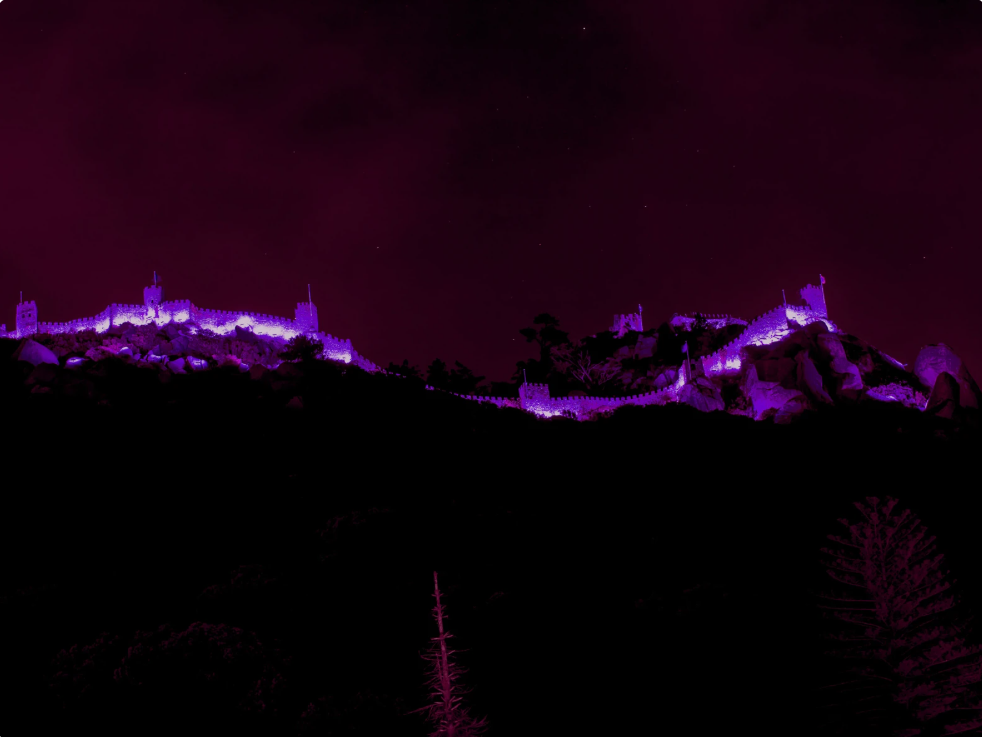
The initiative, a joint effort by the Quake – Lisbon Earthquake Museum and the "Remember 1755" movement, aims to keep the memory of the great 1755 earthquake alive. In addition to the monuments being lit in the campaign's official colour of purple, all fire services and vessels on the Tagus will sound a coordinated, sustained siren blast on 1 November at 9: 40 am, which is the exact time the earthquake hit in 1755.
Entities participation
The list of sites to be illuminated includes some of Portugal's most iconic historical, cultural and religious sites: the Praça do Comércio, the Lisbon Cathedral and the Christ the King Sanctuary in the Lisbon area; the Casa da Música in Porto; the Jardim das Portas do Sol in Santarém; and the Fortress of São João Baptista in Angra do Heroísmo (Azores). The initiative has the backing of a number of local municipalities from north to south of the country as well as the Portuguese Firefighters League, Transtejo Soflusa (the transport company) and the Portuguese Association of Insurers.
Ricardo Clemente, founder of the 'Remember 1755' movement and the Quake Museum, commented that "the fact that we now have so many entities and municipalities from north to south of the country involved is a clear indication of the significance of the 1755 memory and of its potential to become a message of prevention." He added that "the fact that the 'Remember 1755' movement is now so widespread across the country is proof that this is a movement which can bring communities together around a common memory" and that "each illuminated monument is a tribute to the victims and a collective pledge to be a more aware and better prepared nation".
The 1755 earthquake
The initiative has grown considerably since it began. It was initially limited to Lisbon in 2024 and had reached five districts by 2025.
In 2026, it expanded to 70% of the country's districts and autonomous regions. The initiative commemorates the events of 1 November 1755, when a violent earthquake destroyed most of Lisbon’s buildings and streets.
A tsunami followed, with waves of about 5 metres, and these waves actually reached up the Tagus as far as the site of the present-day Rua Augusta Arch. At the same time, there were catastrophic fires, set alight by the hearths in the homes and by the candelabras in the churches, and the result was a total disaster, with the death toll estimated at between 10,000 and 90,000.
Set The Portugal News as your preferred source for news on Google
 Add as a preferred source on Google


 Portugal Handbook
 English
 Nederlands
 Deutsch
 Français
 Español
 Italiano
 Svenska
 Pусский
 中文
 Türkçe
 Português
 Czech
 Hungarian
 Polski
 عربي
 Suomi
 עִברִית
 Português (Brasil)

Follow us on social media