


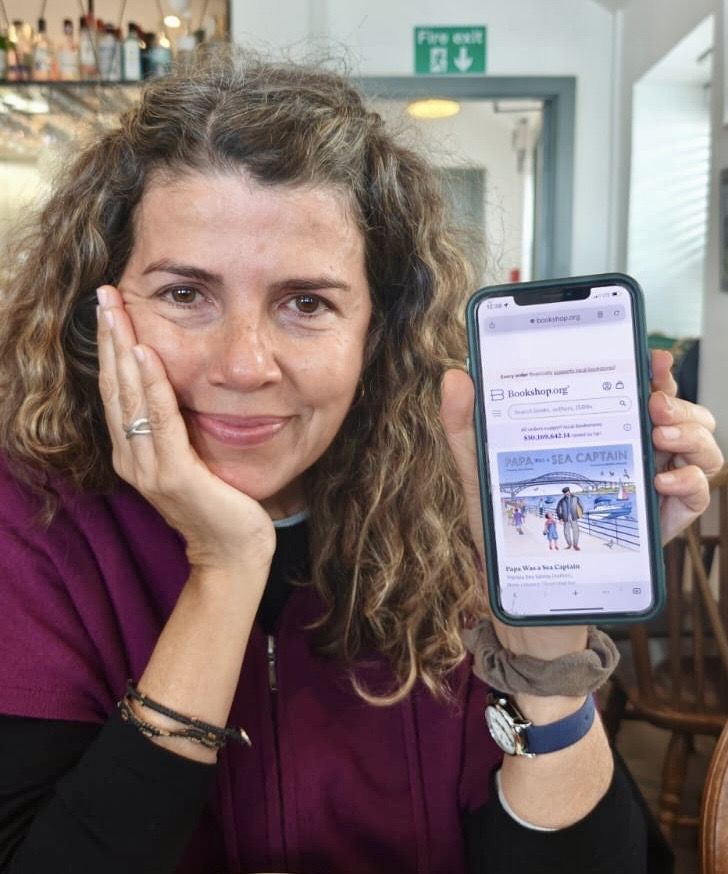
My friend Shiona and I were touring the Highlands where she lived, and we’d stopped at a seafront restaurant. Food was a logical choice after walking Rosemarkie Beach with its pretty, moss-covered rocks, on a bay belonging to the North Sea. We had to eat quickly because she had tickets for a cruise on the Loch Ness, in keeping with the theme of ships, she said; I hadn’t known her father had also been a seaman as an officer in the Royal Navy.
I asked her, “What did you mean when you said my book was online?”
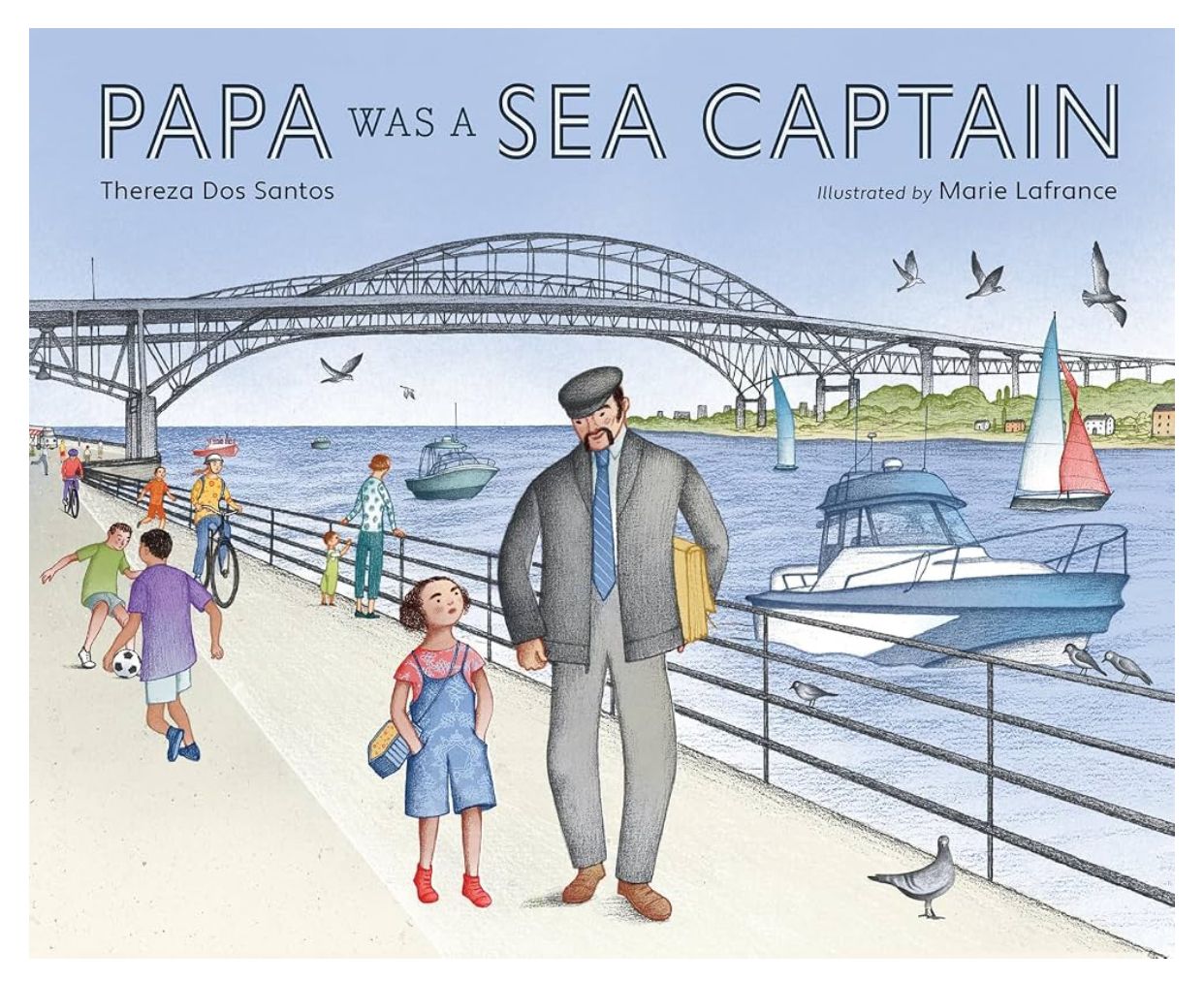
She took out her phone, tapping the screen before handing it to me. There it was, on Bookshop.org, the beautiful cover of my book, illustrated by Marie Lafrance, a four-time nominee for the Governor General’s Literary Award in Canada. Not long ago, I learned that her great-grandfather was a pilot on the St. Lawrence River, which was likely why she accepted this project.
Inspired by life
Papa Was a Sea Captain, a story inspired by life with my dad, has been a long time coming, and I’d like to propose that the process of writing (and illustrating) a picture book can be compared to building a ship. Both require a vision, careful design and countless adjustments. And, as it turns out, both can take just as long. (Warning: I may get carried away with the analogy, but I hope you’ll indulge me.)
First comes the concept. Before a ship is built, there are fundamental questions to answer: Where will it sail? What must it be designed to do? For Papa Was a Sea Captain, those early specs might be compared to the notes I scribbled at a writing conference workshop back in 2019, a very rough outline of a story that had not yet found its course.
Then comes design. A ship is custom-engineered for its particular mission, with every decision influencing another. Writing a picture book is much the same. That first messy draft gets revised, reshaped, and reworked, sometimes over and over, with each edit getting you closer to the heart of the story.
The publishing house could be the shipyard where drawings are adapted, and shipbuilding begins. Writers begin working with an editor, whose comments and suggestions must be addressed, and the language refined to tell the story in as few words as possible for young readers. Once the text is ready, it moves on to the illustrator, who works with the art director.
But a ship is not simply built and sent out to sea. It must be inspected and tested; every part is examined before the vessel moves on to the next stage. A manuscript goes through its own inspections as it advances through editorial review, while so does the art that goes with the text. For example, words and lines may be removed because the details are shown in the illustration, or a picture may require tweaking to convey a mood more accurately.
And then we have sea trials: the ship’s seaworthiness must be tested under real conditions. For a picture book, this is the stage when all eyes at the publisher are on the manuscript and art combined - giving suggestions to adjust and refine.
Finally, before a ship is delivered to its owner, even the hull and propeller are cleaned and polished to perfection at dry dock. A book, too, receives those final rounds of meticulous attention before it is printed and delivered to its ultimate destination: the reader. In both cases, the journey from an idea to a finished product is long, detailed, and sometimes unpredictable, with plenty of revision and brass to polish!
Maiden voyage
“I can’t believe it’s on pre-order already,” I told Shiona.
Pre-orders, I read, count towards a book’s crucial first week of sales, where good numbers make good things happen, like pushing the book higher in Amazon search rankings. Strong pre-order numbers give the publisher confidence and may signal larger print runs, which would align with my goal of getting this possibly first Luso-North-American picture book on the map and in the hands of little Luso-descendants (and boating enthusiasts) around the world.
As we waited for our food, I checked Indigo and Amazon (Canada, US and Portugal), the book was there, Barnes and Noble, there, Blackwell’s in the UK, there. I’d definitely have to connect with the new indie children’s bookstore in Toronto, I thought, my mind racing ahead.
My joy and surprise turned to tears, and Shiona said, “Right, let’s take a photo.”
So, this photo is the moment I learned that my debut picture book would truly enter the world next spring. The look in my eyes, tears just dried, is unmistakable; it is the look of hard work finally materialising. This story about me and my dad and ships and Portuguese history was flying its flag, and its maiden voyage was finally in sight.
So, to this book that, in its writing, gave me more time with my dad, who is no longer with us, I use the nautical term for good luck and wish it fair winds and following seas!
Thereza Dos Santos is a Luso-Canadian children’s book writer. You can find her on Instagram @therezadossantos and www.therezadossantos.com.
In Europe, her book, Papa Was a Sea Captain, is available for pre-order now on www.amazon.es (Portugal & Spain) and www.blackwells.co.uk (UK), and major online retailers in North America. ISBN-10: 1771476907, ISBN-13: 978-1771476904
By Thereza Dos Santos
Set The Portugal News as your preferred source for news on Google
 Add as a preferred source on Google


 Portugal Handbook
 English
 Nederlands
 Deutsch
 Français
 Español
 Italiano
 Svenska
 Pусский
 中文
 Türkçe
 Português
 Czech
 Hungarian
 Polski
 عربي
 Suomi
 עִברִית
 Português (Brasil)

Follow us on social media