


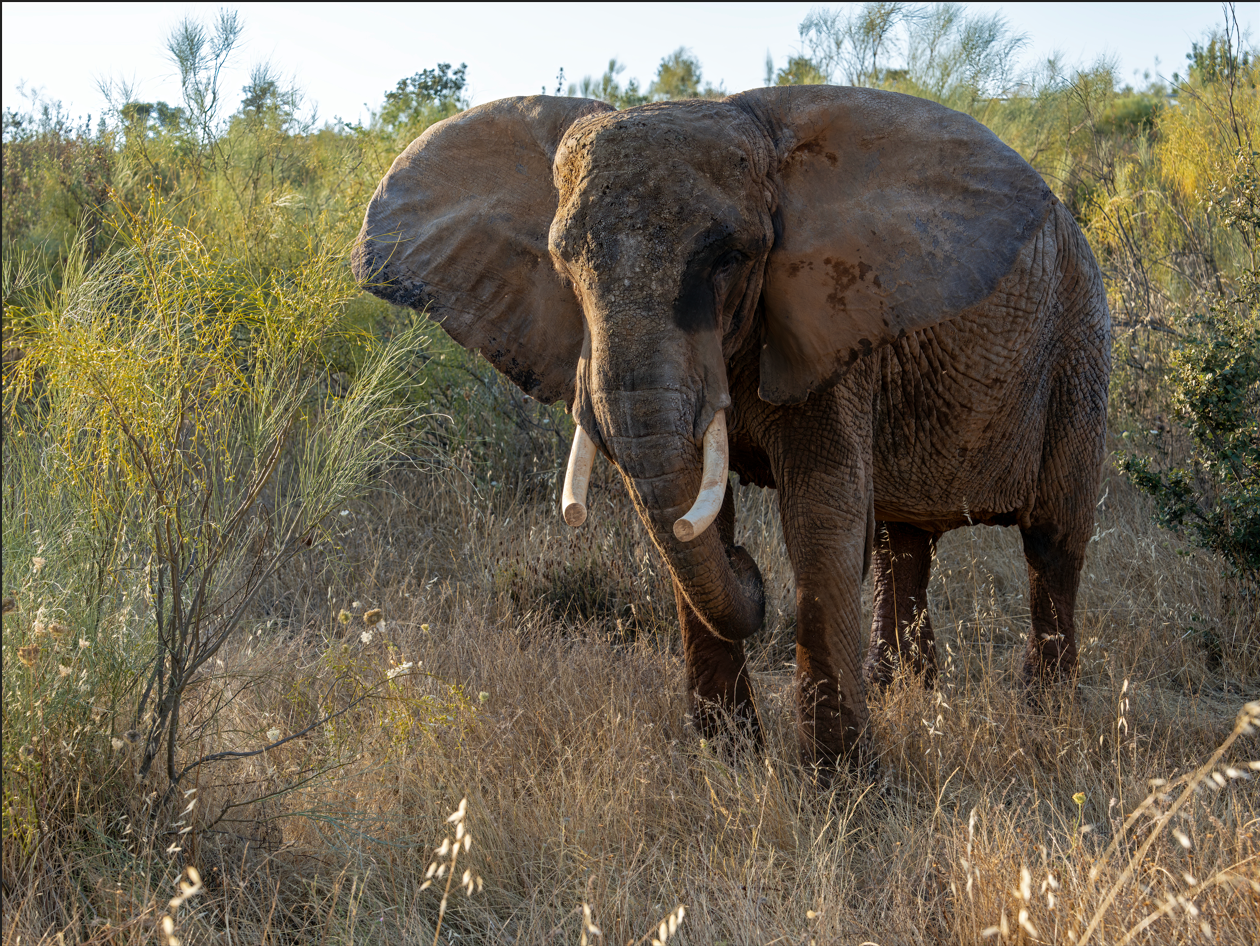
Her arrival, through a voluntary agreement with the Víctor Hugo Cardinali circus, completes the implementation of Portugal's ban on wild animals in circuses. The law was passed in 2019 and took full effect in 2024, but Julie could not leave until there was somewhere suitable for her to go. With her move, no wild animals remain in any Portuguese circus.
Julie came to Portugal from southern Africa as a young calf and joined the Cardinali circus in 1988. After nearly forty years, she was retired when the ban took full effect in 2024, and her last companion died the same year, leaving her all alone.
"There could be no more fitting first resident than Portugal's last circus elephant," said Kate Moore, Managing Director of Pangea. "By her second day, she was already exploring her enclosure, and she now has the freedom to spend each day exactly as she chooses. Pangea exists for elephants like Julie. Governments also can't enforce their own legislation without somewhere to send confiscations, and owners who genuinely care for their animals have had no better alternative. Our focus now is to give Julie the best possible quality of life in her time ahead."
Whilst many European countries have banned wild animals in circuses, such bans are hard to enforce without somewhere for the animals to go. Portugal is unusual in having both passed the law and found a home for the last remaining wild animals, rather than just letting them die out.
Víctor Hugo Cardinali, Circus Director, said: "Julie has been part of our family for nearly forty years, so this was not an easy decision, but it is the right one for her. We wish her a happy life in her new home."
Set on a 402-hectare reserve between Vila Viçosa and Alandroal, Pangea gives elephants the space, autonomy and companionship they need. She will be joined later this year by Kariba, another African elephant currently alone at a Belgian zoo.
Set The Portugal News as your preferred source for news on Google
 Add as a preferred source on Google






 Portugal Handbook
 English
 Nederlands
 Deutsch
 Français
 Español
 Italiano
 Svenska
 Pусский
 中文
中文 Türkçe
 Português
 Czech
Czech Hungarian
 Polski
 عربي
عربي Suomi
Suomi עִברִית
 Português (Brasil)
Follow us on social media