


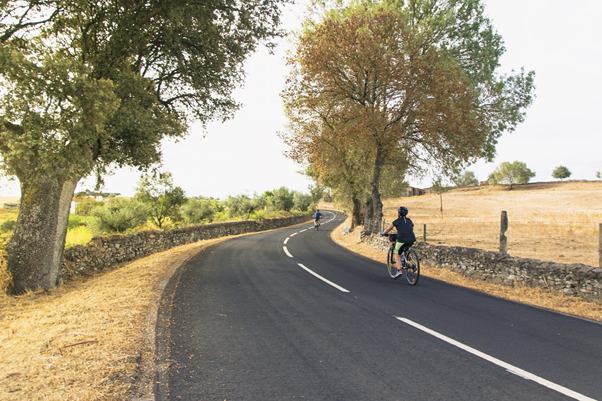
A farmer waves as you ride past. Someone points you towards a fountain to refill your bottles. A winery opens its doors after you arrive from the road.
These are the moments that make cycling through Portugal feel different.
You are not simply travelling between destinations. For a few hours, you become part of the landscape.
You smell pine trees as you climb through the hills, hear church bells from a village below, feel the road change beneath your wheels and watch vineyards, cork oaks or Atlantic cliffs appear around the next bend.
And that is what makes Portugal such an extraordinary country to explore by bike.
It may be small, but its landscapes change remarkably quickly. The green hills of the north give way to the terraced vineyards of the Douro, the wide horizons of the Alentejo, the Atlantic cliffs of the Algarve and, further out in the ocean, the volcanic landscapes of the Azores.
You do not need to be chasing kilometres to enjoy it. Some of the best days on a bike are the ones where the route becomes secondary to everything you discover along the way.
Live Love Ride has spent more than a decade operating Portugal Bike Tours, building routes around first-hand knowledge of its roads, landscapes, food, traditions and people.
Because a great cycling holiday is not simply about having a route.
It is about knowing which route is worth taking.
Five landscapes, five very different rides
Portugal does not have one great cycling landscape.
It has several.
Each region has its own rhythm, its own roads, its own flavours and its own reasons to slow down. Here are five places where Portugal really comes alive on two wheels.
The North and the Portuguese Camino
Where Portugal turns green
The north is granite, deep green hills, vineyards and rivers. The air is softer, the countryside feels older, and the roads quickly become quieter once you leave the cities behind.
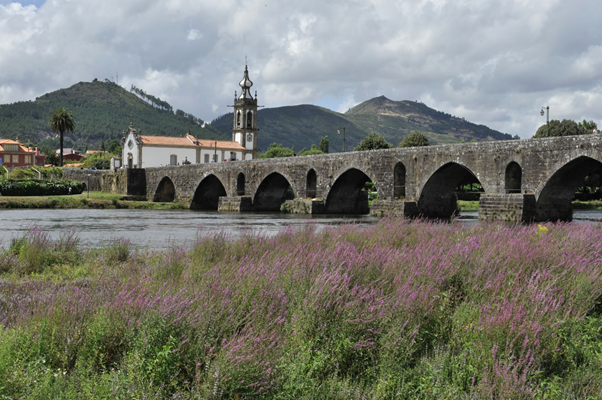
Following the Portuguese Camino towards Santiago adds another layer to the journey. The route takes you through historic towns, forests, small villages and country lanes, with pilgrims sharing the road and a simple Bom Caminho often being enough to start a conversation.
You begin to notice things you might otherwise ride straight past: a stone church tucked behind a village square, an old bridge crossing a river, a café where locals have been stopping for coffee for decades.
For those who want to experience this journey, cycling tours in the Portuguese Camino can be followed along the coast or through the historic inland route, depending on the kind of ride you are looking for.
If the Camino has caught your attention, discover Live Love Ride's bike tour in the Portuguese Camino by the coast.
The Douro Valley
A staircase of vineyards
From the river, the Douro looks almost peaceful.
Ride into the vineyards and you quickly discover that the hills have other ideas.
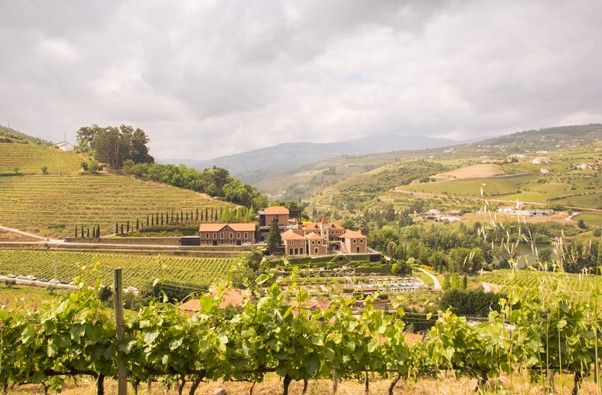
Terraces climb steeply from the water, following the contours of the valley towards old quintas and villages perched above the river. Centuries of work have shaped this landscape, and cycling through it gives you a completely different understanding of the wine produced here.
There is one useful rule for the Douro:
Do not plan your day too tightly.
You will want to stop for the view. Someone will suggest a wine tasting. Lunch will take longer than expected. You will reach the top of a climb and turn around simply to see the landscape you have just ridden through.
Let it happen.
That is the Douro.
Insider tip: Ride the road from the high vineyards down towards the river and, if you have the legs, make your way towards Pinhão. Stop at Casal de Loivos for one of the great views over the valley, then continue down through the terraces. Once in Pinhão, take a moment to see the station's famous blue-and-white azulejos depicting scenes from the region and its harvest.
The reward after a day of climbing? A table overlooking the vineyards, a glass of Douro wine and nowhere else you need to be.
Want to experience the Douro from the saddle? Explore Douro valley bike tours, from the vineyards of the wine country to the quieter roads of the International Park.
The Alentejo
The long, slow horizon
The Alentejo does not rush.
Cork oaks stand alone in enormous fields. Whitewashed villages sit on distant hilltops. Vineyards disappear towards the horizon, while long, quiet roads seem to stretch forever.
You can ride for an hour here and feel as though you have barely moved. And that is exactly the point.
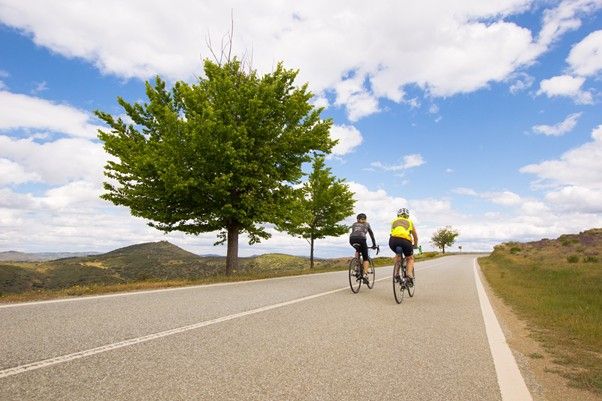
The landscape encourages you to slow down. There is space between the villages, space between the climbs and, most importantly, space in the day.
The Alentejo is also where a ride most naturally ends around a table.
Fresh bread, olive oil, local cheese, cured meats and migas. Lunch becomes longer than expected. A glass of wine becomes another. Nobody seems particularly concerned about the clock.
Insider tip: Climb to Marvão, perched dramatically on a granite ridge near the Spanish border. The final ascent is a proper effort, but once you reach the village walls, the views stretch for kilometres across the plains. Another option is Monsaraz, overlooking the vast waters of Alqueva. Stay until evening and watch the landscape disappear into one of Portugal's darkest skies.
The Alentejo is not a region to rush through. It is a region to enjoy.
If this sounds like your kind of cycling, discover Alentejo bike tours and explore the region's vineyards, historic villages and open countryside.
The Algarve
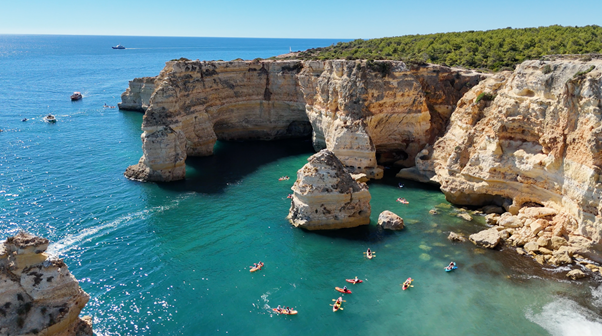
From quiet towns to wild Atlantic cliffs
There is more than one Algarve.
In the east, the coast is calm and low, shaped by the lagoons and islands of the Ria Formosa. Salt pans, citrus groves and whitewashed villages give the landscape a Mediterranean feel.
Further west, everything changes.
The roads become wilder. Cliffs rise above Atlantic beaches. The wind carries the smell of the ocean and the landscape opens towards the horizon.
This is an Algarve that many visitors never see.
And cycling is one of the best ways to find it.
Insider tip: Start at the eastern end of the Algarve, near the Spanish border, and make your way west towards Sagres and Cabo de São Vicente, following the coastline and quieter inland roads along the way.
And if you want to earn the view, head inland to Monchique and climb towards Fóia, the highest point in the Algarve. The road winds through trees and cork oak before opening onto spectacular views towards the coast.
Afterwards, there is only one sensible thing to do: sit down for a long lunch.
Ready to discover the Algarve beyond the beaches? Explore Algarve bike tours and ride from quiet coastal landscapes to the wild Atlantic west.
The Azores
Out in the middle of the Atlantic
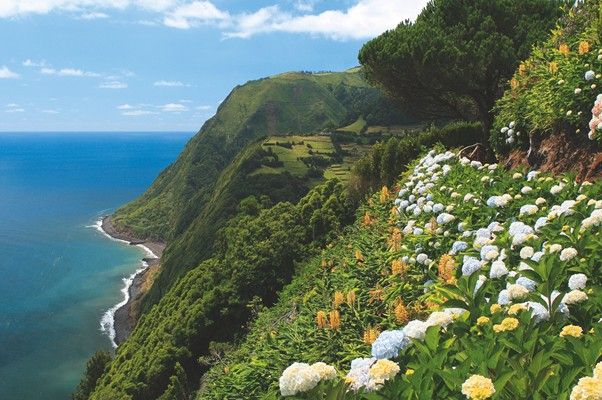
Fly a couple of hours west of Lisbon and Portugal changes completely.
The Azores are green, volcanic and surrounded by nothing but ocean. Roads climb towards crater lakes, cross lush valleys and run along cliffs high above the Atlantic.
On São Miguel, hydrangeas line the roads and volcanic landscapes unfold around every corner. Steam rises from the ground around Furnas. Tea plantations cover the hills. Waterfalls disappear into dense forest.
Fly a couple of hours west of Lisbon and Portugal changes completely.
The Azores are green, volcanic and surrounded by nothing but ocean. Roads climb towards crater lakes, cross lush valleys and run along cliffs high above the Atlantic.
On São Miguel, hydrangeas line the roads and volcanic landscapes unfold around every corner. Steam rises from the ground around Furnas. Tea plantations cover the hills. Waterfalls disappear into dense forest.
Here, the weather can change within minutes.
Rather than fighting it, embrace it.
The islands reward riders who leave a little room in the itinerary and let the day decide what kind of adventure it will become.
Insider tip: Make the climb towards the viewpoints above Sete Cidades and take time to look down over the famous blue-and-green lakes. Later, stop at Gorreana, one of Europe's oldest tea plantations, before continuing towards the coast.
And if your route takes you near Furnas, save room for lunch. The famous cozido das Furnas is slow-cooked underground using the heat of the volcanic earth. Order it ahead, ride up an appetite and finish with a traditional bolo lêvedo.
The Azores are not simply another cycling destination.
They feel like another world.
Want to experience this volcanic landscape on two wheels? Discover Azores bike tours and explore São Miguel's crater lakes, thermal springs and Atlantic roads.
The Portugal you do not see from the road
There is a reason people remember cycling holidays differently.
It is not always the biggest climb or the most famous viewpoint.
It is the bakery you found because you were hungry.
The old man who pointed you towards the right road.
The swim you had not planned.
The village square where you stopped for coffee and somehow stayed for half an hour.
The glass of wine that tasted better because you had spent the morning climbing through the vineyards it came from.
These moments are difficult to find when you are simply moving from one destination to another.
On a bike, they find you.
And that experience changes depending on where you ride. From the vineyards of the Douro and Alentejo to the Atlantic coast, the Algarve, the Azores and the roads towards Santiago, Portugal offers remarkably different journeys within a relatively small country. For travellers deciding where to cycle in Portugal, choosing the destination is really about choosing the kind of Portugal you want to experience.
And this is where local knowledge matters.
The best roads are not always the ones that appear on a map. Sometimes it is the small lane that avoids the main highway. The climb that looks intimidating but ends with an unforgettable descent. The restaurant hidden away from the tourist route. The viewpoint that is better at a certain time of day.
Knowing those details can change an entire journey.
Leave the schedule loose
If there is one piece of advice for cycling in Portugal, it is this:
Leave some room in the plan.
Take the road with the better view.
Stop when a village café looks too inviting to pass.
Ask the person behind the counter what they would order.
Ride down to the beach even if it means climbing back up afterwards.
Stay for one more glass of wine.
You can always get there tomorrow.
Because the Portugal people fall in love with is rarely the Portugal they rushed through. It is the Portugal you notice when you are riding.
For those who want to discover it with local expertise, Live Love Ride offers guided and self-guided cycling holidays across the country, with carefully designed routes, premium bikes, hand-picked hotels and a local team who knows these roads from the saddle.
For more information, read the cycling in Portugal travel guide.
Portugal is a small country.
But give it enough time and you will discover that the roads never seem to end.
Take the long way.
Set The Portugal News as your preferred source for news on Google
 Add as a preferred source on Google









 Portugal Handbook
 English
 Nederlands
 Deutsch
 Français
 Español
 Italiano
 Svenska
 Pусский
 中文
中文 Türkçe
 Português
 Czech
Czech Hungarian
 Polski
 عربي
عربي Suomi
Suomi עִברִית
 Português (Brasil)
Follow us on social media