


Portugal has up to nineteen amphibian species distributed across its varied habitats from north to south. These include seven species of newts and salamanders, and twelve different frogs and toads. In addition, the introduced African clawed frog can be found along some streams around Lisbon, with ongoing efforts to remove this invasive species, as it is a threat to indigenous amphibians and fish.
Many species are shy and secretive, and only appear after heavy rainfall. However, a few are familiar to people and include the warty toads, which are often found in gardens, and the widespread Perez’s or Iberian Water Frog, a common resident in many garden ponds and water features.
With the winter rainfall season around the corner, amphibian activity is bound to increase. You may start to hear the evening chorus of different frogs emanating from the surrounding wetlands.
What are amphibians?
Amphibians are a collective group of vertebrate animals with a highly absorbent skin. They are reliant on water for breeding. Female frogs usually lay their eggs in water, and these eggs are fertilised externally by the male. The eggs hatch out as tadpoles, and these eventually metamorphose into small frogs. Newts and salamanders tend to have a more elaborate breeding ritual.
Portugal has two of the three main groups of amphibians. Frogs (Portuguese rãs) are smooth-skinned and generally more associated with permanent water, and toads (Portuguese sapos) have a warty skin and are mostly terrestrial, only returning to water to breed.
Male frogs and toads call during the breeding season to attract resident females. The calls are often mistaken for either a bird or an insect.
The second group includes the newts and salamanders, which in general appearance look similar to lizards, but can easily be told apart. Lizards have clear dry scales, whereas newts and salamanders have a generally smooth and wet skin. Unlike frogs and toads.
A third group of amphibians, which are not found in Europe, are the tropical caecilians, which look very much like earthworms. These specialised amphibians live under damp leaf-litter of forest floors in tropical regions of the world.
The familiar garden pond frog
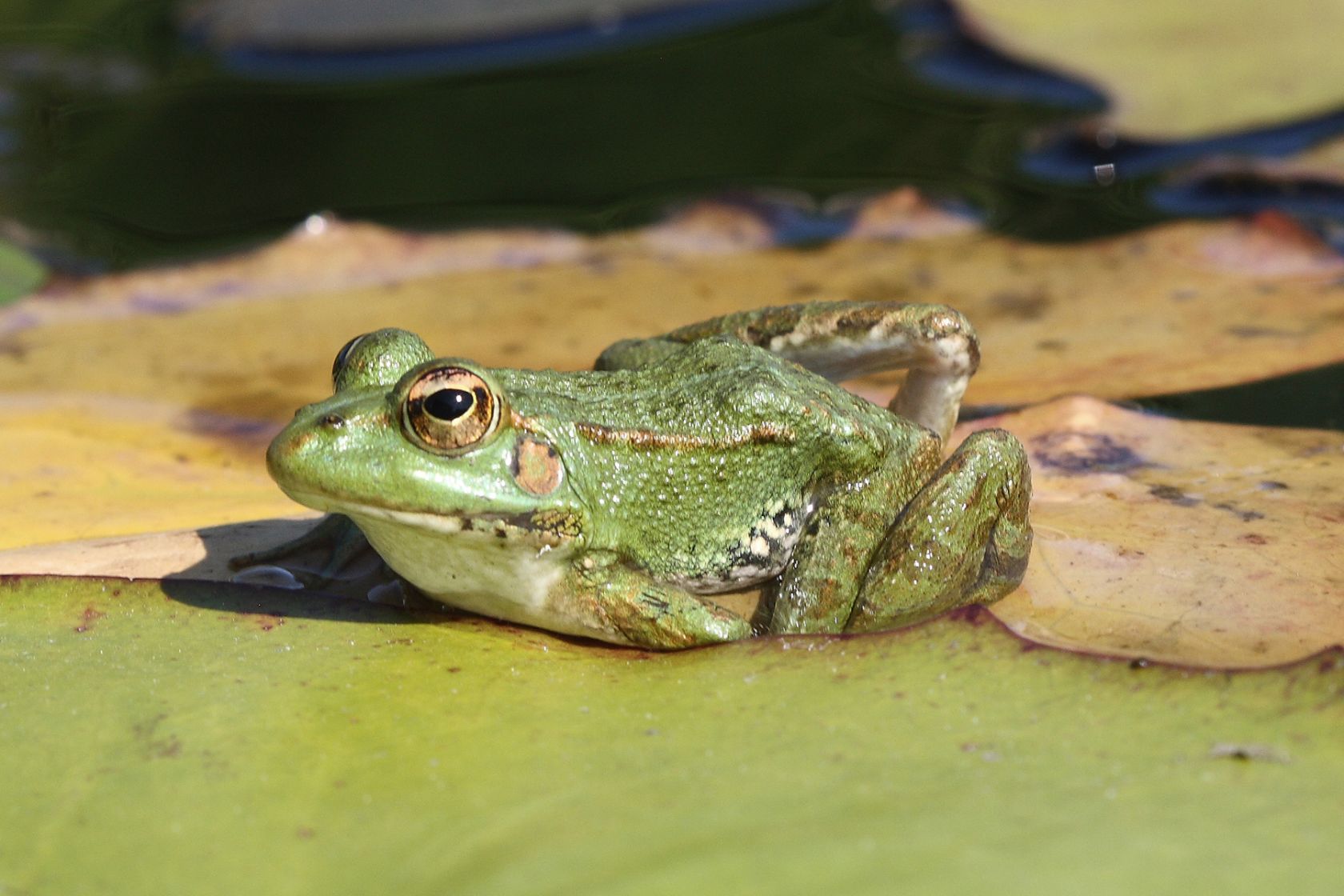
The Iberian Water Frog (Pelophylax perezi) is a common and highly adaptable frog which can easily be observed. These frogs can be seen around many coastal estuaries, as they have an unusual tolerance for brackish water, as well as streams, rivers, dams, and wells. Another unusual behaviour is that they are fond of sunbathing. Many amphibians will rapidly dehydrate when exposed to the sun, but water frogs have a remarkable tolerance, but will jump back into the water when they get too hot.
During rainy weather, they have the ability to travel long distances across open ground. That is how they find their way into garden ponds and ornamental water features. While most of Portugal’s amphibians become active during the rainy season, Iberian Water Frogs are active throughout the year. The males can be heard calling at any time of the year, but intensity does increase when it is raining. Females can lay up to 12,000 eggs!
The garden pond frogs become accustomed to people and may sit sunning themselves on floating lily leaves. If approached too closely, however, they will leap straight into the water or into thick vegetation.
Frogs as pest controllers
Frogs should be protected and encouraged. They feed on millions of harmful insects, including flies and mosquitoes. It is also important to know that frogs and toads are completely harmless to people, and despite the perpetuated myth, toads cannot give people warts. Toads, on the other hand, can secrete a milky toxic secretion from glands, and this may harm small dogs, so it is good practice to train dogs to leave toads alone if encountered.
Folklore
There are dozens of myths and superstitions surrounding frogs across Portugal. Some are associated with witchcraft and spells and greatly feared. However, in northern and rural Portugal, frogs are accredited as living weather barometers. Old herders used frogs to predict heavy rainfall. If the frogs started calling intensely, or if they started hopping along the open ground, heavy rainfall could be predicted over the next few days. This is partially factual, as frogs are sensitive to barometric pressure and humidity and will increase their activity prior to rain.
Set The Portugal News as your preferred source for news on Google
 Add as a preferred source on Google


 Portugal Handbook
 English
 Nederlands
 Deutsch
 Français
 Español
 Italiano
 Svenska
 Pусский
 中文
 Türkçe
 Português
 Czech
 Hungarian
 Polski
 عربي
 Suomi
 עִברִית
 Português (Brasil)

Follow us on social media