


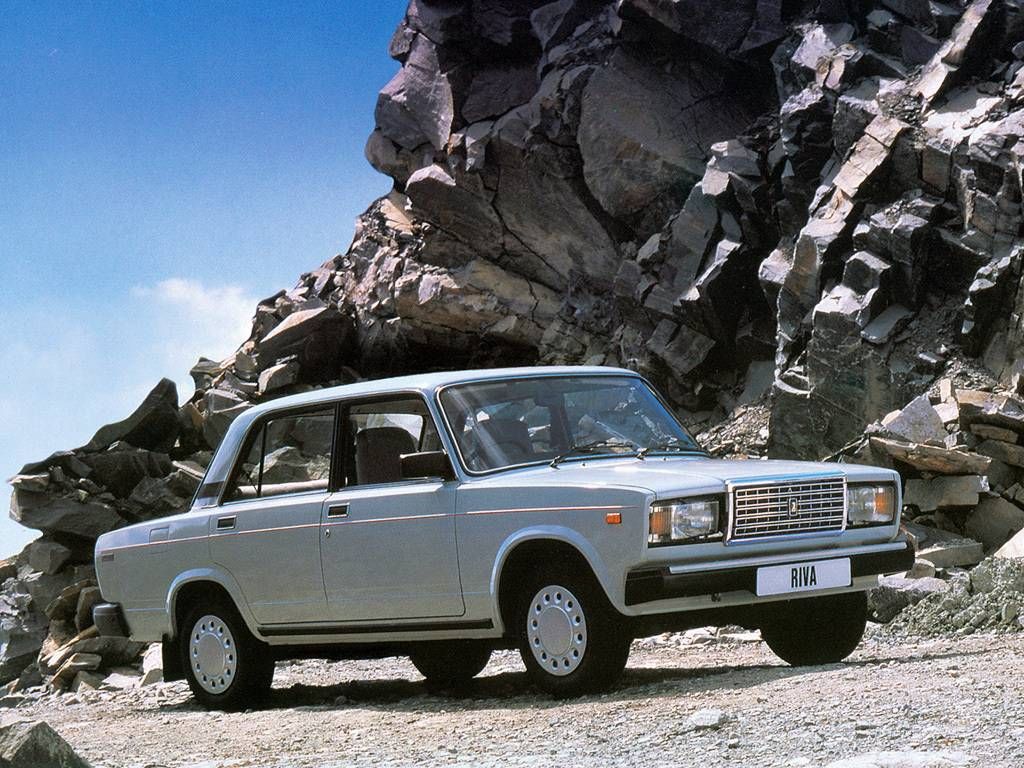
There are many things in this world that have been described as “indestructible.” The AK- 47. The Nokia 3310. The cockroach. And then there’s the Lada. A car that doesn’t so much refuse to curl up its tootsies; it stubbornly continues to exist out of sheer socialist principle. A bit like Jeremy Corbyn.
The Lada (or Zhiguli as it's referred to in Russia) began life in the 1970’s. It was the Soviet Union’s answer to a question nobody remembers asking, “What would happen if we took an Italian family car, drained all the joy out of it, moulded it out of moltendown corned beef tins and sent it into the world with brakes modelled on the Flintstones car?” And with that, the Lada was born. It was really a Fiat 124 that had been kidnapped, interrogated and indoctrinated by the Politburo, until all traces of Italian flair (of which there was very little) had been removed.
Fiat designed the original 124 for zipping through sunny piazzas while a man named Lorenzo might have flirted with a woman called Sofia at a fashionable coffee shop. The Zhiguli, by contrast, was designed for roads that weren’t really roads at all, but frozen mud that vaguely headed towards a ramshackled village with one cow, half a dozen Babushkas (with a combined age of 2022) and a solitary shop that sells nothing but pickled turnips and eggs.
Styling: A box with some other boxes bolted on
If you’ve ever wondered what would happen if a filing cabinet and a wardrobe produced offspring. Ladies & gentlemen, I give you the Zhiguli. Look at one from the side, and all you see is blandness. A straight, unbroken wall of iron oxide where curves were presumably outlawed. The designers didn't waste time on boring aerodynamics. And yet, in its own way, there’s a certain charm to its boxiness. Not elegance. Not beauty. But charm, in the sense that dogs with one eye and a missing limb are charming.
Performance? Yes, in theory
If we want to talk horsepower, we must imagine the smallest, laziest ass in existence. No thoroughbreds here, but moreover, some wheezy old mules that cough quite a lot. The early 1200-series cars produced between 58 and 64 horsepower, which in today’s money is roughly what a medium-sized leaf blower achieves. Zero to sixty? Maybe? Provided you have a strong tailwind, a downhill gradient and the weight of expectation on your side. Top speed? Let’s put it this way, we won’t be overtaking anyone unless they’ve broken down. In fact, Zhiguli passengers achieved a sort of philosophical
enlightenment by travelling so slowly that they could contemplate all the mysteries of the universe before getting to their destination. Still, the communist engineers insisted it didn’t need to be fast. It only needed to move. And on that score, the Zhiguli wins.
Handling: More rolls than a Swiss bakery Driving a Zhiguli is a bit like steering a sofa that someone has balanced on four shopping trolley wheels. It leans, it wobbles, and in a corner, it gives the distinct impression it would rather be anywhere other than where the driver wants it to be.
The suspension was designed for potholes large enough to swallow livestock. On flat roads, therefore, it bounces like a toddler after six cans of cola. At speed (meaning anything above 35 mph) the Zhiguli begins to sway gently from side to side like a drunken uncle at a wedding reception. The steering provides absolutely no feedback - nyet! If you turn the wheel, the car merely thinks about changing direction; it might agree, but there again, it might not. You're not really driving a Zhiguli, you’re negotiating with it.
Interior: Soviet luxury
Open the door, carefully, because hinges aren't a strong point, or strong at all - full stop. Step inside and we’re greeted by a collection of plastics so brittle they make 1970s British Leyland dashboards seem like they’re carved from solid mahogany. The seats are firm, I mean, really firm. After an hour behind the wheel, our spines will be jarred as much as our fillings. The dashboard is a masterpiece of minimalist design, in the sense that the Soviet Union had a shortage of almost everything, including switches. Yes, you do get a speedometer and a fuel gauge that just spew outrageous propaganda. There are warning lights that are permanently illuminated. If one goes out, it’s not because the problem has been fixed; it’s because the bulb has blown.
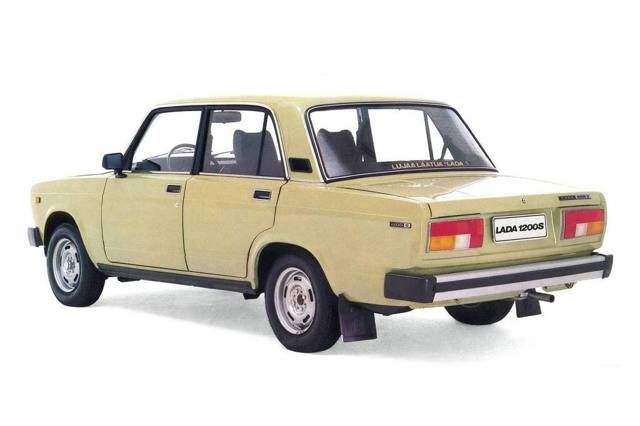
Air conditioning? Don’t be ridiculous. You open a window instead. Heating? Yes, theoretically, but it functions more like a faint warm breeze generated by someone with bad breath gently breathing through the air vents.
Reliability? It's weirdly good but for all the wrong reasons
Now, here’s the clever bit. Because the Zhiguli is built like a tractor wearing an unfashionable trouser suit; almost nothing on it is complicated enough to go catastrophically wrong. No computers and no electronics.
Half the car can be repaired using a hammer, and the other half using another hammer. If something breaks (and it will), you can fix it immediately, wherever you are. Russian owners became extraordinarily adept at roadside running repairs, able to remove and rebuild an engine using nothing but a spanner, a loaf of bread, and pure stubbornness. Parts availability was never a problem because every other car was basically the same. This was automotive homogenisation on a Maoist scale; a grey suit on wheels. And, it sort of makes sense if you actually think about it.
Cultural Icon
Despite its quirks, flaws and resemblance to a depressed fridge, the Zhiguli is widely loved. It was the first car many Soviet families ever owned. It carried wedding parties, holiday luggage, livestock and occasionally all three at once. It represented freedom, the ability to travel without needing permission from a man with a moustache and an oversized hat. Outside Russia, Ladas became a joke. We mocked them relentlessly. In the UK, it was the car you bought if you’d given up on life.
Why It still matters
Today, Zhigulis survive in surprising numbers. Not because they're collectible or beautiful, but because they refuse to give up. It’s become retro, iconic and cool in the way only something that absolutely isn’t cool can be. In a world where modern cars have twelve computers arguing constantly about tyre pressures, the Zhiguli is refreshingly honest.
The Soviet cockroach of cars
The Lada Zhiguli was never fast or pretty. It is, objectively, bad at almost everything modern cars are supposed to be good at. But it has heart. It has a sort of cheerful indestructibility that makes you want to pat it on its rusty old roof. Driving one feels like stepping back into a simpler age, when cars were machines, not gadgets.
The Zhiguli is proof that automotive charm doesn’t require perfection. Sometimes all that's needed is four wheels, a bulletproof engine with a dogged determination to soldier on. And for that reason, unbelievably, I rather like them.








 English
 Nederlands
 Deutsch
 Français
 Español
 Italiano
 Svenska
 Pусский
 中文
中文 Türkçe
 Português
 Polski
 عربي
عربي Suomi
Suomi עִברִית
 Português (Brasil)
Follow us on social media