


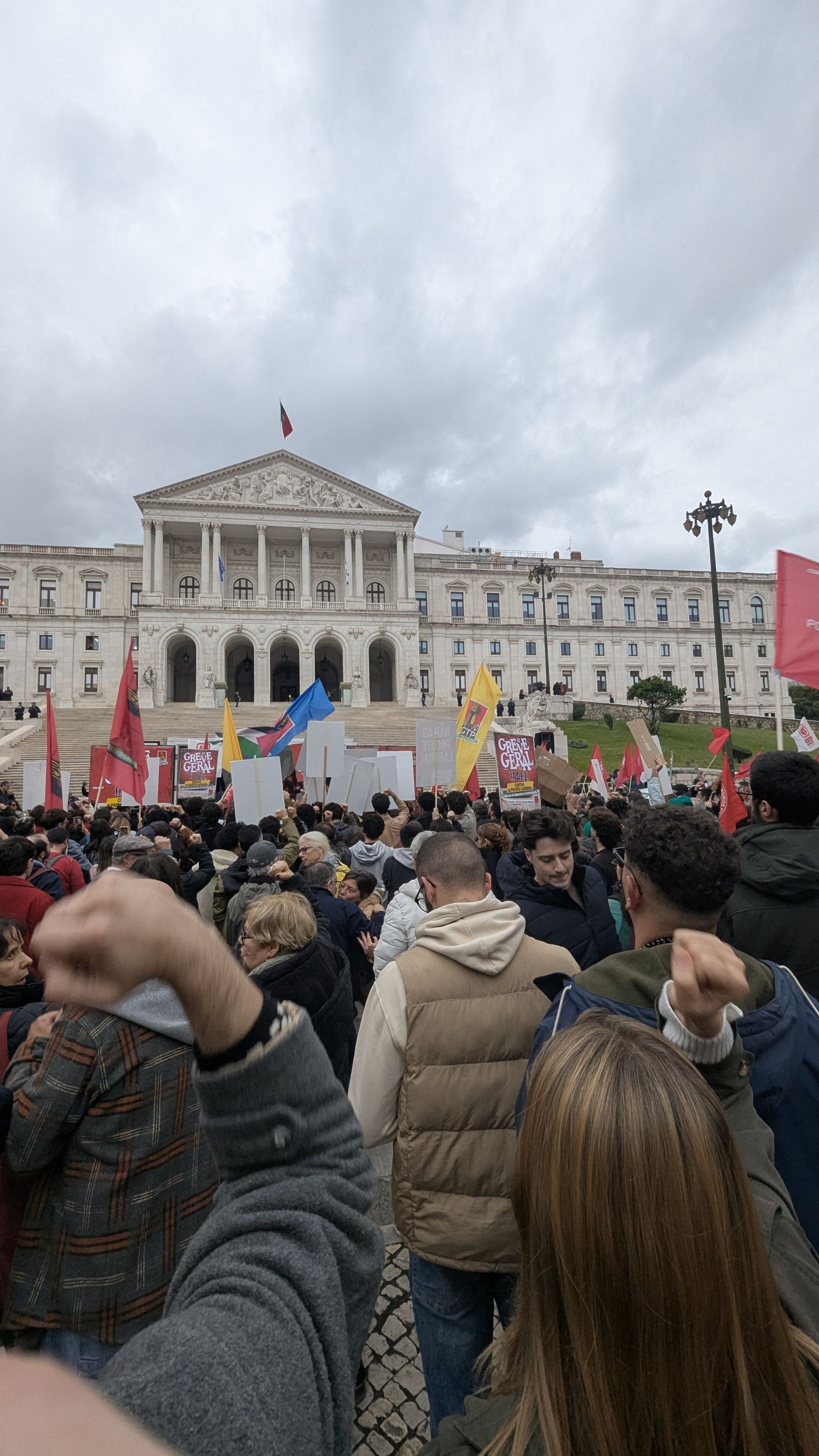
The strike is being called jointly by the National Federation of Unions of Public and Social Service Workers (FNSTFPS), the National Union of Workers of Local and Regional Administration, Public Companies, Concessionaires and Related (STAL), and the Union of Workers of the Municipality of Lisbon (STML).
Workers in general careers
The strike covers approximately 350,000 workers in general careers in the central, direct and indirect, local and regional Public Administration, said Joaquim Ribeiro, a leader of the national federation, at a press conference in Lisbon, on behalf of the three structures.
The unions are demanding an immediate increase in the career pay of these professionals, recognition of the professions' specificities, and the immediate start of salary negotiations without waiting until next year.
The strike serves to send "an urgent warning to the Government," to show that "we cannot wait until 2027 to start negotiations, and the workers will demonstrate this," said Joaquim Ribeiro.
Demonstration in Lisbon
In addition to the nationwide strike, the unions have scheduled a demonstration in Lisbon for the same day, at 11 am.
The union leader said that the strike includes "the lowest-paid in the public administration" and accused the Luís Montenegro government of "always leaving the workers in general careers for last."
"The workers in general careers are no more, but they are also no less than any other professional group," he said, stressing that what is at stake are "the workers who live in the worst conditions within the Public Administration workforce," who are close to the minimum wage and who have seen "their pay scale compressed."
“Many workers, especially operational assistants, were even affected by the national minimum wage,” the union leader exemplified.
“These are the workers who keep public services running” and who “show their faces every day” in serving the public, said Joaquim Ribeiro, giving as examples workers in Social Security, urban sanitation, garbage collection, schools and universities, registry and notary services, and the justice system.
Strike participation
When asked about expectations for strike participation, the leader said that the unions expect a “very strong” turnout and said that this will be “an opportunity to pressure the Government” on the eve of the presentation of the State Budget proposal for 2027 (OE2027), which must be submitted to parliament by 10 October.
“We are certain that it will be a major public administration strike, with thousands of public services closed, thousands of schools closed, and disruptions to garbage collection,” he said.
Joaquim Ribeiro acknowledged that the unions are aware that the strike “will create disruption for the population,” but what they tell the population “is that the workers are also striking so that the public service is better provided.”
“With the wage stagnation we have had, the remuneration levels of technical assistants and senior technicians have approached the national minimum wage by more than 200 euros, and we cannot wait to start negotiations from mid-2027 to see this reflected in 2028,” he argued.
He added that “the salary updates of recent years are insufficient to cope with the cost of living, and at the moment, what the unions hear in the workplace is that “there are more and more months and less and less salary.”
Of the 353,000 in general careers, 170,000 are operational assistants, 92,000 are technical assistants, and 88,000 are senior technicians, according to the unions.
 Add as a preferred source on Google





 Portugal Handbook
 English
 Nederlands
 Deutsch
 Français
 Español
 Italiano
 Svenska
 Pусский
 中文
中文 Türkçe
 Português
 Czech
Czech Hungarian
 Polski
 عربي
عربي Suomi
Suomi עִברִית
 Português (Brasil)
Follow us on social media