


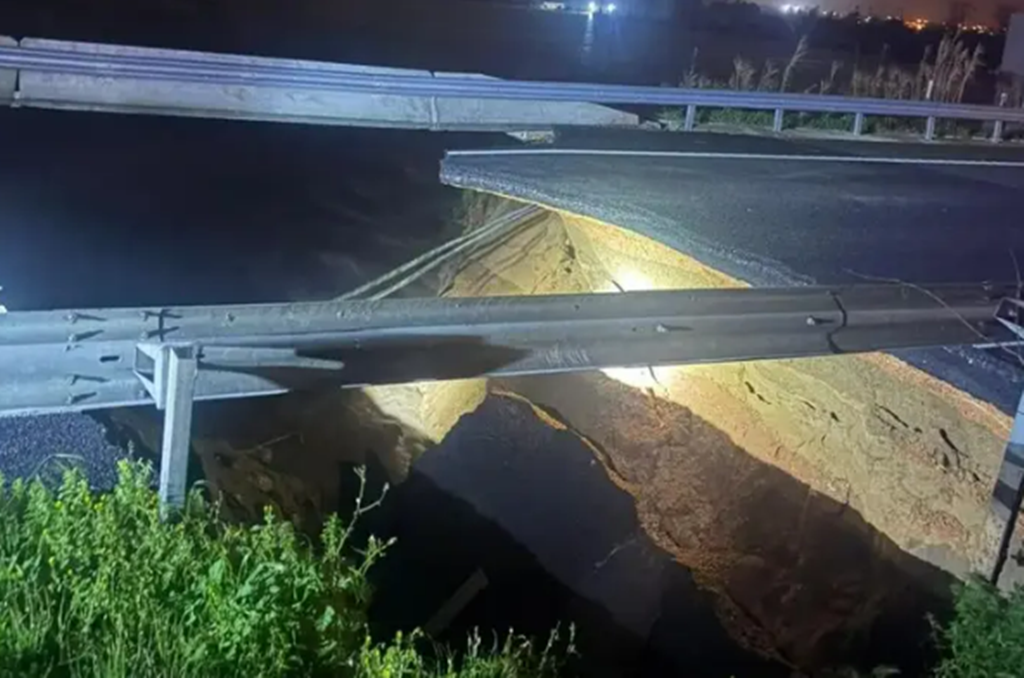
In a statement, Brisa Concessão Rodoviária (BCR) announced that “four days after the bursting of the Mondego dike, which led to the erosion of the northern abutment with Viaduct C and the subsequent collapse of the A1 platform at kilometre 191 [in the Coimbra area], the work to consolidate (rebar) the embankment has been completed.”
“In the next two days, the stabilisation of the transition slab, in the South-North direction, is expected to be completed, and it is anticipated that the platform reconstruction works will begin this week,” the company added.
According to Brisa, in total, “more than nine thousand tons of stone material were used to prevent erosion of the embankment and protect the affected area, serving as a base for the reconstruction work on the platform, in the North-South direction of the A1, between the Coimbra Sul and Coimbra Norte junctions.”
On the ground, over the past few days, there were “more than 70 workers and technicians, more than 50 resources were mobilised – including technical equipment and transport – and 35 trucks travelled more than 80,000 kilometres to transport” the materials for the first phase of the work.
“The work that is now nearing completion aimed to prevent the worsening of the damage caused by the force of the Mondego River waters, after the bursting of the dike under Viaduct C, on both lanes of the A1,” explained the concessionaire.
The reconstruction of the transition slab and the pavement could only be done after the embankment was replaced, the note also states.
Meanwhile, the Portuguese Environment Agency (APA) has already begun work "on the temporary closure of the area where the dike broke, work that is underway under viaduct C."
The company also said that, in the coming days, "the technical solution for the definitive repair of the road will be finalised, and it is expected that this work will begin this week."
The work is being monitored by technical teams from the National Laboratory of Civil Engineering (LNEC) and the Ministry of Infrastructure and Housing.
BCR also indicated that it is "working closely with the Institute for Mobility and Transport, the National Republican Guard, the National Emergency and Civil Protection Authority, and the APA.
The infrastructure rupture on the evening of 11 February was caused by the breach of the Mondego dike and the consequent excavation of the embankment soils, due to the exceptional flow of water in the river in the Coimbra region.
According to Brisa, the alternative routes for A1 users remain the A8/A17/A25 corridor or the IC2.
 Add as a preferred source on Google





 Portugal Handbook
 English
 Nederlands
 Deutsch
 Français
 Español
 Italiano
 Svenska
 Pусский
 中文
中文 Türkçe
 Português
 Czech
Czech Hungarian
 Polski
 عربي
عربي Suomi
Suomi עִברִית
 Português (Brasil)
Follow us on social media