


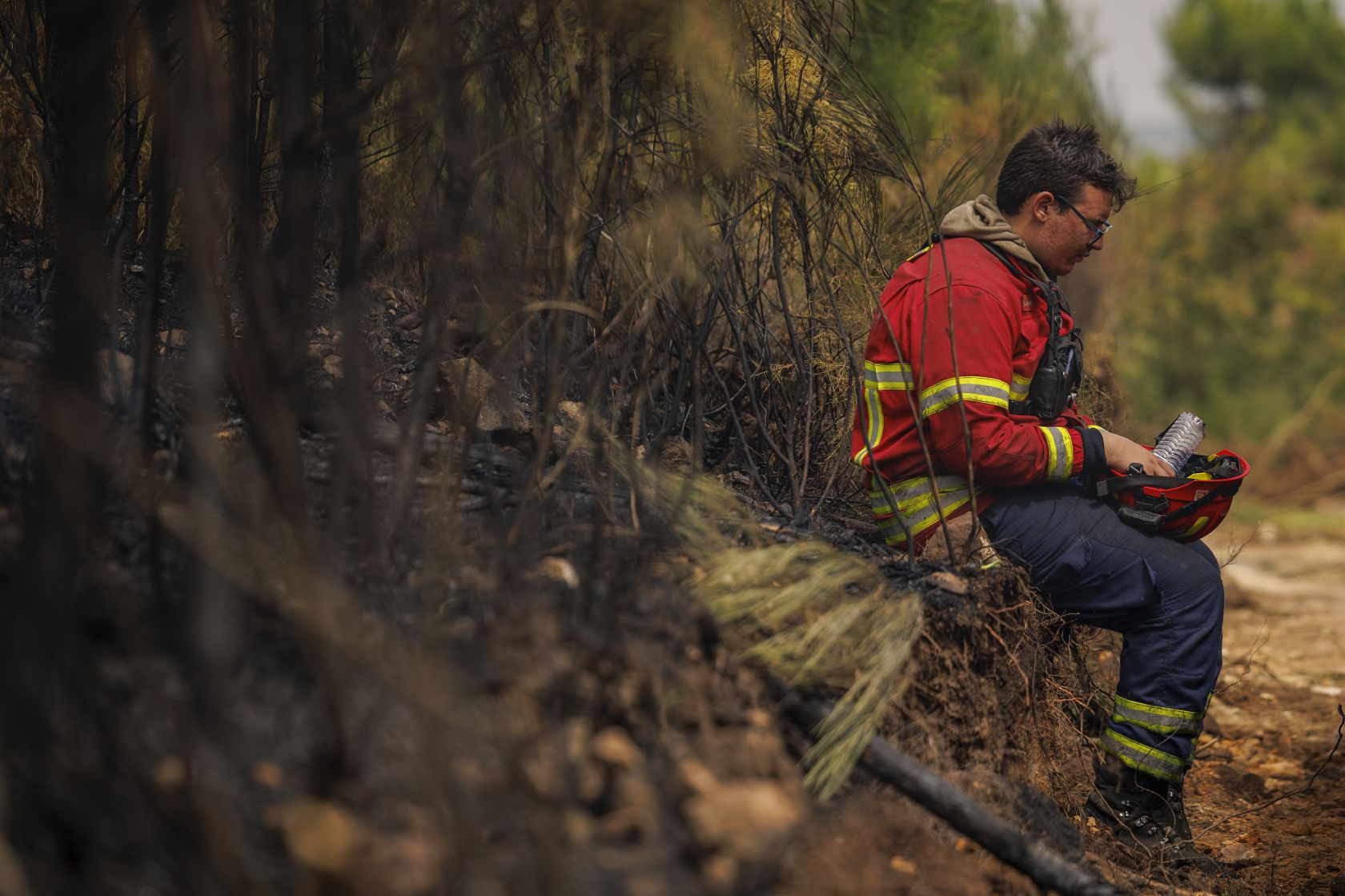
In statements to the Lusa news agency, the federation's president, Steven Sousa Piedade, expressed "enormous concern" about the financial situation of the fire departments, stressing that "the funding and financial autonomy of the associations are limited."
Admitting that it is a difficult decision, he did not rule out the possibility of grounding: "If we don't have money to fuel the vehicles, some will have to stop. We are talking about heavy firefighting vehicles and ambulances. How are we going to decide to stop an emergency vehicle? But if there is no fuel, there is no alternative," he warned.
As an example, he cited the case of the Cruz Lusa fire brigade in Faro, which consumes an average of 1,000 litres of fuel per week, "representing a monthly increase of about two thousand euros," with an annual impact of €24,000.
The official also criticised the Government's support, which provides 360 euros per heavy vehicle and €120 per light vehicle, calling it "manifestly insufficient."
The Government approved, on 6 April, the temporary amendment to the Tax on Petroleum Products (ISP) regime to extend the tax relief on fuels, whose prices have been escalating due to the conflict in the Middle East.
"The Government says that the €120 correspond to a reduction of 10 cents per litre. In an ambulance, that amount is exhausted in two days of service," he stated, pointing to the example of a fire brigade like the one in Portimão, which carries out three to four urgent transports to Faro daily.
“We are left with 28 or 29 days of the month without any support,” he argued.
The Algarve Firefighters Federation therefore advocates for “the immediate reduction of VAT and the Tax on Petroleum Products (ISP)” applied to the fuel used by firefighters, considering that “only in this way will it be possible to guarantee effective cost relief.”
“That, indeed, would be a visible measure,” he emphasised.
The official also warned about the approaching peak season, a period marked by a significant increase in operational activity for firefighters, and questioned, “How can the fire departments respond without reinforced support?”
According to him, the measures announced by the Government “do not minimally serve the purpose of assisting the population,” whether in pre-hospital emergency care, firefighting, or the transport of non-urgent patients.
Steven Sousa Piedade pointed to Spain, where a 60-cent-per-litre reduction in diesel fuel was adopted, contrasting with the 10-cent reduction applied in Portugal.
“Thus, we cannot continue to fulfil our mission. If other measures are not taken, it will be very difficult to keep the vehicles in service for the population,” he concluded.
 Add as a preferred source on Google








 Portugal Handbook
 English
 Nederlands
 Deutsch
 Français
 Español
 Italiano
 Svenska
 Pусский
 中文
中文 Türkçe
 Português
 Czech
Czech Hungarian
 Polski
 عربي
عربي Suomi
Suomi עִברִית
 Português (Brasil)
Follow us on social media