


A recent study made by The Wall Street Journal titled “Inside the Race to Protect Submarine Cables from Sabotage” responded to the U.S. Strategic Subsea Cables Act of 2026 by revealing that the rapidly expanding global fibre-optic network is threatened by physical and geopolitical risks from ill-defined sources.
An assessment made by European Intelligence agencies (such as the Finnish SUPO) which investigated the tampering of cables in the Baltic Sea, has found that there is no evidence to support the theory of Russian activity. Similarly, no concrete evidence has been produced to support the allegations that Russian submarines were responsible for the surveillance discovered by the British navy in an undisclosed location within an EEZ of the Atlantic Ocean.
It has been known for some time that such clandestine spying activity using underwater unmanned vehicles is now a global activity but whether the operators are a nation-states, corporations or criminal organisations remains unclear.
A few days after the WSJ report was made public, the Portuguese journal Expresso stated that the United States, through its ambassador Mr. John Arrigo, was exerting diplomatic pressure on the Portuguese government to improve the almost non-existent security offered for U.S. owned underwater equipment by a naval force of two small attack submarines, eight thirty-year-old corvettes and various coastal patrol boats. Failure to do so could jeopardise the pending investment by seven U.S. super-tech companies in data centres and IT network.
The European Centre for Development Policy Management has now stated that the growing threat to the telecommunications network of the EU located in territorial waters is not from conventional weaponry such as limpet mines and depth charges but rather the escalating concentration of control and ownership by foreign interests - particularly the giants of technology of the U.S. It emphasises the potential volatility in trade and military conflict due to a fragmented geopolitical situation.
Sines is destined to become a node to which 25% of the global fibre network will be connected by year 2040. Almost all of this huge increase will be to countries which are not allied to the USA.
For example, the 2Africa system when completed will have a cable length of 45,000 km which will connect 46 landing stations (nodes) in 33 countries of Africa, Asia and Europe. Significantly, Pakistan, India and the Gulf were added to the original contingent in September 2021. 2Africa will incorporate many innovations such as new aluminum conductors and ROADM selective switching which will provide a maximum capacity of 180Tbps on 16 fibre pairs. Installation and finance is supported by a consortium led by China Mobile International and includes Telecom Egypt, Vodafone, Meta, Orange and Bayobab. The construction contract has been awarded to Alcatel Submarine Networks.
The EllaLink System is being built with the latest technology and will give direct access to Brazil and Latin America via Sines from data centres in Portugal, Spain and France. Initially, capacity will be 72 Tbps over four fibre pairs. However, this will be undoubtedly be expanded when the Mercosur trade agreement becomes fully effective. The BELLA (Building Europe Link with Latin America) consortium has the EU as its leading investor through the Horizon 2020 programme but also receives funds from all the countries which will be connected. Importantly, the research and education networks of Latin America (RedCLARA) and Europe (GÉANT) will be integrated. The pan-European equity fund Margeurite II which is active in digital infrastructures, energy and renewables has joined the project as one of the key sponsors.
Brazil is a founder member of the BRICS nations (Brazil, Russia, India. China and South Africa). In 2025 it initiated a feasibility study to connect all five by a fibre optic cable system which will span 34.000 km . This will enhance individual data sovereignty by forming a digital cooperative. Controversially, Iran, the UAE, Saudi Arabia, Egypt and Ethiopia have all expressed a volition to become members. If this is permitted, Brazil will become the pivot for an enormous circle of cables which will bypass the hegemony dominated by the USA and its diminishing number of western allies.
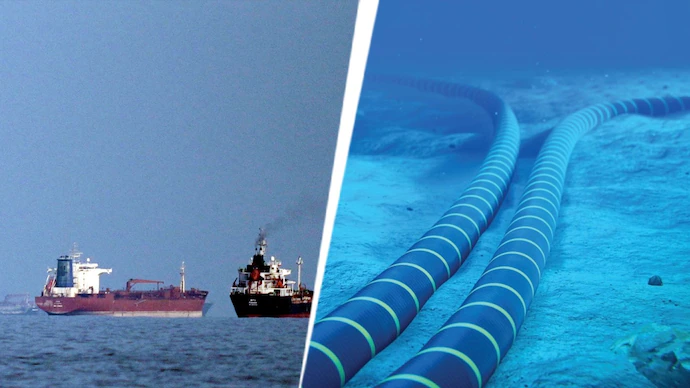
At present, Sines is linked to the U.S. by only one cable. This is the resilient Nuvem system which travels 6,900 km from South Carolina through Bermuda and the Azores and has a maximum capacity of 384 Tbps arranged through 16 fibre pairs each of 24 Tbps.
This makes the obtuse observations and threats of the U.S. ambassador implausible. The Portuguese navy is only authorised to protect subsea infrastructure which exists within territorial waters. International law as administered by the UN applies to the high seas including EEZs.
Following the example set by Australia the EU could declare exclusion channels of 7 km width within territorial waters atop all international cables. Access would then be refused to vessels which may cause damage by dropping anchor, trawling or using diving equipment. Robotically controlled underwater vehicles (UVs) equipped with laser weapons can then be employed to constantly patrol cable routes in conjunction with maintenance vessels which possess special grapples to locate and splice damaged sections. They would also coordinate with signals from the cables which can be programmed to operate as sensors and thus be able to identify the nature of any intruder in the exclusion zone above. The International Seabed Authority of the UN will grant security licences to the nations adopting such protection and supervise the presentation of claims for compensation which may be presented through the international courts of justice.
Interestingly, the USA does not recognize this authority but would still be liable for any maverick activity such as deep-sea mining, factory fishing and underwater explosions caused by its forces which could damage, accidentally or deliberately, cables and other infrastructure. Just how it could be brought to justice remains to be seen.






 Portugal Handbook
 English
 Nederlands
 Deutsch
 Français
 Español
 Italiano
 Svenska
 Pусский
 中文
中文 Türkçe
 Português
 Polski
 عربي
عربي Suomi
Suomi עִברִית
 Português (Brasil)
Follow us on social media