


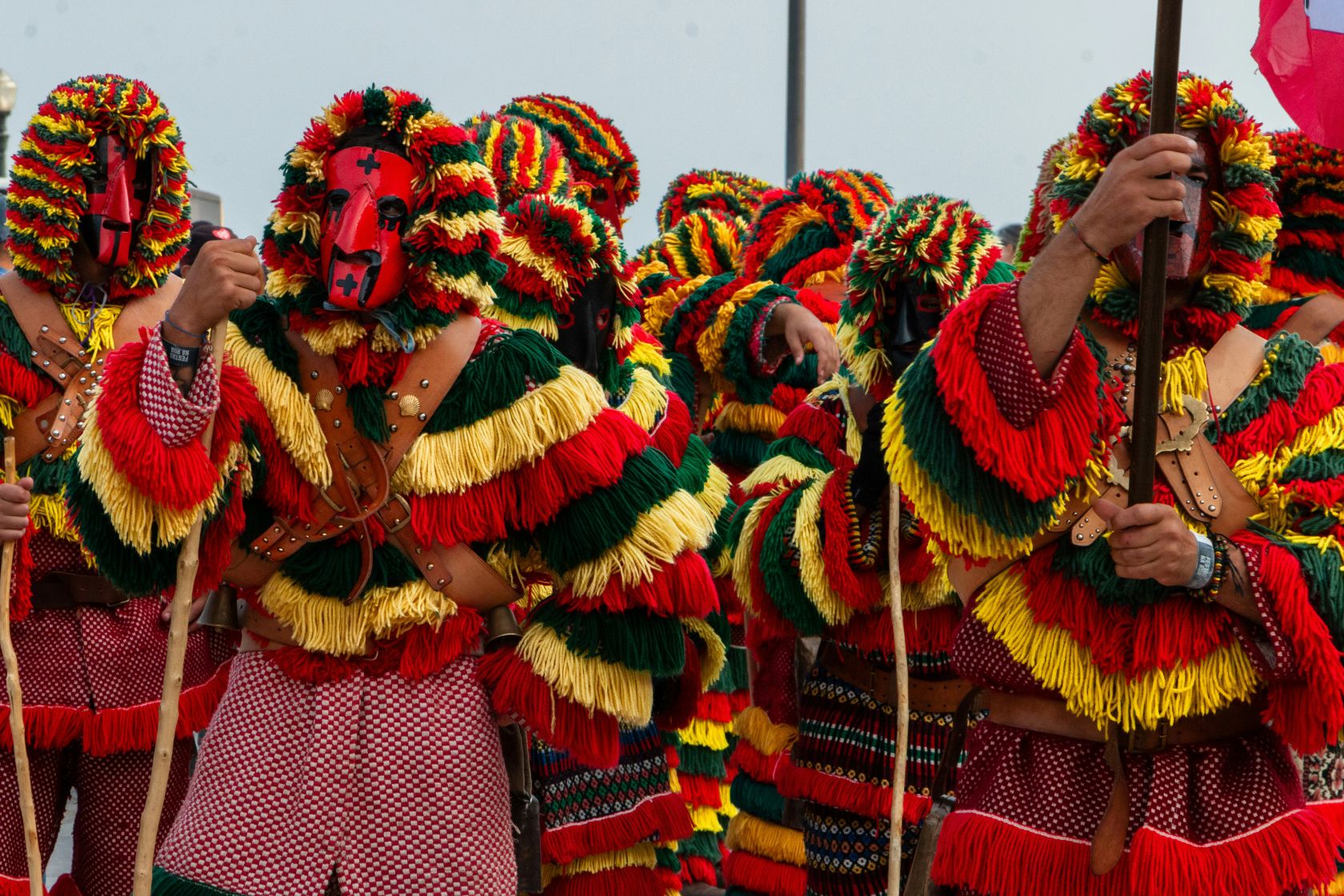
The event’s 48th edition, taking place in the Avenida Júlio Graça Gardens from Saturday through 9 August, will centre on the theme of Intangible Cultural Heritage of Humanity. For the first time, this theme will not be limited to a specific exhibition but will extend across the entire 16-day cultural program.
Caretos de Podence, Fado, Cante Alentejano (Alentejo polyphonic singing), falconry, Portuguese equestrian art, Estremoz clay figures, and the Mediterranean diet are among the expressions recognised by UNESCO that will be showcased through public-facing activities.
The program kicks off on 25 July with the creation of a flower carpet, a practice the municipality of Vila do Conde aims to nominate for the Representative List of the Intangible Cultural Heritage of Humanity, followed by an appearance by the Caretos de Podence at the venue.
The following day, Portuguese falconry will be featured in a children’s activity involving close contact with a bird of prey. In contrast, Portuguese equestrian art will be showcased in a demonstration by Quinta d’Agra.
Music will also play a prominent role, with a night dedicated to Fado on Monday and two performances of Cante Alentejano: the first on 2 August by the group “Os da Boina” during “Lace-maker’s Day” (Dia da Rendilheira), and the second at the closing ceremony on 9 August by “Cantum” (the Cante Alentejano group from the University of Minho).
Bobbin lace, another cultural expression Vila do Conde hopes to see recognised by UNESCO, will be a highlight of Lace-maker’s Day, featuring live demonstrations by artisans of different generations, as well as a discussion on 8 August regarding the history, techniques, and preservation of this tradition.
The program also includes a workshop on Estremoz clay figures and an installation inspired by the Festas do Povo (People’s Festival) of Campo Maior, featuring a giant tambourine placed in the bandstand of the Avenida Júlio Graça Gardens.
The Gastronomic Days, inspired by the Mediterranean diet, will showcase culinary traditions from various Portuguese regions, including Trás-os-Montes, Entre Douro e Minho, Beiras, Ribatejo, Estremadura, Alentejo, the Algarve, the Azores, and Madeira, with a focus on local and seasonal products.
The thematic exhibition will also highlight Portuguese cultural expressions inscribed by UNESCO on the List of Intangible Cultural Heritage in Need of Urgent Safeguarding, such as cowbell making, the black pottery of Bisalhães, and the moliceiro boat, a form of traditional boatbuilding from the Aveiro region.
In addition to bobbin lace and flower carpets, the exhibition will showcase wooden boatbuilding, forging a link between internationally recognised heritage and practices that Vila do Conde aims to promote and see formally acknowledged.
Organised by the Association for the Defence of Handicrafts and Heritage of Vila do Conde and the City Council, the 48th National Handicrafts Fair offers free admission.






 Portugal Handbook
 English
 Nederlands
 Deutsch
 Français
 Español
 Italiano
 Svenska
 Pусский
 中文
中文 Türkçe
 Português
 Czech
Czech Hungarian
 Polski
 عربي
عربي Suomi
Suomi עִברִית
 Português (Brasil)
Follow us on social media