


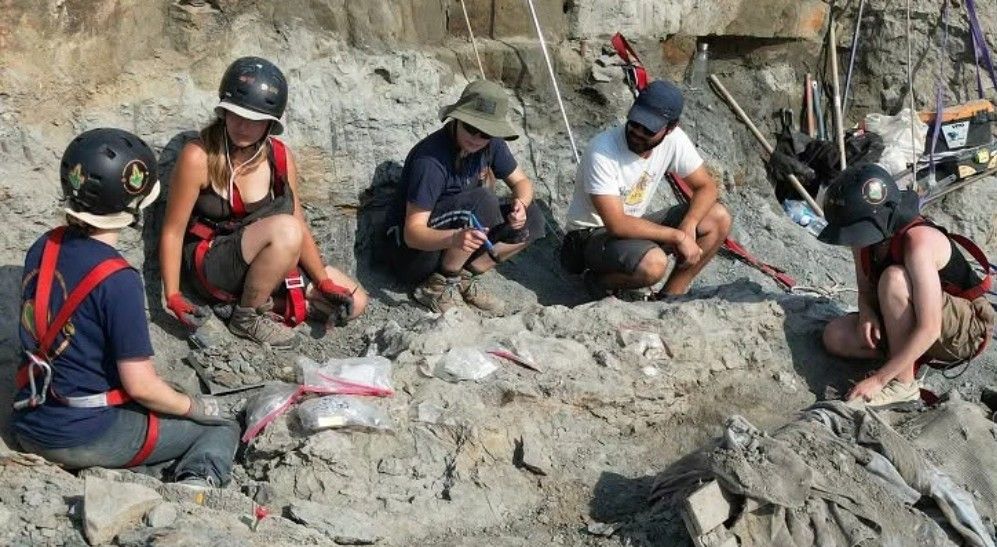
Researchers from the Centre for Research in Paleobiology and Paleoecology (Ci2Paleo) and the Natural History Society (SHN) state that the remains belong to an ankylosaur – a heavily armoured herbivorous dinosaur that lived around 155 million years ago during the Late Jurassic.
The discovery was made near the mouth of the Sizandro River in Torres Vedras, where the fossil has been exceptionally well preserved. As reported by RTP, the skeleton is already estimated to be around 85% complete, making it an extremely rare find for both Portugal and Europe.
The find was made almost by chance. In June 2025, Luís Domingos, a researcher at Ci2Paleo, noticed part of a dinosaur bone sticking out of a cliff near the mouth of the Sizandro River. Once the bone had been safely recovered before coastal erosion could destroy it, the team returned to investigate the area in more detail.
When scientists returned later that summer, they uncovered around 45 osteoderms – the bony plates that formed the dinosaur's natural armour. Their discovery confirmed that the remains belonged to the Ankylosauria group, one of the rarest dinosaur groups found in rocks dating from the Jurassic period.
Speaking to RTP, Ci2Paleo director Bruno Camilo said the fossil comes from geological layers dating between 157 and 152 million years ago, making it older than any previously identified ankylosaur found in Portugal. Because of its age, researchers believe it represents the oldest known ankylosaur from continental Europe.
Excavations resumed this summer after the site had been protected during the winter months. Researchers say there is a strong possibility that even more of the skeleton remains buried beneath the animal's armour, as it appears to have been fossilised lying face down. If confirmed, the specimen could prove to be even more complete than current estimates suggest.
As stated by the research team, the discovery is expected to provide valuable new information about the evolution of armoured dinosaurs in Europe and could become one of the most scientifically significant dinosaur finds ever made in Portugal.
 Add as a preferred source on Google







 Portugal Handbook
 English
 Nederlands
 Deutsch
 Français
 Español
 Italiano
 Svenska
 Pусский
 中文
中文 Türkçe
 Português
 Czech
Czech Hungarian
 Polski
 عربي
عربي Suomi
Suomi עִברִית
 Português (Brasil)
Follow us on social media