


Every morning, I walk beside the Tagus. Some days the river is silver and still, like polished glass stretching towards the Lisbon shores. Some days it is dark and restless, shaped by wind, tide, and weather. In sunshine it shimmers with light. In a storm it turns almost black. Boats move quietly around the Alcochete pier. The Vasco da Gama Bridge stretches across the river to the east, while in the distance the red span of the 25 de Abril Bridge and the imposing white statue of Christ the King stand watch over the city.
The river is never the same. And yet it is always itself.
Observing it over the past few years, I have often been reminded of a line by the Portuguese poet Fernando Pessoa, writing through his shepherd-poet Alberto Caeiro. He wrote that the Tagus leads to the world. Standing beside it now, I sometimes wonder whether rivers also lead us back to ourselves.
Perhaps that is why I found myself thinking about the Tagus while reflecting on a creative collaboration that began more than ten years after I first encountered the work of Swedish artist Ingela Johansson. Long before there was a novel, there was a painting.
Filmed by Per Westberg
While living in Malaysia, my husband and I bought one of Ingela's works: a woman in a red dress standing before the Singapore skyline. Years later we acquired another, a solitary woman standing before an immense orange sun. Both paintings spoke to something I could not yet fully name. Both explored women standing at thresholds between the life they had lived and the life that was quietly calling them forward.
When I finally completed my novel, The Red Silk Dress, I sent Ingela an early copy and asked whether she might consider endorsing it. As well as writing a heartfelt endorsement, something unexpected happened. The book moved her deeply, and we began discussing an artistic and literary collaboration. Rather than illustrating scenes from the novel, Ingela responded to seven emotional turning points within the story, and together we created RED: Seven Emotional Thresholds, a collection of paintings inspired by the transformational journey of my novel’s central character, Claudette.
Only later did she tell me that she had painted the collection beside Klarälven, the river that runs near her home in Sweden. Perhaps it is no wonder, then, that rivers seemed to move quietly beneath the whole collaboration.
Each painting captures a moment when something shifts. Not dramatic, but purposeful.
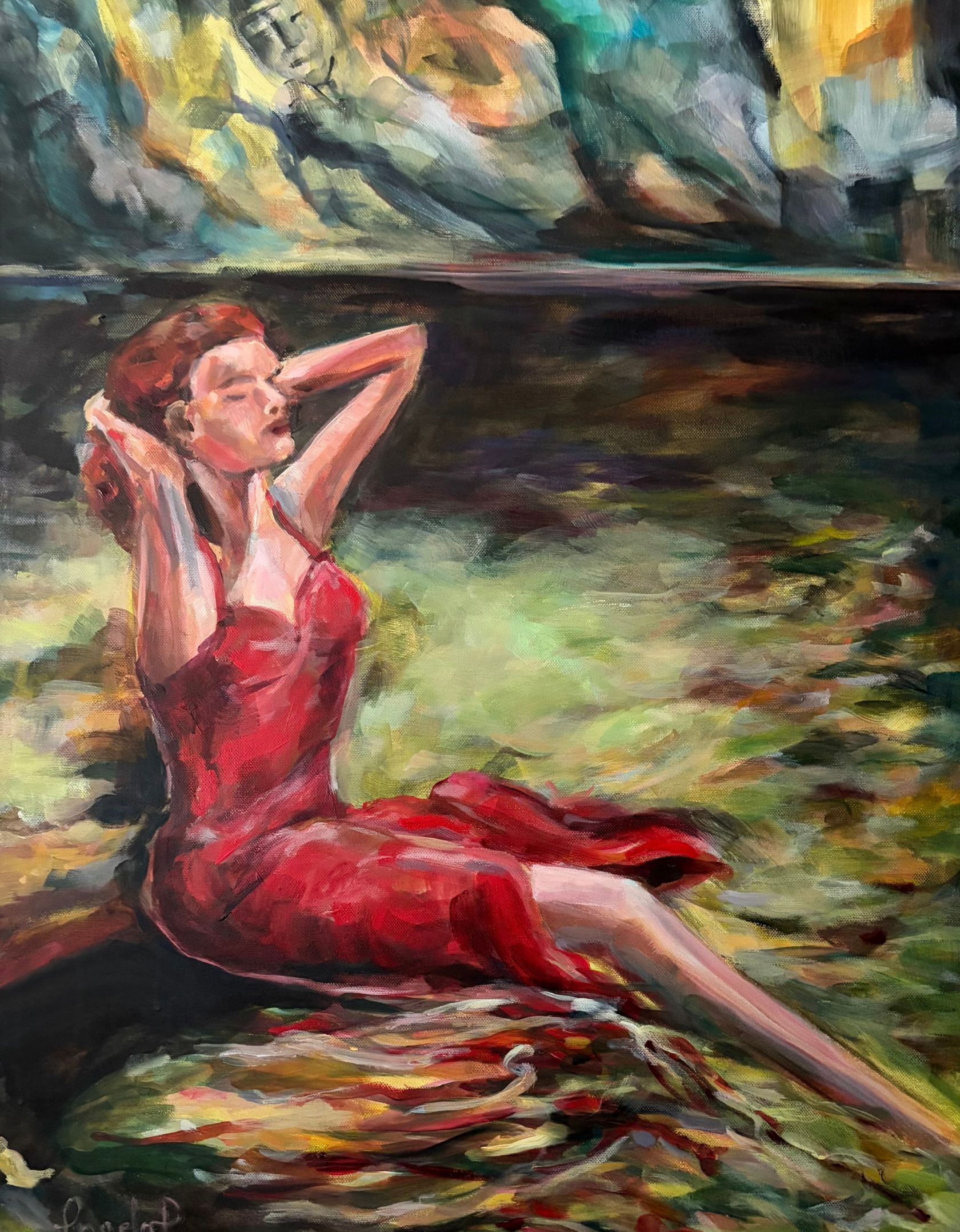
“The water touched something deeper, visceral, alive and her body began to remember what life had taught her to forget.” Natalie Turner
Of all seven, two called most strongly to me. The first was Sovereign in Red. A woman stands upright beside the water, grounded and self-possessed. There is strength in her posture and certainty in her presence. When I first saw it, I recognised something familiar. It spoke of qualities I have relied upon throughout much of my life: independence, courage, resilience, and the willingness to begin again.
The second was The Living Current. Inspired by a scene in The Red Silk Dress in which Claudette steps cautiously into Cambodia's River of a Thousand Lingas, it depicts a woman immersed in water, dressed in red, yielding herself to the current.
The River of a Thousand Lingas is a real place. Hidden in the Cambodian jungle, ancient carvings lie beneath the flowing water, symbols associated with creativity, fertility, life force and renewal. In the novel, Claudette steps into the water with the quiet knowledge that something within her has already begun to change.
In Ingela’s painting, all caution is gone. The woman is not testing the water. She has already entered it. She is not resisting the current. She is allowing it to hold her.
When the time came to choose one painting from the collection to keep for myself, I was torn. Sovereign in Red spoke to the woman who stands: strong, clear, composed. The Living Current spoke to the woman who flows: sensual, instinctive, alive. For a long time, I thought strength was the quality I most admired. Yet it was The Living Current that I chose.
There is something ancient and deeply feminine in it, as though the woman is stepping into more than water. She is yielding to intuition, to desire, to life itself. The painting feels alive. It breathes. Perhaps I chose it because it revealed something I was still learning. There are seasons in life that ask us to stand firm. And there are seasons that ask us to trust the current.
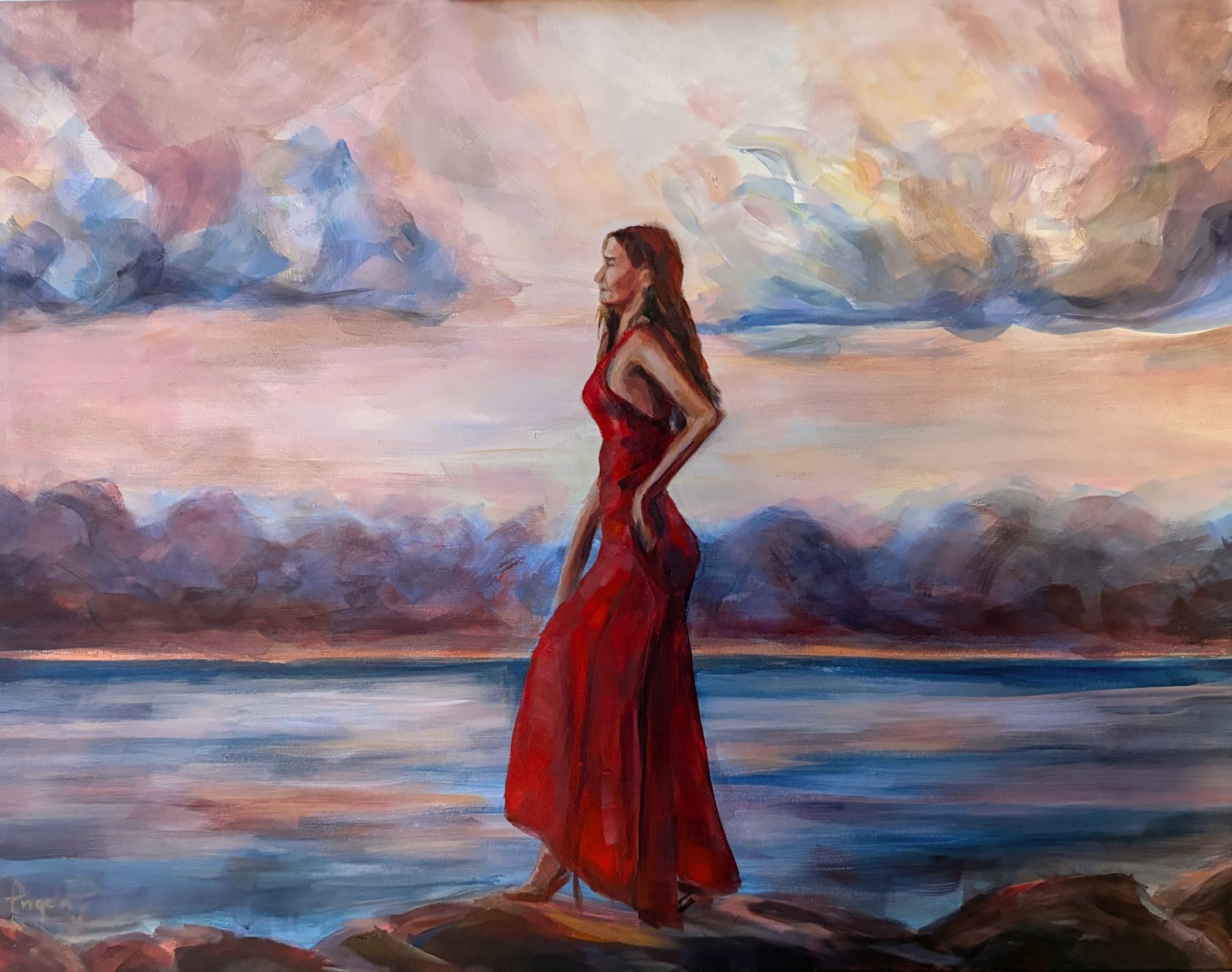
“Standing on solid ground, she reclaimed the truth of who she was.” Natalie Turner
As I walk beside the Tagus now, I find myself thinking often about that distinction. The river responds to whatever the day brings. Light, weather, wind, and tide move across its surface, changing its appearance completely. Yet somehow it remains itself. Perhaps we do too. The older I get, the more I suspect that transformation is not about becoming someone else. It is about becoming more fully who we already are.
Today, the collaboration with Ingela has grown beyond the book itself. The paintings have become part of Red Silk salons, conversations, prints and exhibitions. People stand before them and begin talking about their own lives, their own thresholds, their own moments of becoming.
That feels fitting. Because art, at its best, does not simply tell us a story. It helps us recognise our own.
And perhaps that is what both the Tagus and The Living Current continue to teach me.
Some thresholds ask for strength. Others ask for softness. Some to stand. Others to flow.
------------
To see the RED Collection, read more about the collaboration, and register interest in future Red Silk salons, visit: www.theredsilkdress.com
About Natalie:
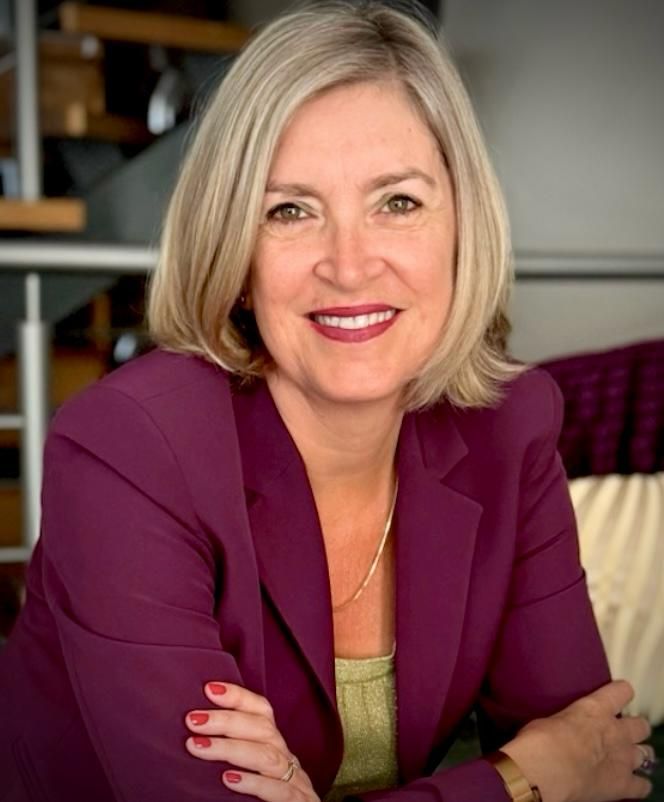
Natalie Turner is a British author based in Lisbon. Her debut novel, The Red Silk Dress explores identity and longing. She also works internationally as a leadership advisor and is the founder of Women Who Lead.
 Add as a preferred source on Google





 Portugal Handbook
 English
 Nederlands
 Deutsch
 Français
 Español
 Italiano
 Svenska
 Pусский
 中文
中文 Türkçe
 Português
 Czech
Czech Hungarian
 Polski
 عربي
عربي Suomi
Suomi עִברִית
 Português (Brasil)
Follow us on social media