


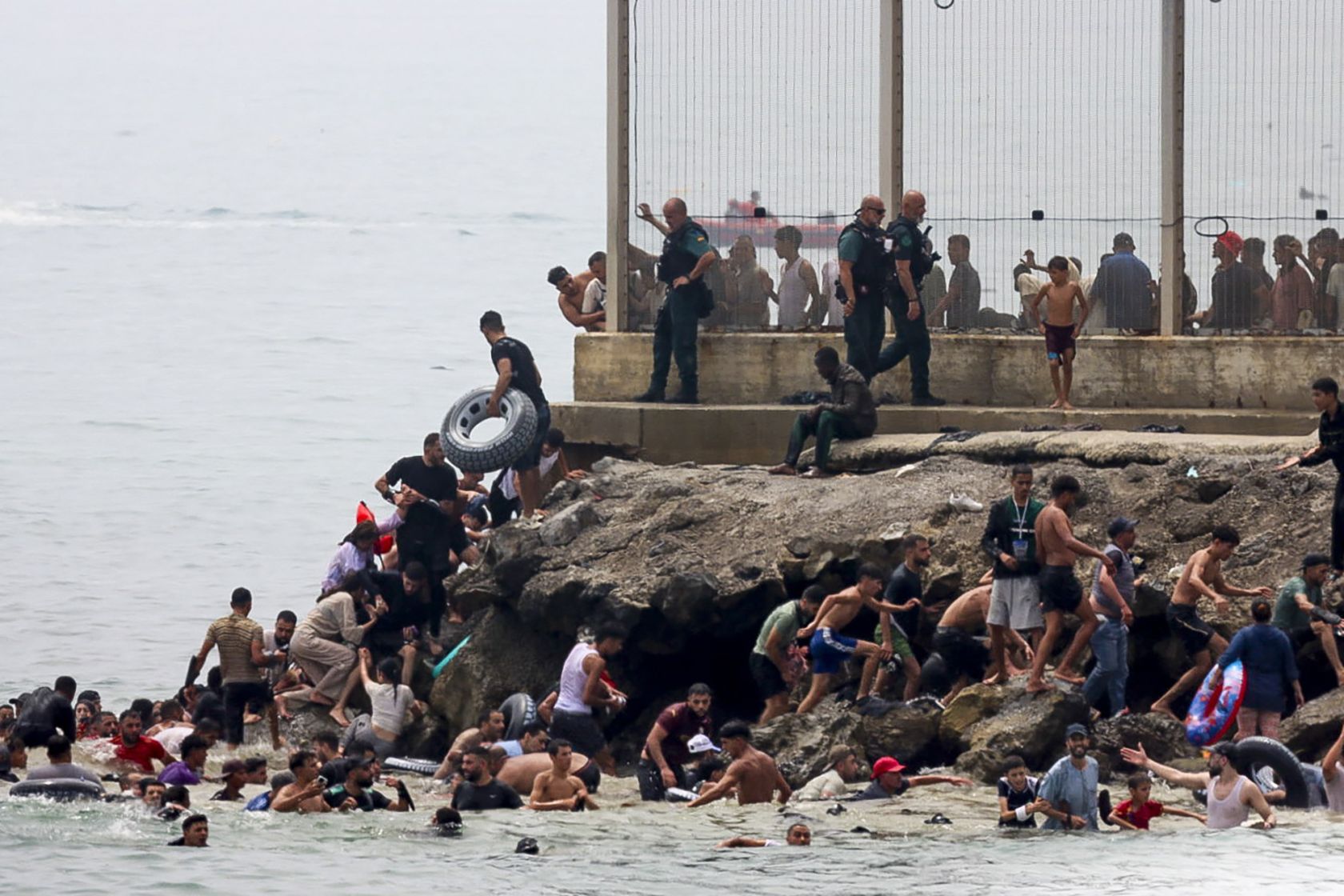
An investigation by Spanish intelligence units concludes that Morocco did not plan or carry out last Thursday’s mass entry of people into Ceuta, whose provisional death toll on Monday was at least 72, with most of the migrants drowned.
Spanish officials hold this stance despite the fact that the North African country “drew political benefit” from the international attention, according to sources cited by El País.
However, whether the government was warned in advance is another topic of discussion, and the newspaper The Objective reports that intelligence assessments had flagged a possible mass entry into Ceuta and Melilla on Morocco's Throne Day.
Were authorities warned?
Information from military and civilian intelligence sources suggests that the Spanish government was in fact warned in advance of the risk of a mass arrival of migrants, and that intelligence alerts were issued over several days, including in the hours immediately before the event, Euronews reports.
In contrast, the Spanish Interior Minister Fernando Grande-Marlaska said on Saturday that the intelligence services gave no warning of what was building on the other side of the border. Both versions are based on unidentified sources, and the Defence Ministry has neither confirmed nor denied them, as National Intelligence Centre reports are classified, MercoPress reports.
Circulation of false information
For the first time since the event last Thursday, Moroccan officials made public statements this Monday, attributing the event to several combined factors such as human trafficking networks, disinformation and misreadings of a Spanish Supreme Court ruling. A view Spain's Interior Ministry and Prime Minister Pedro Sánchez currently seem to agree upon.
The Supreme Court ruling, issued by the administrative chamber, established that people reaching Ceuta and Melilla by swimming cannot be summarily returned without a formal procedure. But the ruling does not declare border returns illegal, nor does it amend immigration law: it simply sets a binding interpretation of an existing provision.
A misrepresented reading of said ruling circulated on social media, and messaging groups spread false claims that Spain would not repatriate those who entered Ceuta.
Border control underequipped
Ceuta and Melilla are Spanish territory; nevertheless, Morocco maintains a claim over both cities. During July, the Civil Guard unions had warned about inadequate resources against ‘maritime arrivals’, and on Thursday last week, border surveillance was scaled back and withdrawn, MercoPress reports.
The Civil Guard and National Police stationed at the border were unable to stop the massive surge of migrants, which Reuters estimates at more than 50,000 people, and instead turned their focus on assisting injured individuals, several sources said.
Sources speaking to The Objective have also criticised Madrid for not deploying the army immediately, despite the fact that they hold standby military units in both Ceuta and Madrid.
"They could have been mobilised without prior meetings, simply following a political decision and an order from the operations command,” Euronews reports the sources quoted by The Objective.
Calls for European action
On Friday, Prime Minister Sánchez described the event as “an attack and a violation of Spain's territorial integrity.” Regardless, the Spanish government has not officially accused Morocco of being responsible, nor has it convened the National Security Council.
The European Commission’s President Ursula von der Leyen has called for "united action" on border security. In a letter to Prime Minister Sánchez, von der Leyen praised his "swift handling" of the crisis, while adding that: “From this incident, it is clear that we must do more to further strengthen our borders at critical points," BBC reports.
In the letter, von der Leyen warned that "the protection of all our external borders is a shared European responsibility", while calling for "vigilant monitoring and the use of physical barriers where needed", according to the BBC. The Spanish Defence Ministry has placed around 1,600 troops at the Interior Ministry's disposal for surveillance duties.
 Add as a preferred source on Google







 Portugal Handbook
 English
 Nederlands
 Deutsch
 Français
 Español
 Italiano
 Svenska
 Pусский
 中文
中文 Türkçe
 Português
 Czech
Czech Hungarian
 Polski
 عربي
عربي Suomi
Suomi עִברִית
 Português (Brasil)
Stop calling these invaders 'migrants'!
By Hart from Lisbon on 04 Aug 2026, 16:17
Agree with Hart 100 %. Euphemisms have always been used by leftists. That's how they lull the sheeple into siding with them. These invader-migrants are simply undocumented leftists that the globalist parties wish to use eventually to remain in power. That's what this whole gig is about - nothing to do with humanity or asylum or other canards. The invaders are being bribed with welfare by the establishment parties so that they can continue their mission of destroying Europe.
By Tony from USA on 04 Aug 2026, 22:06