


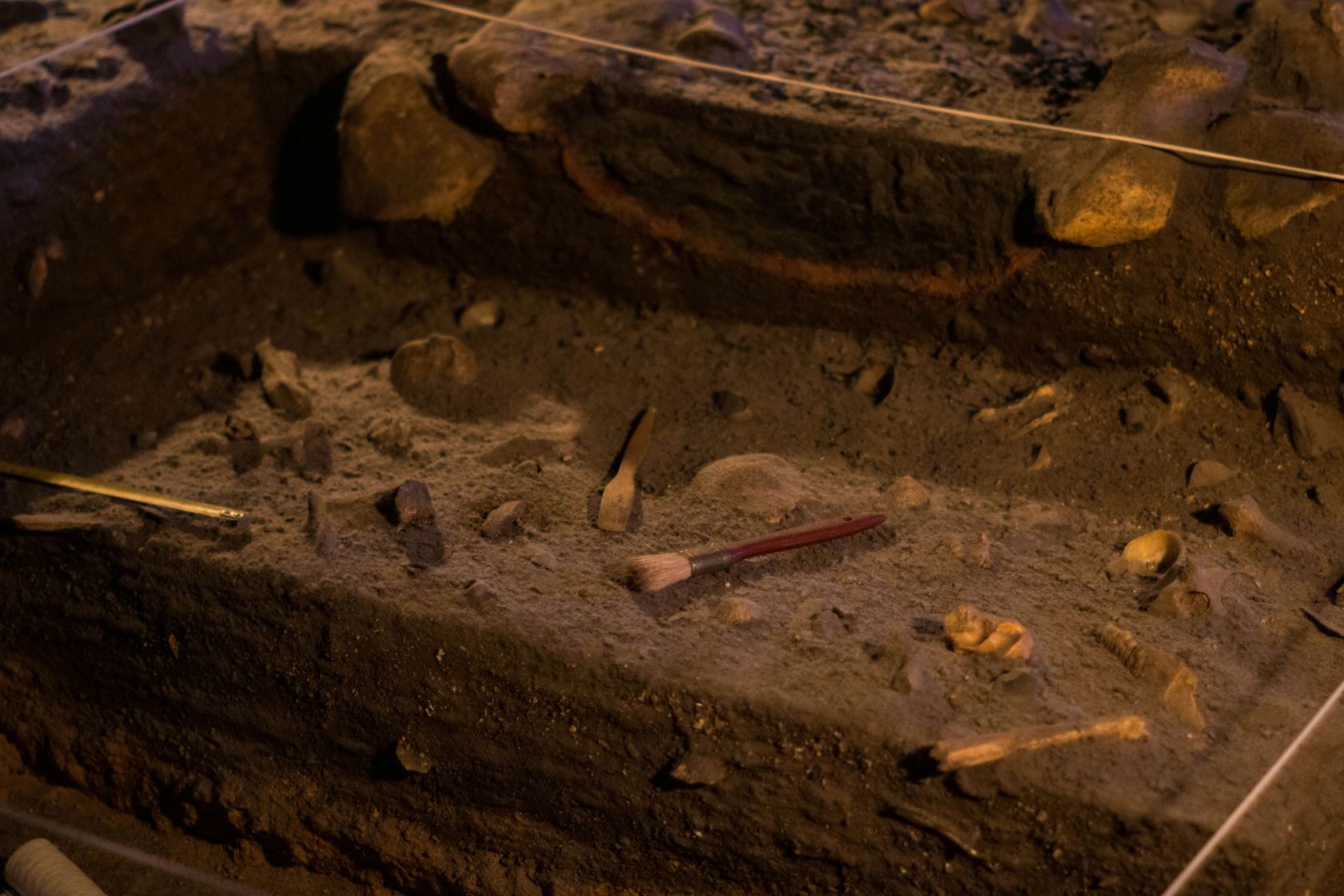
In a statement, the university's School of Science and Technology (NOVA FCT) said that “more than 80 bones discovered in the 1990s made it possible to identify a previously unknown species of salamander-like amphibian”.
Fossil quality
The fossils, which included isolated skull bones, vertebrae and other skeletal elements, were found in Areny, Huesca, in Spain's Aragon region, and revealed that “albanerpetontids, a mysterious group of extinct lissamphibians, evolved from more slender forms into more robust ones towards the end of the Cretaceous, shortly before the major mass extinction caused by an asteroid impact, which led to the disappearance of non-avian dinosaurs”.
Alexandre Guillaume, a researcher at the GEOBIOTEC Research Centre (GeoSciences, Geotechnologies and Geoengineering) at NOVA FCT, who led the research, said that “palaeontologists have found many tiny albanerpetontid fossils in Europe, but no species had yet been described”.
Albanerpetontids would have been less than five centimetres long and had “a tongue that they rapidly projected to capture food, similar to chameleons, dry and scaly skin, keratin-like claws and eyelids”.
Importance to the ecosystem
According to the study, published in the scientific journal Cretaceous Research, these amphibians were an “important component of ecosystems” during the Mesozoic geological era, “but their tiny size and fragile bones make them difficult to identify”.
The research team also found evidence that two distinct lineages of albanerpetontids may have existed in Europe towards the end of the Cretaceous.
“We are still missing a lot of information about Central Asia, but our data suggest that Western European species may have been influenced to some extent by North American species, while those in Eastern Europe may have been influenced by Asian species or older European populations,” Alexandre Guillaume said, as quoted in the statement.
The Ribagorça area, where the bones were collected in 1997, is “very rich in vertebrate fossils”, said Eduardo Puértolas-Pascual, from the Spanish Geological and Mining Institute (IGME) and one of the research supervisors.
“In recent years, two new dinosaur species and two crocodile species have already been described,” he added, explaining that what makes the area “particularly interesting is that it lies immediately below the Cretaceous-Palaeogene boundary, which marks the mass extinction caused by the asteroid impact”.
Species name
The new amphibian species has been named Synorerpeton ribagorzana.
The name Synorerpeton comes from ancient Greek and means “the animal that crawls at the boundary”, according to the statement, which explains that it is “a double play on words, referring both to the proximity of the Cretaceous–Palaeogene (K/Pg) geological boundary, associated with the asteroid impact, and to the border between Aragon and Catalonia, where the fossils were found”.
Meanwhile, ribagorzana “pays tribute to the Ribagorça region and the Noguera Ribagorzana river, which precisely marks the geographical division between the two regions”.
Complex migrations
NOVA FCT argues that “this discovery helps shed light on the complex migrations of amphibians in the past and highlights the Iberian Peninsula — and, in particular, the Ribagorça region — as a key window into understanding the final chapters of the age of dinosaurs”.
Palaeontologist Miguel Moreno-Azanza, from the University of Zaragoza in Spain, was another supervisor of the research, which also involved researcher Hugues-Alexandre Blain, from the Institut Català de Paleoecologia Humana i Evolució Social.
Set The Portugal News as your preferred source for news on Google
 Add as a preferred source on Google


 Portugal Handbook
 English
 Nederlands
 Deutsch
 Français
 Español
 Italiano
 Svenska
 Pусский
 中文
 Türkçe
 Português
 Czech
 Hungarian
 Polski
 عربي
 Suomi
 עִברִית
 Português (Brasil)

Follow us on social media