


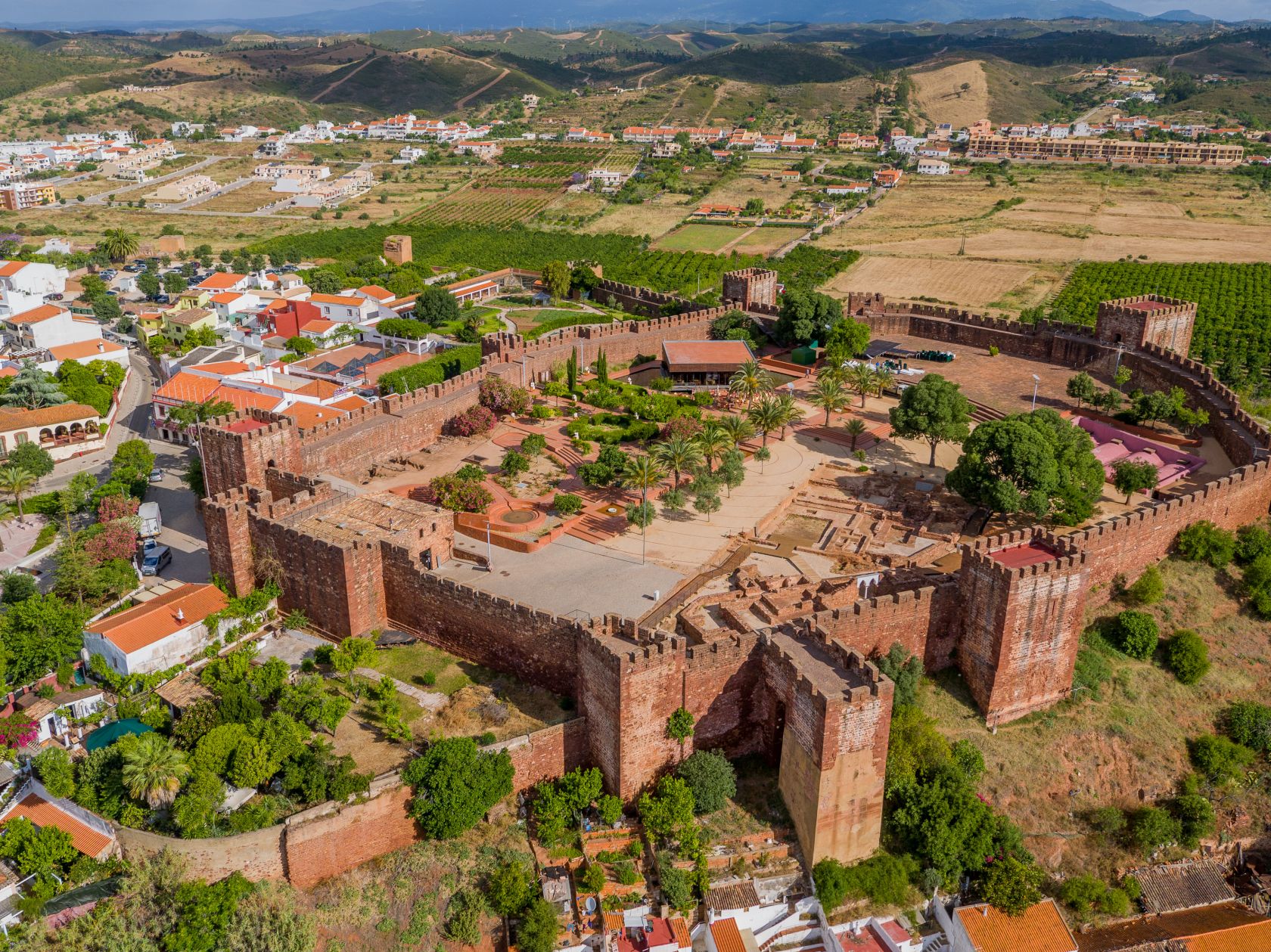
The capture by The Moors of the Iberian Peninsula is one of the most significant episodes in European History. It created an Islamic Empire which was to last for nearly eight centuries and brought about great social, political and religious changes.
The last decades of the Visigoth elective monarchy can be compared to those of the Roman Empire. Rivalry between royalty and nobles was excessive and led to plots and skirmishes between factions. Engagement in debauchery was a way of life.
When King Erwig fell ill in year 687 his weakness enabled conspirators to have him tonsured and imprisoned as a penitent in a monastery. He was succeeded by King Egica, who enforced his rule by confiscating the estates of rivals, and by King Witiza whose reign of terror led to his family being banished after his death in 710. In his place, the nobles elected Roderic, a renowned philanderer, who erred by ravishing Florinda, the daughter of Count Julian, an ambassador to the court of North African king Muza and governor of the Christian enclave of Ceuta
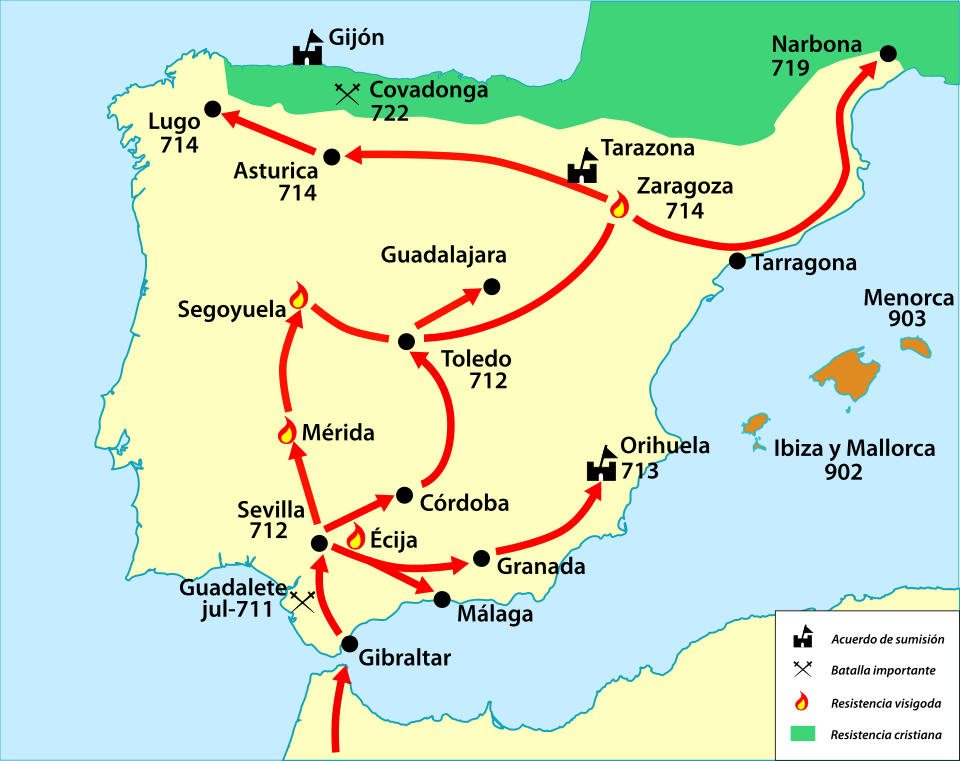
Julian was so enraged that he intrigued with Berber tribesmen to organize a raiding force of about 8,000 warriors who, in 711, crossed into southern Iberia where they were joined by rebels belonging to the Witiza clan. Together they cause mayhem by raiding villages loyal to Roderic who was absent in the north directing a campaign against the rebellious Vacones. An improvised resistance force led by Roderic´s nephew, D. Inigo Sanchez was defeated and the Berbers, laden with booty and captives returned to North Africa.
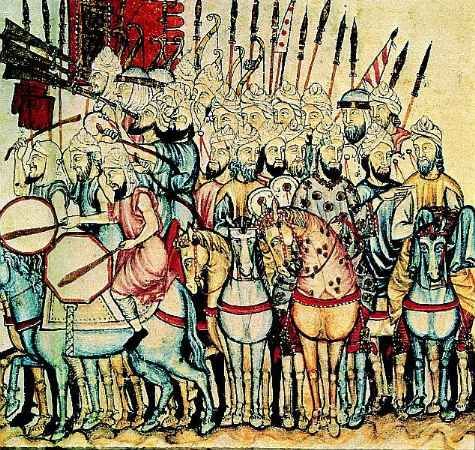
The scene was now set for conquest by an army said to number 12,000 infantry and 2,000 cavalry which crossed the Straits of Gibraltar. Against this might Roderic raised an equally large army which was soon depleted by the desertion by many nobles of the Witiza faction. Additionally, many of his “soldiers” were untrained farmers with only staves and sling-shots for weapons. Nevertheless, they joined battle in the Summer of 711 in the vicinity of the river Guadalete. This lasted several days of intense bloodletting on both sides.
Roderic had been carried into the mêlée. dressed in fine apparel over his body armour, in a Chariot made of ivory but, seeing that his men were about to be vanquished, he mounted a horse and rode into the thick of the battle with sword in hand. This was to no avail and the king disappeared thus giving rise to many legends. Some say that he drowned while trying to escape across the river where his crown and pearl embroidered sandals were found on the bank. Other chronicles maintain that he swopped clothes with a shepherd and then travelled to Pederneira, on the coast near Nazaré, where he confessed his sins to the holy monk Romanus and spent his last days in a hermitage.
Be that as it may, the Umayyad army continued a relentless advance across southern and central Iberia. They encountered little resistance as most of the governors of Visigothic municipalities believed that this was only a temporary incursion and were glad to avoid further strife by agreeing trucial surrenders. However, the arrival of Musa ibn Nusair, the Arab governor of Ifriqiya (modern day Tunisia and parts of Libya) with reinforcements from Arab countries showed that, unlike the Berbers who were intent on plunder, there was a planned intention to establish an empire within European boundaries.
Consequently, combatants and their families, were allocated land for homesteading; the Egyptians between Beja and Faro and the Syrians from the region of Emesa between Faro and Seville. This was a continuation of Roman policy from which assimilation would eventually form a united Portuguese nation.
The only resistance from the Romano-Hispanic population was found in the north-wast region of Galicia where a patriot named Pelayo organised the tribes of the Asturias into a fighting force which was able to defeat the local Garrison of Berbers in the battle of Covadonga in year 722. Wisely, Pelayo created a type of “no-mans-land” by moving part of the Asturian people to the higher ground where they were protected from any raids of revenge by the fierce Berbers. The Umayyad leadership had no interest in contesting the north-west corner of Iberia. Instead, they turned their attention to conquering the rest of Iberia and were only deterred from advancing into France by a defeat at Poitiers in 732.
Elsewhere, resistance to the new imperialists continued to crumble. There was no central Visigoth defence organization for a national army; merely a series of municipalities or principalities which were often in rivalry with each other. The exception was Merida which was the seat of the Supreme Court for Lusitania. Here a strong Roman-Hispanic populace led by Sacuru, a Gothic noble, fended off numerous attacks until the siege reduced provisions and surrender was inevitable. Under cover of darkness, dignitaries and their families retreated to the coast to embark on a small fleet which carried them westwards across the Atlantic Ocean to the fabled island of Antilia. Legend has it that the island was large enough to accommodate several cities which were built by refugees but no archeological evidence has been found either in Madeira or the Azores to support this.
Some relief to the people of the north-west was brought by a revolt against their Arabic allies by the Berbers. In 741, the garrisons of Galicia abandoned their posts and marched on the strongholds of Córdoba and Toledo only to be soundly defeated and encouraged as a body to return to Africa. This resulted in the Muslim presence being even more reduced and gave a splendid opportunity to Alfonso, a grandson-in-law of Pelayo. He was able to unite the Asturias with Galicia and parts of Lusitania to form an independent and sovereign state with an unoccupied strip along the frontiers to prevent settlement by the Moors.
Over the next decade, there were numerous skirmishes between the nascent state of Portucale and Al-Andalus which was the name given to the rest of Iberia. There was and to-ing and fro-ing of frontiers and casualties on both sides but the determination of Alfonso enabled him to make gains by retaking Tuy, Lugo, Guimarães and Famalição.
Meanwhile, civil unrest in Damascus resulted in the reduction of the Umayyad dynasty and its replacement by the Abbasid family. In a settlement, an Arab prince, Abd al-Rahman I was granted the emirate of Córdoba in 756. Thereafter, the civilization of Spain on Islamic principles became assured. These we shall examine in Part 2.
Set The Portugal News as your preferred source for news on Google
 Add as a preferred source on Google


 Portugal Handbook
 English
 Nederlands
 Deutsch
 Français
 Español
 Italiano
 Svenska
 Pусский
 中文
 Türkçe
 Português
 Czech
 Hungarian
 Polski
 عربي
 Suomi
 עִברִית
 Português (Brasil)

Follow us on social media