


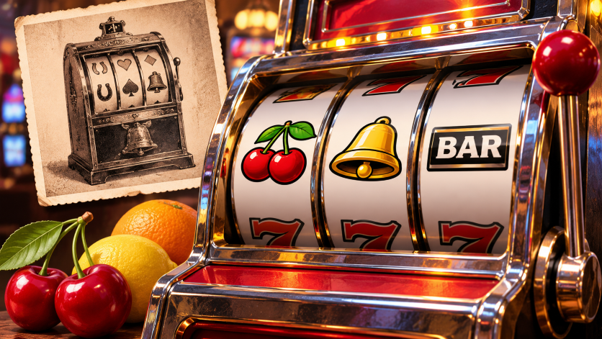
Those symbols arrived about a decade later, for reasons that had more to do with the law than with design, and they never left. Online slots still use the same cherries, sevens and BARs, and casinos often attach their promotional spins to these simple fruit-themed games because they are easy to understand. Among the current offers for free spins no deposit in Canada, one gives new players 150 spins on a slot called Fruit Million, a modern game built entirely around the symbols that replaced Fey’s card suits more than a century ago.
Charles Fey’s Liberty Bell (1898): horseshoes, card suits and a cracked bell
Fey, born in Bavaria in 1862, had been making coin-operated devices in San Francisco for several years before the Liberty Bell. Earlier machines used five drums printed with playing cards and paid out in drinks or cigars at the bar’s discretion. Fey’s idea was to reduce the reels to three and the symbols to five, which made an automatic payout mechanism possible. The machine counted the winning combination and dropped the coins itself.
The choice of symbols was practical. Horseshoes were a familiar sign of luck, the card suits came from the poker machines the Liberty Bell replaced, and the bell gave the device a name every American recognised. The site of Fey’s workshop is now California Historical Landmark No. 937, and of the original Liberty Bell machines, only three are known to survive. One of them is held by the Nevada State Museum in Carson City.
Why fruit replaced card suits: gum-vending machines and the gambling bans
The Liberty Bell was copied almost immediately. The Mills Novelty Company of Chicago began producing its own version in 1907, using the same symbols, and soon after released a model called the Operator Bell, which could be fitted with a chewing-gum dispenser. California and many other states had already moved to ban gambling machines, and the gum was a legal workaround: every coin bought a stick of gum, so the device could be presented as a vending machine.
Writing in Cabinet magazine in 2005, Fey’s grandson Marshall Fey explained that the gum was of poor quality and usually left in the tray, because players were interested in the coins, not the confectionery. To reinforce the idea that the machine sold sweets rather than taking bets, the poker symbols were replaced with pictures of the gum’s flavours: cherry, orange, plum and lemon. The fruit was, in effect, a disguise.
The BAR symbol and the bell: what the gum wrapper left behind
The BAR comes from the same period. It started as a picture of the gum wrapper label, usually linked to the Bell-Fruit Gum Company, whose stylised logo looked like a stick of gum with a word across it. On later machines, manufacturers such as Pace and Bally worked their own names into the same rectangular shape, and the single, double and triple BAR became standard symbols in their own right.
The bell survived for a different reason. Fey’s Liberty Bell had been so successful that the word “bell” had become trade slang for any three-reel slot, and keeping the symbol on the reels told players they were looking at the real thing. A modern classic slot with cherries, a bell, BARs and a red seven therefore carries three layers of history: Fey’s design of 1898, the gum-vending disguise of around 1910, and the manufacturer logos of the decades that followed.
“Fruit machines” in Britain and slot machines in Portugal’s casinos today
The disguise also shaped the vocabulary. In the United Kingdom and Ireland, slot machines are still widely called “fruit machines”, decades after any of them dispensed gum, and pub machines kept the classic fruit reels long after American casinos moved to video screens. The split between the two traditions never fully closed, and a comparison of UK and US slot machines shows how differently the two markets still design and regulate them. The original symbols have become a style of their own, used deliberately by game designers who want a machine to look traditional.
In Portugal, slot machines remain the core of the land-based casino business. According to figures from the gaming regulator SRIJ, automatic machines accounted for close to 80 percent of the gross revenue of the country’s casinos and machine rooms in the second quarter of 2025. That business is now organised under a new round of state contracts, and The Portugal News has reported that the new casino concession agreements are expected to generate more than one billion euros for the state over the next two decades, with the Algarve among the key gaming regions. On many of the machines inside those casinos, the reels still show the cherries and BARs that first appeared on a Chicago vending machine more than a hundred years ago.
18+ (19+ in most Canadian provinces). Please play responsibly. Free and confidential support is available from the Responsible Gambling Council at responsiblegambling.org.
Set The Portugal News as your preferred source for news on Google
 Add as a preferred source on Google


 Portugal Handbook
 English
 Nederlands
 Deutsch
 Français
 Español
 Italiano
 Svenska
 Pусский
 中文
 Türkçe
 Português
 Czech
 Hungarian
 Polski
 عربي
 Suomi
 עִברִית
 Português (Brasil)

Follow us on social media