


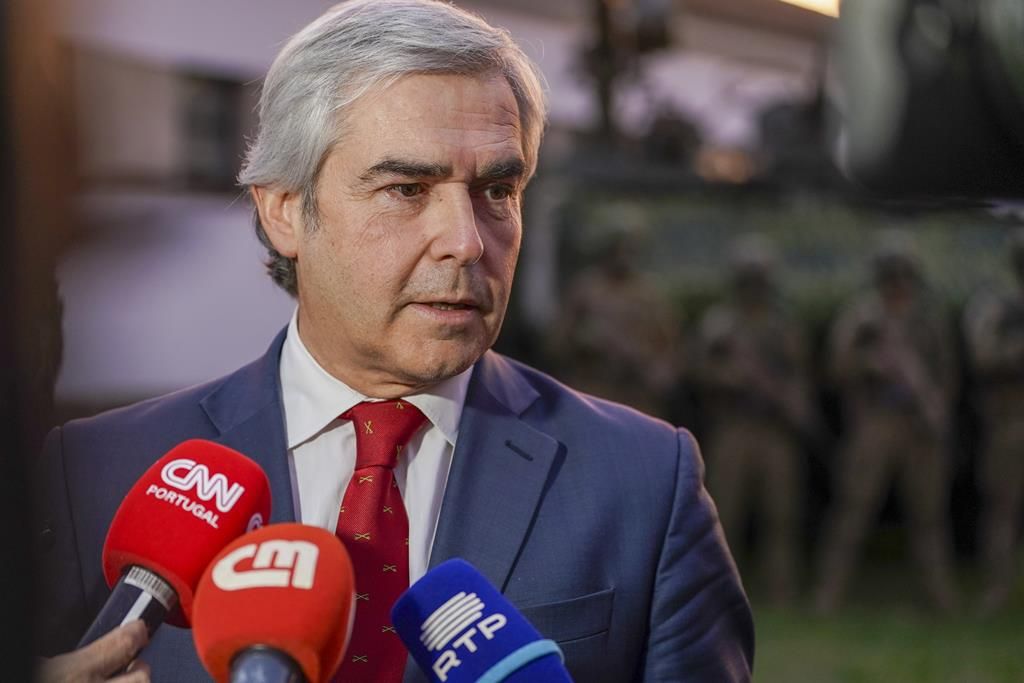
Speaking to journalists at the end of a meeting of NATO defence ministers in Brussels, Nuno Melo said that "a large part of the global economy" depends on free navigation in the Strait of Hormuz and indicated that Portugal is "studying the possibility" of strengthening its participation in naval operations in the Middle East.
The Minister recalled that Portugal has already participated in the EU naval operations Aspides in the Red Sea and Atalanta in the Indian Ocean.
“And we are considering the possibility of reinforcement at three levels. One: personnel, at headquarters. Second: in terms of mine control, including unmanned vehicles that will be delivered, if decided in due course. And also, with the possibility of using national information collected via satellite and underwater for this effort,” he stated.
Nuno Melo indicated that “all of this is being considered and will be brought to the Superior Council of National Defence in due course so that it can be decided, in accordance with the law.”
Asked if this means that Portugal could participate in mine clearance operations in the Strait of Hormuz, the Minister of National Defence replied: “If the conditions are met, Portugal could, with our capabilities, participate in this effort.”
“With our capabilities, not beyond them,” he added.
Eventual Portuguese participation
Regarding whether this eventual Portuguese participation in the Strait of Hormuz would be carried out under the initiative of France and Germany, which aims to guarantee free circulation in that maritime route, the Minister said it will be done within the framework of the “collective effort” being requested of NATO Allies.
Regarding possible reinforcement of human resources for EU naval operations in the Middle East, Nuno Melo said that the numbers have not yet been defined.
“At this moment, the study is underway, involving, as is expected, the General Staff of the Armed Forces, after consulting the branches which, in the advice they provide, will then justify the proposal that will be presented to the Superior Council of National Defence by the Government,” he indicated.
In addition to this reinforcement in the Middle East, Nuno Melo also indicated that Portugal had authorised joining a Norwegian initiative “for the defence of the Atlantic,” which includes “several countries,” among them Canada and “the main European Atlantic countries.”
“And Portugal will also be there, with its capabilities, in a collective effort,” he said.
Finally, regarding allies in Eastern Europe, the Minister of National Defence said that Portugal is currently present in “four countries” and is also “studying the possibility of strengthening its participation, namely by accepting a request from the Romanian Government, regarding a growing threat from ‘drones’”.
“And Portugal is studying the possibility of reinforcing its presence in Romania with capabilities in all fields,” he said.
On 18 June, upon entering the NATO meeting, the United States Secretary of War, Pete Hegseth, indicated that Washington will review its military presence in Europe in the next six months. Nuno Melo said that the Americans “are largely withdrawing from their capabilities, relegating to the Europeans the obligation to ensure their collective defence”.
“And Portugal is up to this challenge,” he said.
 Add as a preferred source on Google





 Portugal Handbook
 English
 Nederlands
 Deutsch
 Français
 Español
 Italiano
 Svenska
 Pусский
 中文
中文 Türkçe
 Português
 Czech
Czech Hungarian
 Polski
 عربي
عربي Suomi
Suomi עִברִית
 Português (Brasil)
Follow us on social media