


Within the past couple of decades, technology has become increasingly more advanced. Gen Z, Gen Alpha, and to an extent, Millennials, have grown up surfing the waves of tech innovation, often leaving older generations standing at the shore.
“Built-by-young-people-for-young-people” technologies have unwittingly overlooked entire demographics: the generations who grew up before the internet was introduced.
“In recent years, a new category building towards more inclusion has emerged. Cleverly named “AgeTech”, it joins well-established categories such as FinTech, HealthTech, and FoodTech, providing technologies specifically aimed at older generations.”
Technology adapting to people
One such technology is the AI app, PeterAI, founded by Kolya Moustafa, in collaboration with the venture studio, Phira Ventures.
With the global population aging due to longer life expectancies, PeterAI seeks to solve what they describe as a universal problem: “All of us, we will need to care for our parents and grandparents more now; we will need to make sure that they stay safe, we will need to make sure that they can still engage with digital technology, because disengagement with digital tech leads to isolation and frustration,” Kolya Moustafa says.
One of his core beliefs is that technology should adapt to people, not force people to adapt to technology. He argues that when elderly people lose confidence in their ability to use technology, it leads to isolation: “You can see that especially in older adults, loneliness is a very present topic, and we hope that with this you’re able to connect with your family and friends on a note that isn’t transactional, but actually unconditionally loving.”
Designed for “older folks"
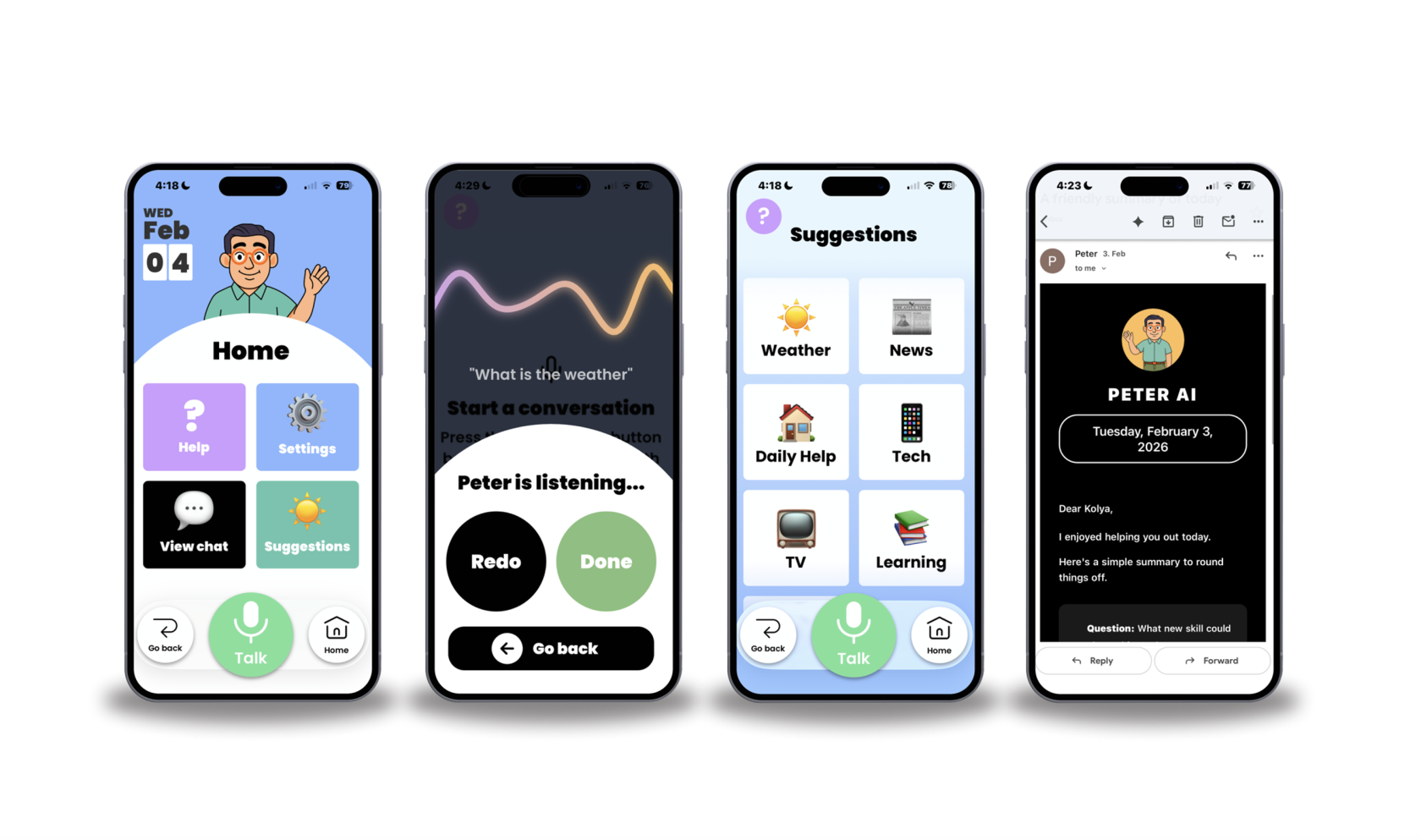
PeterAI is deliberately built to accommodate the needs of older generations. For starters, it does not require a password. With each login, a code will be sent directly to the user’s phone, averting the stress of memorising passwords.
PeterAI is designed with large buttons and voice-based interaction rather than typing: “Being confident using your phone is not easy, especially if you’re typing. We have this on speaking instead of typing. If you have to fight your keyboard every time you send a message to your loved ones, that’s frustrating,” Moustafa explains.
Every day at 6 pm, an email will be sent to the user with a summary of that day’s interactions. As the beta user, Frank Baltz, who has been on board since the beginning, describes it, the daily summary email is “… reminding you that Peter is there for you.”
Baltz has expressed overall excitement with PeterAI, comparing it to ChatGPT, “just for older folks,” as he says, while highlighting the interface with big buttons and the simple built-in dictation.
Instant call support is available through the app, and eventually, Moustafa wants this to be a twenty-four-hour feature. Never automated robot voices, but actual human beings picking up the phone: “It’s very human to human in that sense. That’s what it boils down to. Philosophy and ethics,” he says.
The digital confidence gap
Beyond usability, PeterAI also runs online seminars focused on digital safety and literacy. The ‘Staying safe online’ seminar centres on building habitual routines for digital confidence: “I always say it’s the habits. All these small things, these are habits, and Peter can help you build those,” Moustafa argues.
As he explains: “Confidence is built just iteration after iteration, and most of these iterations are failures, right? They have now failed so much that they need a success, and Peter feels intuitive and allows them to have tech that works for them without a steep learning curve."
A startup built between cultures
PeterAI was built at the Portuguese venture studio, Phira Ventures, which is based in Lisbon and New York. Their European anchor is in Portugal, and as Moustafa describes it, there are many positives to starting a business here: “It’s just a very fast-moving country. A lot of innovators are here. The community is very great in the sense that you can enter it easily.”
Moustafa praises Portugal’s entrepreneurial scene as highly international, which, in his words, creates better grounds for achieving great results: “I think, and I truly believe, that international opinions, and people, bring a more faceted and layered perspective that just accelerates the innovation.”
Innovation benefits from cultural exchange: “All this plays together to something that’s enabling us to achieve something greater than just one country or one culture,” he says.
Human Connection in the Age of AI
With the drastic rise of AI tools, there have been rising concerns that AI assistance will eventually replace human interaction overall. To Kolya Moustafa, it is crucial to differentiate between a companion and an assistant: “I want AI enabling us to have human-human connections. And I think that’s the way AI can enable us to do something, because the human-human connection is so much more important.”
At its core, PeterAI is not really about technology, but about reclaiming time: time otherwise lost to digital tasks, fixing settings and explaining apps, and giving it back to conversations, closeness and moments shared between generations.
For the founders, the goal is not to make elderly people “better at tech,” but to make technology secondary, so families can spend less time playing IT support and more time simply being together.
 Add as a preferred source on Google







 Portugal Handbook
 English
 Nederlands
 Deutsch
 Français
 Español
 Italiano
 Svenska
 Pусский
 中文
中文 Türkçe
 Português
 Czech
Czech Hungarian
 Polski
 عربي
عربي Suomi
Suomi עִברִית
 Português (Brasil)
Follow us on social media