


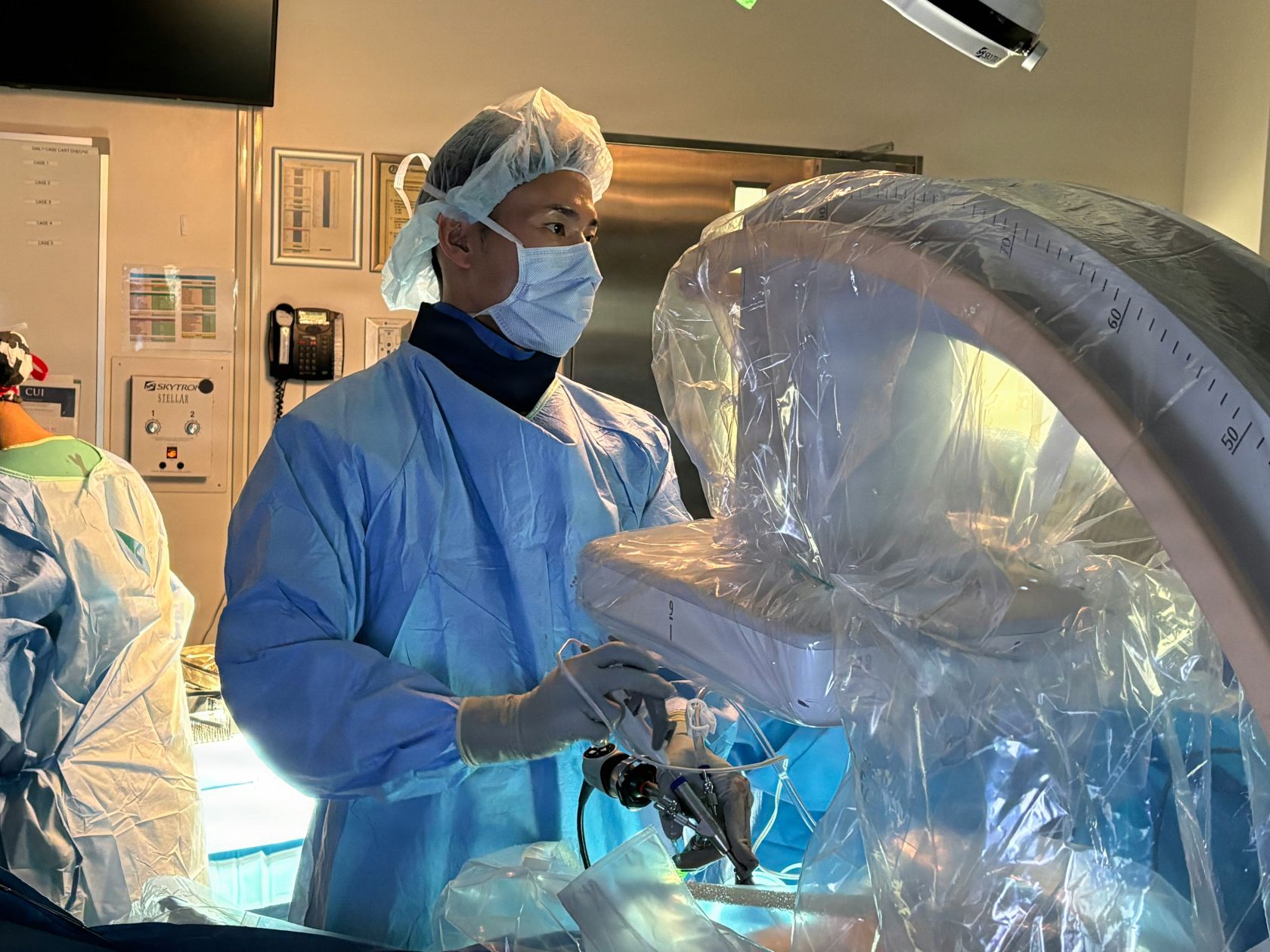
The operation successfully removed a tumour that was threatening the sight of 48-year-old Rhys Hibbert while protecting the nerves and blood vessels surrounding it.
The University College London Hospitals NHS Foundation Trust announced that the procedure was carried out at the National Hospital for Neurology and Neurosurgery in London as part of a clinical trial.
During the operation, the AI system analysed the live video from an endoscopic camera and highlighted important structures at the base of the brain. This helped the surgical team identify areas to avoid while removing as much of the tumour as safely possible.
Unlike systems that work from scans taken before an operation, the technology tracked what was happening inside the patient’s brain in real time. However, the surgeon remained fully in control throughout the procedure, with the AI acting as an additional guide.
The tumour was located on Hibbert’s pituitary gland, close to major blood vessels and the nerves responsible for vision. In this part of the brain, even a difference of one millimetre can result in blindness, a stroke or other serious complications.
Tumour discovered after sudden collapse
Hibbert’s tumour was discovered in December 2024 after he lost consciousness while out walking and suffered a seizure.
Tests revealed an 11-millimetre tumour on his pituitary gland. Although he did not initially require surgery, his condition became worse over time, causing hormone problems, tiredness and loss of peripheral vision.
His sight deteriorated to the point that he repeatedly tripped over objects and began using walking sticks.
Following the operation, Hibbert said his vision improved dramatically. Within a week, he was able to walk independently without glasses or sticks and is now recovering at home.
Trained using previous operations
The AI system was developed by the Hawkes Institute at University College London and was trained using hundreds of videos from previous pituitary tumour operations.
Researchers marked nerves, blood vessels and other important structures in the videos, helping the technology learn what to look for during a live procedure.
The system had previously been tested in laboratories and used as a training tool for surgeons, but this was the first time it had provided real-time assistance during an operation on a patient.
The clinical trial was funded by the UK’s National Institute for Health and Care Research and Google, with support from several medical and research organisations.
Set The Portugal News as your preferred source for news on Google
 Add as a preferred source on Google








 Portugal Handbook
 English
 Nederlands
 Deutsch
 Français
 Español
 Italiano
 Svenska
 Pусский
 中文
中文 Türkçe
 Português
 Czech
Czech Hungarian
 Polski
 عربي
عربي Suomi
Suomi עִברִית
 Português (Brasil)
Follow us on social media