



When people consider establishing residence in another country, tax is often reduced to a single figure: the top rate of income tax. It is a reasonable starting point, but it leaves a great deal out. A new briefing from Global Citizen Solutions' Global Intelligence Unit, Tax Optimization for Global Citizens, compares 48 jurisdictions across 11 measures, from income and inheritance tax to what happens when residence ends.
Five findings stand out.
A lower rate does not always mean a lower tax position
Uruguay's top rate of income tax is 36%, close to rates across much of Western Europe. Hungary's is 15%. On rates alone, Hungary would appear the more favorable choice. In the briefing, however, Uruguay ranks 12th and Hungary 31st.
The difference lies in what each country taxes. Uruguay generally does not tax income earned abroad, which is a key reason it records the strongest score in the study for how its tax system is designed. Hungary taxes residents on their income from anywhere in the world and offers few benefits to new arrivals.
For individuals whose investments or business interests sit in more than one country, what the rate applies to can matter more than the rate itself.
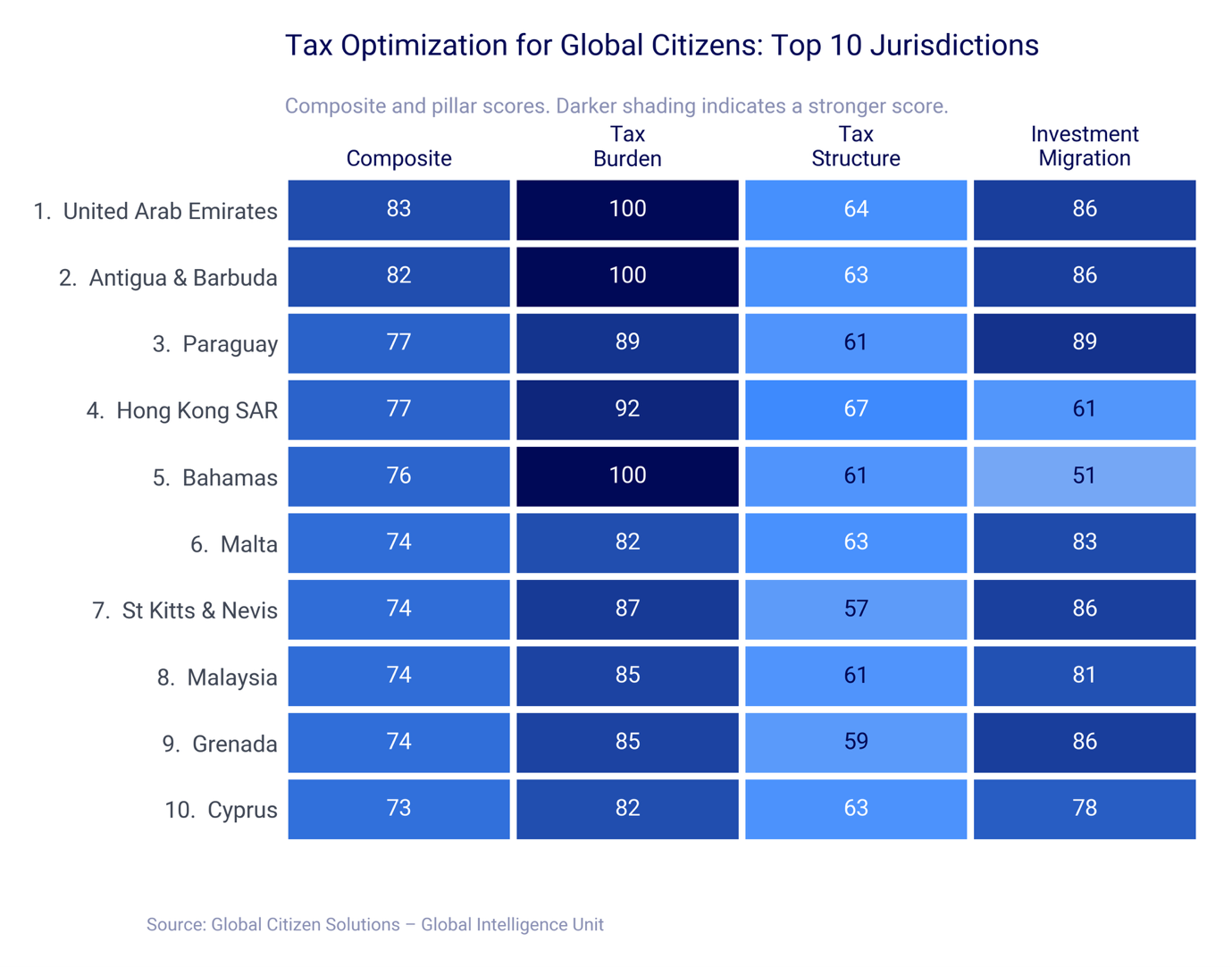
The treatment of foreign income varies widely
Countries take very different approaches to income earned abroad. Some, including the United Arab Emirates and the Bahamas, levy no personal income tax. Others, such as Uruguay, Paraguay and Malaysia, tax only income earned within the country. Malta taxes foreign income only when it is brought into the country.
Portugal taxes residents on their worldwide income, as do most jurisdictions in the briefing. Like Cyprus, Italy and Greece, Portugal also offers a special regime for qualifying new residents. The regime, known as IFICI, provides a 20% flat rate on eligible Portuguese income for up to 10 years, alongside an exemption on most foreign-source income. It is aimed at professionals in areas such as research, innovation and startups, and pension income does not receive preferential treatment.
Regimes of this kind can be valuable, but they differ from a country's standard tax rules. They typically apply for a defined period, require an application, and can be revised by the government that introduced them. Italy, for example, has changed the cost of its regime twice in nine years. When a regime forms part of a plan, it is worth considering how long it will apply and what the position will be once it ends.
A residence permit and tax residence are separate
A residence permit, such as a Golden Visa, grants the right to live in a country. It does not in itself make the holder a tax resident. Tax residence usually depends on time spent in the country, typically around 183 days a year.
Seven of the ten jurisdictions leading the briefing's residency and citizenship program rankings have no minimum stay requirement. Residence rights can therefore be held without a change in tax position. For many families, this is part of the value of a residency program: it provides another option, available if and when they choose to use it.
The rules on leaving matter as well as arriving
Some countries apply an exit tax when an individual ends their tax residence. This treats the departure as if the individual's assets had been sold, taxing gains that have built up but have not been realized.
The briefing finds that 31 of the 48 jurisdictions impose no exit tax, while 17 apply some form of it. Spain, France and Germany apply broad versions. Portugal and the United Kingdom apply narrower ones.
For individuals holding shares, a business or other assets that have grown in value, the timing of a move can matter as much as the destination. Because the rules of both countries interact, qualified tax advice in each jurisdiction is an important part of the planning.
Tax and quality of life rarely align, with some notable exceptions
The briefing compares its findings with quality-of-life data from the Global Passport Index 2026. In general, the more favorable a jurisdiction's tax position, the lower it tends to rank on quality of life.
However, seven jurisdictions score well on both: Malta, Cyprus, Uruguay, Costa Rica, Mauritius, Switzerland and Portugal. Of these, Portugal ranks highest for quality of life, at 11th in the world.
None of the seven achieves its position by charging no income tax. Each attracts international residents through the way it treats foreign income, while continuing to fund public services through taxation.
Different circumstances, different priorities
What matters most also depends on the individual. For those with significant wealth, inheritance tax can outweigh income tax. France charges up to 60%, Japan 55% and Germany 50%, while none of the top 13 jurisdictions in the study applies it.
For retirees, pensions, healthcare, cost of living and consumption taxes tend to carry more weight. For remote professionals, the treatment of foreign income is often decisive. Income is usually taxed according to where the work is performed rather than where clients are based. Living in one country while serving clients in another does not automatically make that income foreign.
Part of a wider plan
A decision about residence can affect how income is taxed, how assets are held, how wealth passes to the next generation, and what options a family has if circumstances change. These questions often involve several specialists, from tax experts and lawyers to private banks and residency and citizenship advisors. Global Citizen Solutions is a residency and citizenship planning advisory firm, helping high-net-worth clients and their families secure greater control over where they can live, travel, do business, and operate across jurisdictions.

The Wealth & Migration Summit, taking place in Lisbon on November 5–6, will bring these perspectives together. Topics include the competition between Portugal and the UAE for global capital, what is changing for Golden Visas in Europe, succession and cross-border tax planning for international families, and why families choose Portugal.
For anyone considering Portugal, or any other jurisdiction, the most useful questions are these. What does the system tax? How does it treat income and assets held abroad? What happens when residence begins and when it ends? How do those rules fit the family's longer-term plans? The headline rate is one part of that picture.
Contacts:
Eleanor Legge-Bourke
Eleanor@globalcitizensolutions.com
Set The Portugal News as your preferred source for news on Google
 Add as a preferred source on Google






 Portugal Handbook
 English
 Nederlands
 Deutsch
 Français
 Español
 Italiano
 Svenska
 Pусский
 中文
中文 Türkçe
 Português
 Czech
Czech Hungarian
 Polski
 عربي
عربي Suomi
Suomi עִברִית
 Português (Brasil)
Follow us on social media