


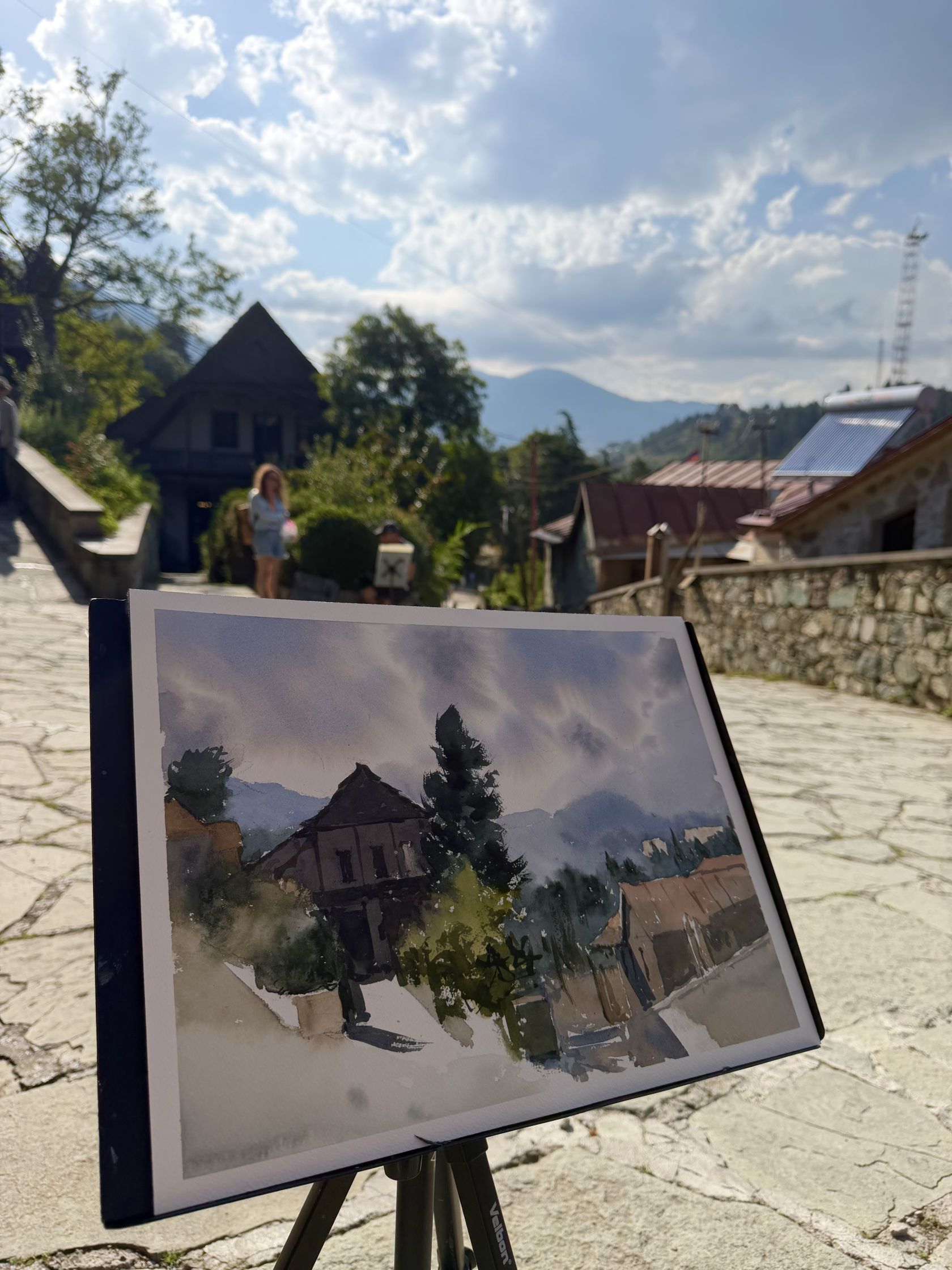
After years of painting and teaching, and most recently attending the international Colors of Armenia Watercolor Festival, I have come to appreciate that the difference goes far beyond materials. Oil and watercolour offer two entirely different ways of thinking, observing and responding to the world.
Oil Painting: The Luxury of Time
Oil painting is wonderfully patient. Its slow drying time allows artists to blend colours, soften edges, adjust proportions and reconsider decisions. A painting can remain workable for hours or even days.
For beginners, this flexibility is a tremendous advantage. A mistake is rarely a disaster. An unsuccessful passage can be scraped away, corrected or painted over. You have time to observe, compare and gradually build your composition.
Oil also offers extraordinary possibilities for depicting light and texture. Its rich pigments can create deep shadows, delicate skin tones and brilliant highlights. You can paint light over dark, build transparent glazes or apply thick, sculptural brushstrokes.
There is something deeply satisfying about this process. You construct an image gradually, almost like building a sculpture with colour.
But oil painting requires patience, space and a certain commitment to materials. Paintings take time to dry, brushes need careful cleaning, and some traditional solvents require appropriate ventilation. Fortunately, solvent-free techniques and water-mixable oils offer practical alternatives.
Watercolour: The Art of Letting Go
Watercolour introduces an entirely different relationship with control.
Unlike oil, watercolour moves quickly. Pigments travel across wet paper, colours merge unexpectedly, and a single brushstroke can create an entire landscape.
Once a wash has dried, substantial corrections become difficult. Some pigments can be lifted, but the original white of the paper is not always recoverable.
This changes the artist’s thinking. You must anticipate rather than endlessly correct.
Watercolour also has a remarkable relationship with light. In traditional transparent watercolour, the white paper becomes the brightest element of the painting. Transparent layers allow light to reflect through the pigment, producing an extraordinary luminosity.
A beautiful watercolour often appears effortless. Yet achieving that simplicity requires considerable observation, preparation and confidence.
And perhaps that is its greatest lesson: learning to recognise which details matter and which can disappear.
Armenia: Five Days of Learning to See
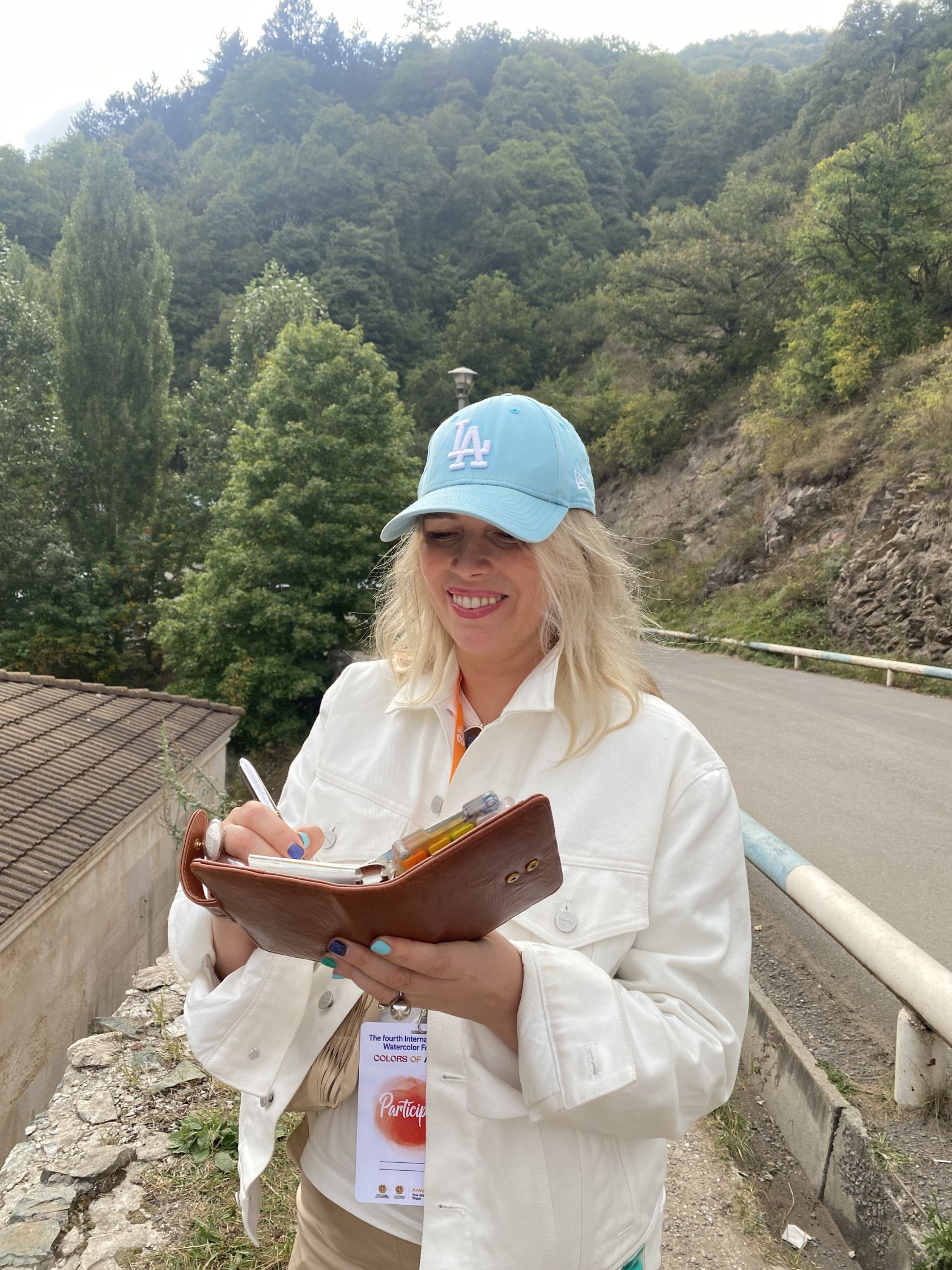
I recently experienced this difference at the Colors of Armenia Watercolor Festival, surrounded by extraordinary international artists whose approaches challenged my understanding of the medium.
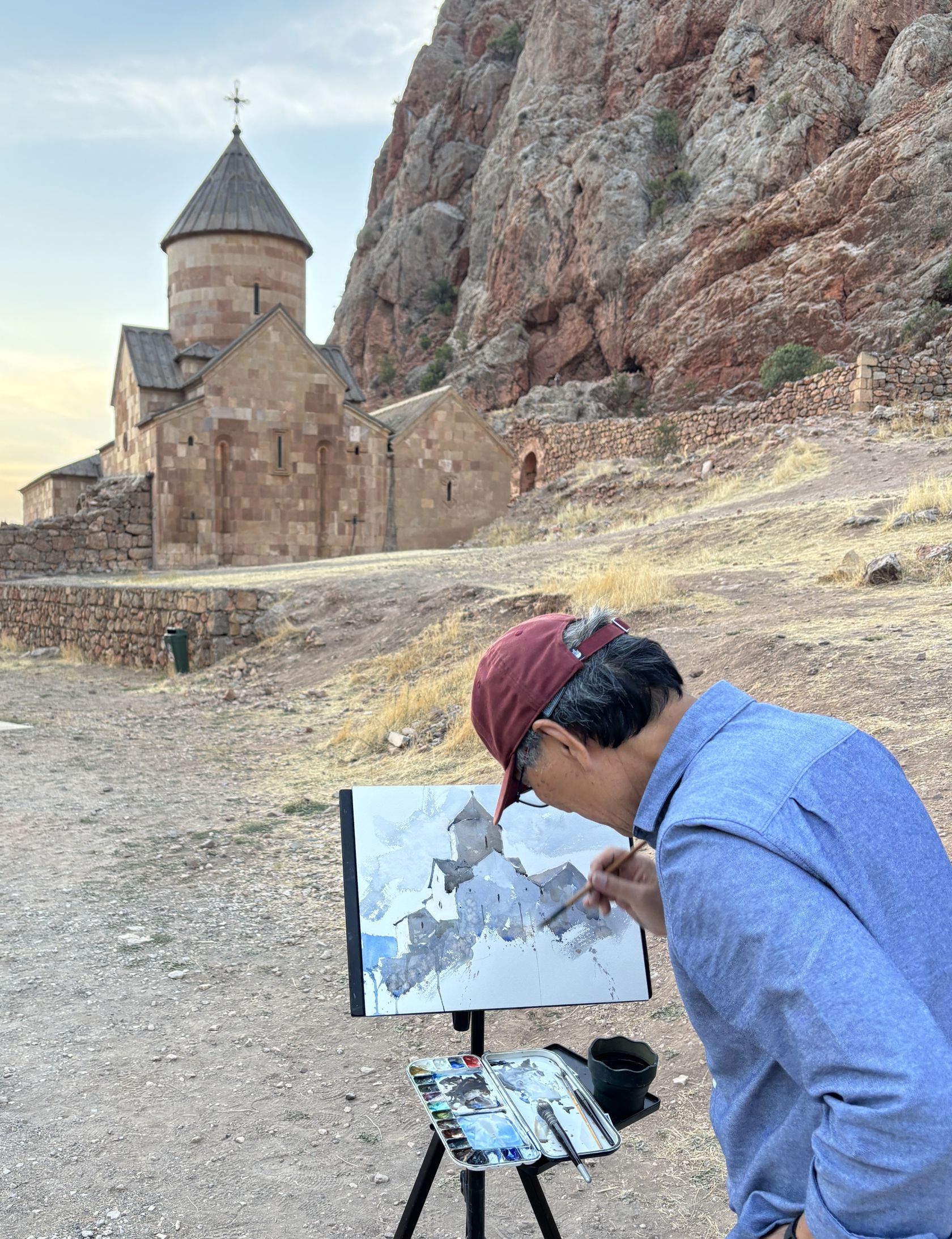
Watching Chinese master Liu Yi was particularly fascinating. Every brushstroke seemed carefully considered: its direction, weight, moisture and relationship with the surrounding white paper. His delicate colour transitions and economical compositions reminded me of the influence of traditional Chinese ink painting.
Other artists demonstrated entirely different approaches. André Kano captured changing light with remarkable ease, while Kapoor’s powerful painting posture revealed just how physical and expressive watercolour can become.
The festival also took us beyond the studio, into Armenia’s extraordinary landscapes.
At Garni, monumental classical architecture rises above a dramatic volcanic gorge. Nearby, the Symphony of Stones presents an astonishing natural composition of towering basalt columns. At Lake Sevan, ancient stone churches overlook vast expanses of blue water.
For a painter, these landscapes are lessons in contrast: hard stone against soft clouds, warm earth against cool mountains, architectural geometry against organic forms.
One important discovery was that plein air painting does not require us to reproduce everything directly in front of us. We can observe, collect impressions and create our own composition, combining observation with imagination.
Sometimes, understanding a landscape means simplifying it rather than recording every detail.
Which Medium Should You Choose?
My advice to beginners is to consider not only what they want to paint, but how they enjoy working.
Oil painting encourages sustained observation, experimentation and revision. Watercolour develops anticipation, decisiveness and an ability to respond to unexpected results.
Neither guarantees an easier artistic journey. Both demand an understanding of drawing, composition, colour and tonal relationships.
Their practical differences, however, are significant. Oil painting generally benefits from a dedicated workspace, while an entire watercolour studio can fit into a small travel bag.
For anyone who enjoys travelling, watercolour offers extraordinary freedom. A sketchbook, a few pigments and a brush are enough to transform a café terrace, a Portuguese fishing village or an Armenian mountain into a personal artistic experience.
Two Mediums, One Creative Mind
Perhaps the most interesting discovery is that these techniques complement each other.
Oil teaches us to construct. Watercolour teaches us to anticipate. One encourages revision; the other invites us to embrace unpredictability.
Both train our ability to observe relationships between colours, shapes, light and shadow. Both demand concentration and reward curiosity.
At Algarve Arts Academy, we encourage students to experiment with different materials rather than immediately committing to one medium. Discovering your artistic language is part of the pleasure of learning.
After Armenia, I returned with a renewed appreciation for watercolour and a simple reminder: painting is not merely about reproducing what we see. It is about learning to see more.
And once you begin looking at the world through an artist’s eyes, even an ordinary landscape becomes extraordinary.
By Julia, artist, educator and founder of Algarve Arts Academy
Set The Portugal News as your preferred source for news on Google
 Add as a preferred source on Google






 Portugal Handbook
 English
 Nederlands
 Deutsch
 Français
 Español
 Italiano
 Svenska
 Pусский
 中文
中文 Türkçe
 Português
 Czech
Czech Hungarian
 Polski
 عربي
عربي Suomi
Suomi עִברִית
 Português (Brasil)
Follow us on social media