


Throughout the Giardini, textiles, weaving, embroidery, ceramics and handmade objects appear with extraordinary confidence.
Techniques once too easily separated from the world of “serious” contemporary art are being used as sophisticated artistic languages — carrying ideas about identity, memory, ecology, politics and cultural inheritance.
Craft, it seems, is having a remarkable second life.
For decades, contemporary art sometimes appeared determined to move away from craftsmanship towards pure concept. Now the two are finding each other again.
The hand matters. Material matters. Skill matters. But the idea matters too.
Perhaps this isn’t really a return to craft at all.
Perhaps it is its reinvention.
At the same time, sculpture, installation and performance are occupying more and more territory. Together, these tendencies suggest something exciting: art is becoming intensely physical again.
We are moving beyond the idea of an artwork as simply an image to look at.
An artwork can be something you enter, hear, touch, walk around or experience unfolding in time.
And somewhere between the pavilions, I had a rather personal realisation.
Watching sculpture, installation and performance occupy so much space at one of the world’s most important contemporary art events, I understood that we had made the right choice at AAA by increasingly bringing these disciplines into our own academic programme and events.
We have been experimenting with exactly this idea: art education doesn’t have to finish with a painting hanging on a wall.
Our Ocean Harp brings visual art together with live classical harp and an ocean-inspired environment. All Senses Night goes further, bringing together art, music, atmosphere, space and audience participation.
Students and visitors are invited not simply to look at art, but to experience it.
Seeing those same boundaries dissolving on the international stage in Venice was wonderfully reassuring.
The Biennale brought another unexpected connection.
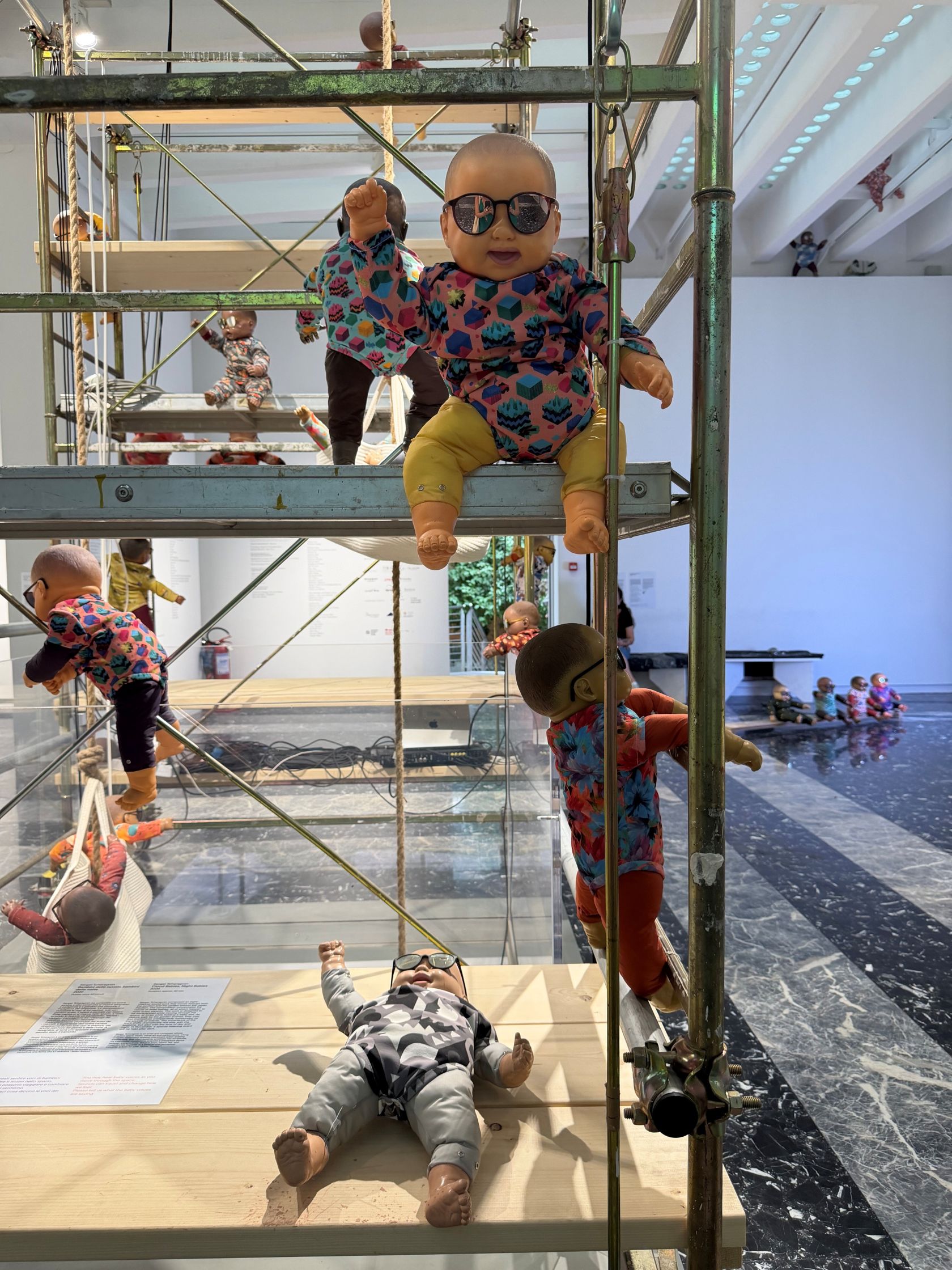
At the Japan Pavilion, Ei Arakawa-Nash’s brilliantly eccentric Grass Babies, Moon Babies gives visitors baby dolls to carry through the exhibition — a playful but surprisingly emotional exploration of care and responsibility.
This September at AAA, we are also turning towards Japan, building a Japanese arch as part of our academic programme.
Ours will, admittedly, be a considerably more traditional interpretation.
No crazy babies planned. At least not yet.
There is a serious idea behind the joke.
Young artists need strong foundations: drawing, composition, colour, observation and craftsmanship remain essential. But those foundations should give them the confidence to cross boundaries afterwards.
A painter can think like a sculptor. A sculptor can work with sound. A ceramicist can create an installation. A musician can become part of a visual artwork.
This is where I believe art education is heading.
The future of art education should not only teach young artists how to make an object. It should teach them how to create an experience.
Sometimes travel introduces an entirely new idea.
And sometimes you travel thousands of kilometres only to discover that the direction you have already chosen feels exactly right.
Julia Gurchenkova, MFA, is the founder of AAA, an artist, curator and educator with over 15 years in the creative industries and experience mentoring hundreds of artists. Her work explores how strong artistic foundations can coexist with contemporary practice and experimentation.
Follow her art and education projects on Instagram @uolja.
Main image caption: Inside the Japan Pavilion at the Venice Biennale: Ei Arakawa-Nash’s wonderfully surreal Grass Babies, Moon Babies, where visitors become part of the artwork by carrying babies through the installation — one of the most playful and unexpectedly touching experiences in the Giardini.
Set The Portugal News as your preferred source for news on Google
 Add as a preferred source on Google






 Portugal Handbook
 English
 Nederlands
 Deutsch
 Français
 Español
 Italiano
 Svenska
 Pусский
 中文
中文 Türkçe
 Português
 Czech
Czech Hungarian
 Polski
 عربي
عربي Suomi
Suomi עִברִית
 Português (Brasil)
Follow us on social media