


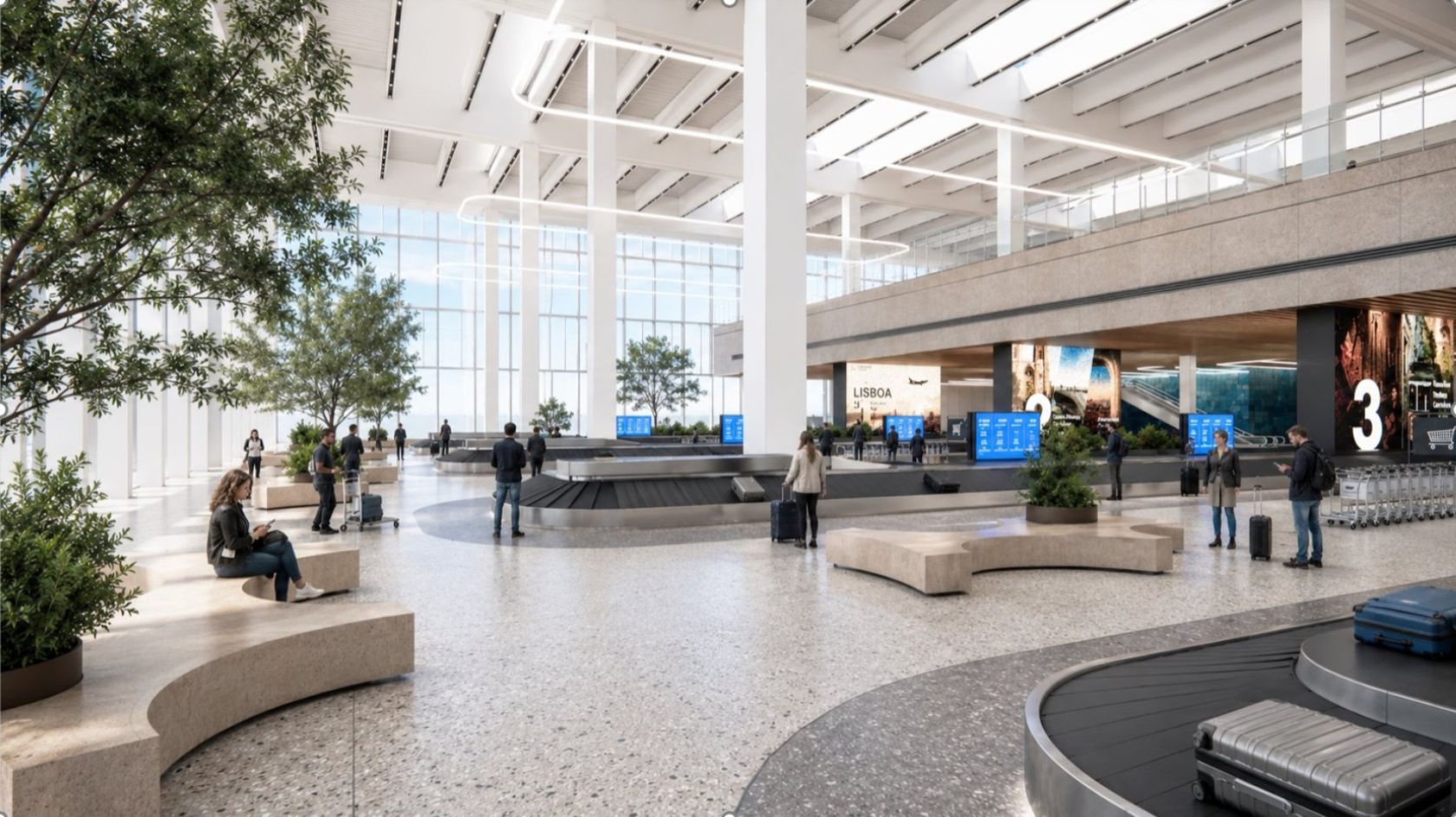
The document, designated as the Technical Report, consolidates the results of the preliminary design stages, detailing the functional program, operational capacity, multimodal connectivity, and long-term structural solutions.
The public presentation, held at the Belém Cultural Centre, marks the submission of the third report within the concessionaire’s proposal process, strictly adhering to contractual deadlines and paving the way for the Government to conduct preliminary studies and further architectural development.
Net Zero facility
The new infrastructure, designed as a Net Zero facility featuring high environmental sustainability standards and advanced technology integration, will launch operations with two runways, 64 boarding gates, 72 air bridges, and a passenger terminal spanning approximately 500,000 square metres.
At opening, the airport will have the capacity to handle 56 million passengers annually, with phased expansion planned to accommodate up to 85 million in subsequent decades.
To facilitate the project, preparatory actions are already underway, including the phased demilitarisation of the Firing Range by 2029, airspace reorganisation, and the installation of essential utility and telecommunications networks.
Accessibility network
The plan also includes an extensive accessibility network, notably a high-speed rail link that will enable the journey between the airport and Lisbon’s city centre to be made in about 20 minutes via the Third Tagus Crossing, alongside the construction of over 250 kilometres of new roads and the upgrading of 50 kilometres of the existing network.
Concurrently, the concessionaire will continue investing in the modernisation of other national airports, encompassing the expansion of Terminals 1 and 2 in Lisbon, runway renovation and a new control centre in Porto, as well as infrastructure improvements in Faro, Madeira, and the Azores.
The updated plan introduces significant changes regarding costs and implementation timelines. As reported by industry sources and news agencies such as Lusa, Euronews, and 24notícias, the investment estimate has been adjusted to a range of €7.9 billion to €8.9 billion (in 2024 prices), updating the single €8.5 billion forecast put forward in the preliminary report.
More precise identification of costs
According to Thierry Ligonnière, CEO of ANA, this report allows for a more precise identification of costs and project phasing. The new schedule anticipates construction beginning in 2029 and concluding in 2033, enabling the operational opening, following testing and certification, to be brought forward to 2035; this replaces the initial 2037 timeline.
The Minister of Infrastructure and Housing, Miguel Pinto Luz, and the Chairman of ANA, José Luís Arnaut, described the moment as the fulfilment of a five-decade-old ambition.
Regarding financing, the concessionaire plans to raise approximately seven billion euros through debt issuance, in return for a phased increase in airport charges at Humberto Delgado Airport between 2026 and 2030, as well as a 30-year extension of the concession, running until 2092, to ensure the project's economic sustainability without cost to the public purse. However, the Government intends to review these contractual terms to mitigate the impact of fees on airlines.
In the short term, the process will continue with the submission of the nearly 5,000-page Environmental Impact Study to the Portuguese Environment Agency by the end of July, followed by the presentation of the financial report on 17 January 2027, and the submission of the complete, definitive application in January 2028.
Set The Portugal News as your preferred source for news on Google
 Add as a preferred source on Google








 Portugal Handbook
 English
 Nederlands
 Deutsch
 Français
 Español
 Italiano
 Svenska
 Pусский
 中文
中文 Türkçe
 Português
 Czech
Czech Hungarian
 Polski
 عربي
عربي Suomi
Suomi עִברִית
 Português (Brasil)
Anyone who has lived in Portugal for more than a few months should laugh at the 2035 opening date. They will be very lucky to open by 2045 and even that is likely overly optimistic.
By Jeff from Lisbon on 23 Jul 2026, 10:42