


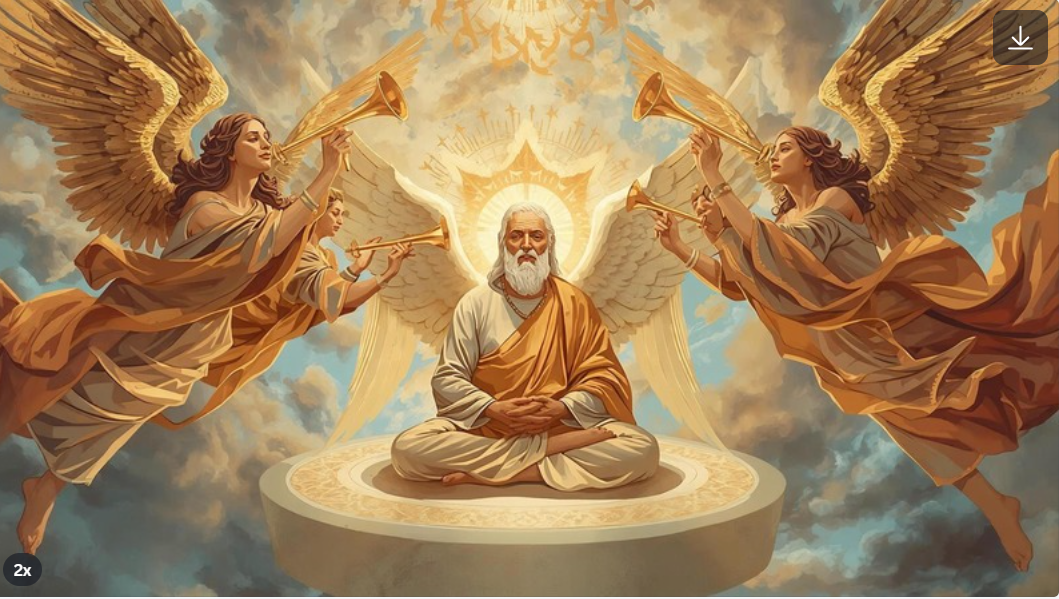
You cannot evaluate a teacher’s quality by the trumpet fanfare from the advertising angels heralding his coming. Some ‘masters’ appoint a publicity agent and others operate quietly and unobtrusively, working personally with their students. The attainment and loving rapport of a lesser-known teacher may well be worth much more to you than the famous guru you must pay vast sums to see from afar. But in any case, we have to realise that both need some kind of financial support.
One is free to choose what seems most reasonable.
No one is obliged to follow the fat cats of Gurudom.
Spiritual enterprise
Many gurus in India are able to teach freely, because they are traditionally supported by the donations of wealthy householders, as are the sadhus (spiritual seekers) still struggling towards enlightenment. The Eastern peoples realise that the cultivation of sages in their midst is of inestimable value to themselves, and thus the world. In the West there are also many teachers who would like to work for nothing, but are obliged to ask a fee, since travel funds, food and housing, taxes, etc., must be found.
Unfortunately, there is no tradition of gifting or supporting a spiritual master in Western society, especially if his vision happens to be outside or beyond the borders of an established religion. He is generally unable to devote himself wholeheartedly to the total awakening of his spiritual potential, being obliged to either set up some semi-commercial spiritual enterprise around himself, or take on some form of worldly work to live by.
Even so, many naive Western seekers tend to feel affronted when their spiritual teacher appears to be even nominally involved in any sort of commerce to survive (thereby labelling him ‘worldly’), and seem to imagine that he should magically exist like a being in a fairytale without the need for money. Yet they are often the last to think of offering anything to ease his burden. Many seem to be under the impression that a teacher’s time is theirs and needs no recompense. This lack of economic support, and the general absence of cultural encouragement, is perhaps a part of the reason why we have had comparatively few mystic masters of distinction in the West.
Judging appearances
We tend to judge our teachers according to our lights, dim as they are. But can we really judge from the appearances of what we see and hear? Some Hindu swamis disdain to touch money at all, snootily considering it ‘vile and dirty stuff’. They may impress the gullible, but are we to take them seriously as holy men, or as neurotics suffering from a form of spiritual one- upmanship? We can also find ascetics vainglorious in their self-mortifications (such as holding one arm in the air for twenty years until it withers like a dried stick), as a means of creating public wonder and support. There are others who take no other food but milk, and are proud of it, adept at the holy game of being ‘more renunciate than thou’. Are these then any more venerable than the money-makers?
In any case, who knows what works a guru may intend to do with his hoarded wealth? We may see him spending it on luxurious hotels and mixing with high society. Does this mean he is a profligate, or is he secretly a ‘Guerrilla of the Inner Planes’ doing ‘undercover’ work where it is most needed, in influencing the leaders of the land? Or perhaps he intends to establish spiritual centres everywhere, or collective farms, orphanages, hospitals and schools. Evidently, some ‘gurus’ may actually be frustrated playboys let loose in the permissive Western world. But is it really our concern?

Is it not the impact of the Master on our lives which matters most? If the love-light in his eyes, or an aspect of his teachings, speaks to us, then we should take that as a gift, and discard anything that does not fit with our perceptions.
Some gurus have mighty mouths and intellectual acumen, but small hearts.
Cultural conditioning
Whatever he does should be related to how we see life within our own psychological make-up and not to what we think he should be or do. It is our choice to take or leave what any guru gives. To try to bind a guru to your preconceived idea is to deny freedom for him and to ignore the opportunity for growth his actions have prompted in you.
There is no ‘ideal’ guru. Even the most illumined sage may act outrageously according to our cultural conditioning. Mahatma Gandhi was known often to sleep between two women as part of his spiritual practice and self-observation. So what seems obvious to outsiders may be something else again. A sage may be doing it to awaken you, or he may have other reasons of his own. In any case, you cannot fathom his motives.
Osho kicked away the crutches of his student’s illusions and walked away laughing.
A real guru is a walking koan.1
And the only answer to it is your own awakening.
Author’s note: This questioner later became an Osho sannyasin.
A koan is a seemingly nonsensical and enigmatic phrase used by Zen Masters to awaken their students to an intuitive awareness beyond the limits of mind and intellect.
Extract from: Sharing the Quest: Revelations of a Maverick Mystic
Find on www.amazon.co.uk /or to avoid the customs problems, get your copy from www.amazon.es
Website: www.muzmurray.org
Set The Portugal News as your preferred source for news on Google
 Add as a preferred source on Google








 Portugal Handbook
 English
 Nederlands
 Deutsch
 Français
 Español
 Italiano
 Svenska
 Pусский
 中文
中文 Türkçe
 Português
 Czech
Czech Hungarian
 Polski
 عربي
عربي Suomi
Suomi עִברִית
 Português (Brasil)
Follow us on social media