


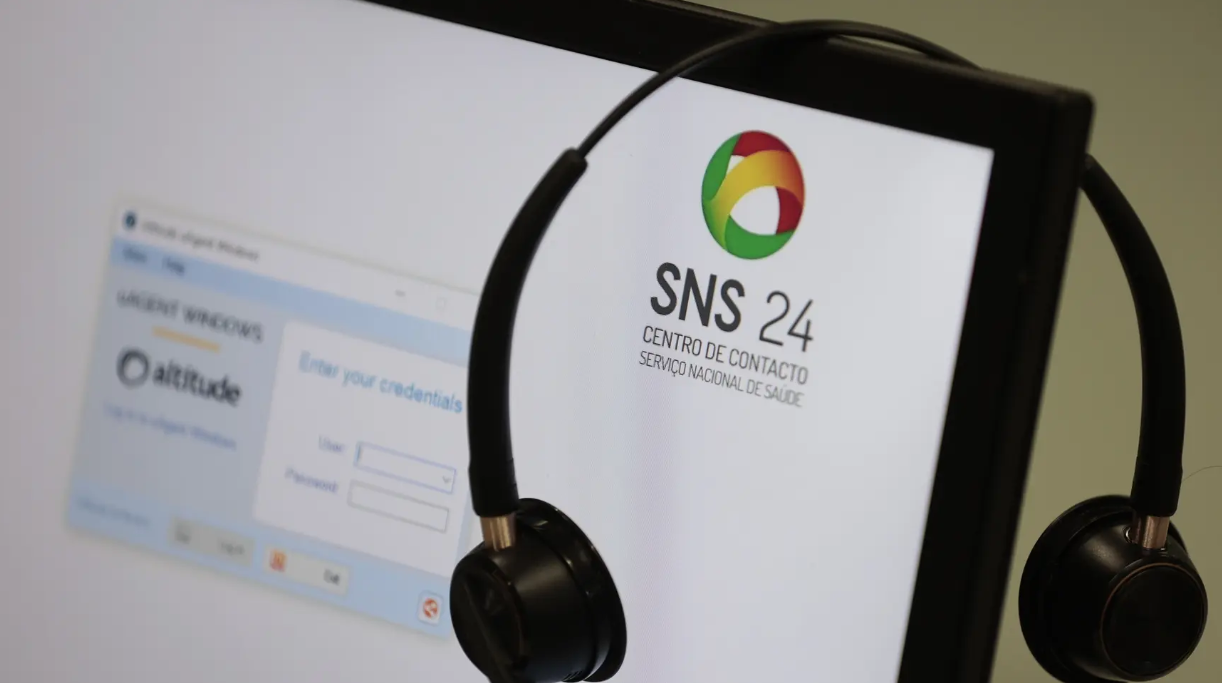
"This will surely be the second highest year ever, after 2021, in the midst of the pandemic, which was a year with an absolutely abnormal demand in which we reached close to nine million calls," the president of the Shared Services of the Ministry of Health (SPMS) told Lusa.
Nine years of operation
This telephone contact centre of the National Health Service (SNS), available at 808 24 24 24, celebrates nine years of operation, after succeeding the then Health Line 24, and is part of a set of services that also include a portal and a mobile application.
In a review of these first nine years, Luís Goes Pinheiro emphasised that what is at stake is "what can be called the true gateway" to the SNS and that it has registered a sustained growth in demand.
In 2025, the number of calls to the SNS 24 hotline reached 5.8 million, and this year, up to July, it has already exceeded four million, an increase of about 17% compared to the same period last year.
"It is expected that, by the end of the year, we will approach or exceed seven million calls," estimated Luís Goes Pinheiro, who chairs the entity that manages the information systems and technological infrastructures of the SNS.
SNS 24 Portal
These numbers are added to those of the SNS 24 portal, with about five million accesses annually, and the mobile application, which has already registered more than 14 million downloads.
The President of SPMS acknowledged that the "Call First, Save Lives" project, implemented in most public hospitals to reduce pressure on emergency rooms, had an impact on the increase in the number of calls, but also attributed this growth to the population's greater awareness of the various services available on the SNS 24.
Reducing demand for emergency services
By reducing unnecessary demand for emergency services, more than half of the users triaged by the line were referred to primary health care, self-care, and even teleconsultations, a new service that started at the end of 2025 and has already ensured more than 130,000 remote consultations with family doctors.
A little older, created in 2020 during the pandemic, the psychological counselling line also recorded about half a million calls, providing people with the "opportunity to talk to a psychologist," Luís Goes Pinheiro added.
To ensure increased demand, as was the case on 20 July with 24,000 calls, the SNS helpline currently has around 5,000 healthcare professionals, more than 3,500 of whom are nurses, with the president of SPMS considering the response capacity to be "quite satisfactory".
Recognising that there are days of the week, periods during the day and times of the year with more intense demand, Luís Goes Pinheiro said that SPMS takes "all complaints and all negative perceptions very seriously", such as those relating to waiting times for calls to be answered.
"What we are doing is preventing these moments of higher demand so that the quality is as homogeneous as possible throughout the week, day and year," said the head of SPMS, adding that the surveys carried out indicate that "92% of SNS 24 users are satisfied or very satisfied" with the operation of the helpline.
Use of Artificial Intelligence
One of the ongoing projects that could be "very transformative" involves the use of Artificial Intelligence (AI) on the line, which is already implemented in the screening of respiratory symptoms, and algorithms are being tested for other situations.
In practice, before a nurse provides care, an AI agent pre-screens the user, "dialogues" with them, and then proposes the appropriate referral to the nurse.
"The agreement rate between the nurse's opinion and the AI agent's suggestion is very high," standing at 86%, highlighted the president of SPMS.
Regarding the contract with Altice, Luís Goes Pinheiro said that it is ongoing and "will continue its execution until its completion," but SPMS is already taking the first steps to launch the new tender to guarantee the provision of the service.
 Add as a preferred source on Google





 Portugal Handbook
 English
 Nederlands
 Deutsch
 Français
 Español
 Italiano
 Svenska
 Pусский
 中文
中文 Türkçe
 Português
 Czech
Czech Hungarian
 Polski
 عربي
عربي Suomi
Suomi עִברִית
 Português (Brasil)
Follow us on social media