


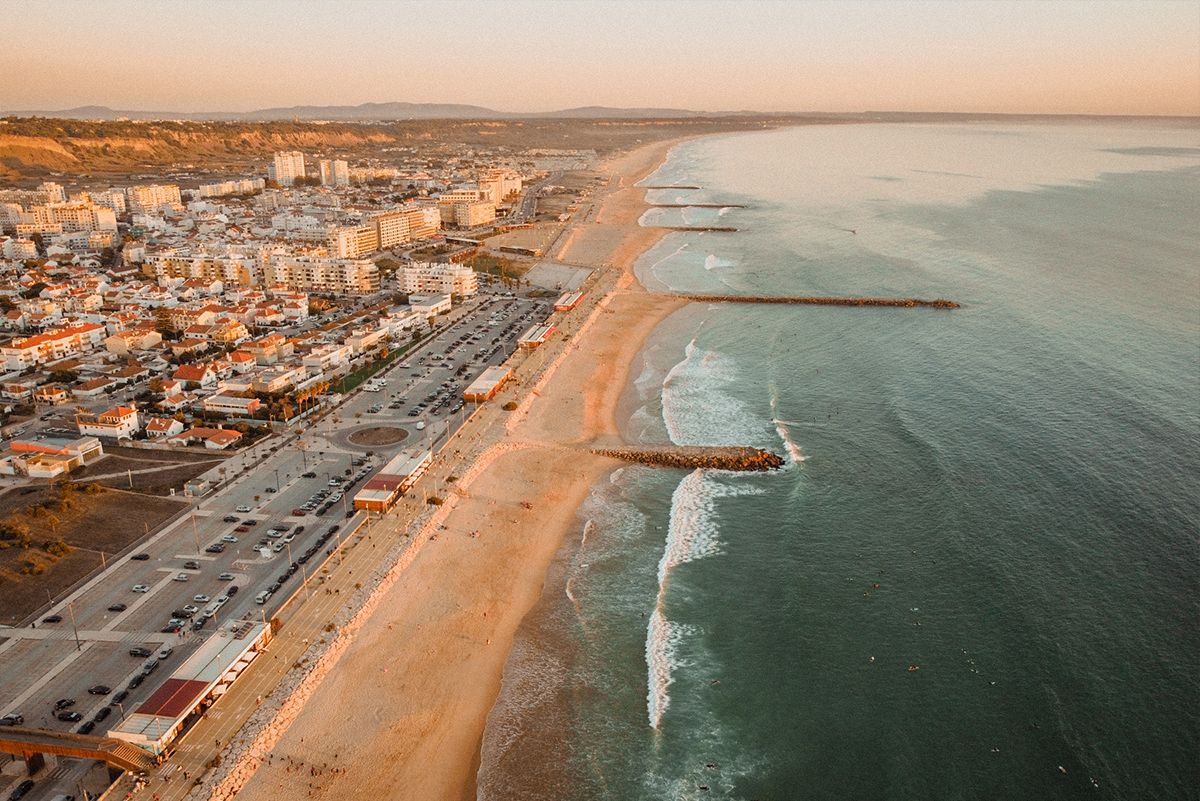
Once primarily associated with summer days by the sea, Costa da Caparica is evolving into a year-round residential destination, combining Atlantic living with proximity to Lisbon. Despite strong price growth over the past decade, property values remain almost 40% below those in the Portuguese capital.
For decades, Costa da Caparica was primarily associated with summer: a place to cross the Tagus, head to the beach and enjoy a slower pace of life. Today, while retaining much of that identity, the area is undergoing a transformation that is increasingly visible in its residential property market.
Located around 17km from central Lisbon, Costa da Caparica offers something that has become increasingly difficult to find so close to a European capital: extensive Atlantic coastline, protected natural surroundings and a more relaxed lifestyle, while remaining within easy reach of the city.
This combination is attracting a broader range of buyers, at a time when the area itself is changing. New hotels, retail and leisure concepts have emerged, while the recent opening of Almada International School has strengthened the international education offer. A significant stretch of the coastline also falls within the Arriba Fóssil da Costa da Caparica Protected Landscape, limiting new construction and helping preserve the area's low-density character and natural environment.
According to Marta Salgado, Sales Director at Athena Advisers Portugal, Costa da Caparica is increasingly being seen as more than a seasonal destination.
“Costa da Caparica is no longer viewed simply as a summer destination. There is growing demand for a lifestyle that offers proximity to Lisbon, but with more space, closer contact with nature and easy access to the sea,” she says.
A significant price gap with Lisbon
This shift has been accompanied by considerable property price growth. According to Confidencial Imobiliário, average prices in the Caparica area have almost tripled since 2015. Yet a significant gap with Lisbon remains.
Across Athena Advisers’ current sales portfolio, which is predominantly focused on the premium segment, average prices stand at €5,956 per sqm in Caparica, compared with €9,548 per sqm in Lisbon, a difference of almost 40%.
For Marta Salgado, this price differential remains particularly relevant given the changes taking place in the area.
“Despite the appreciation already seen, the almost 40% difference compared with Lisbon remains significant. Combined with planned improvements to transport links and the investment coming into the area, this points to interesting potential for buyers entering the market at this stage.”
Transport infrastructure is one of the factors expected to influence Costa da Caparica's future development. In July 2024, Almada City Council, Metropolitano de Lisboa and Transportes Metropolitanos de Lisboa signed an agreement for the extension of the Metro Sul do Tejo to Costa da Caparica. Plans include approximately 7km of new track and 10 additional stations.
This comes alongside other public and private investment on the south bank of the Tagus, including the planned €800 million Innovation District around NOVA University's Monte da Caparica campus.
But, Marta Salgado argues, price alone does not explain the area's growing appeal.
“Several factors are converging: new infrastructure, public and private investment, a wider range of services and residential demand that is no longer exclusively seasonal. Together, they are gradually changing Caparica's position within Greater Lisbon.”
A new generation of residential projects
The changing profile of the area is also being reflected in the type of housing reaching the market, with new developments aimed at permanent residents as well as second-home buyers and long-term investors.
One example is Caparica Hills Villas, a residential development currently being marketed by Athena Advisers. Located on the cliffs above Costa da Caparica, in the Capuchos area, it is five minutes from the beach and around 15 minutes from Lisbon, depending on traffic.
Designed by Portuguese architecture studio Promontorio, the project includes three- and four-bedroom villas with internal areas ranging from 222 to 350 sqm. Private gardens extend to as much as 1,032 sqm, while the homes also feature private pools, rooftop terraces with sea views and garages equipped for electric vehicle charging.
All the villas are west-facing, making the most of natural light and Atlantic sunsets. The development forms part of a wider plan that also includes a golf course, hotel, spa and educational facilities. Prices for the villas marketed by Athena Advisers currently start at €1.395 million.
For Marta Salgado, developments of this kind reflect a broader change in what buyers are looking for on Lisbon's south bank.
“Projects like this show how the residential offer is changing: larger homes, generous outdoor space and associated services for buyers who do not necessarily want to choose between living by the sea and maintaining a close connection to Lisbon.”
What is emerging in Costa da Caparica is therefore not simply another coastal property market. Its appeal lies increasingly in the possibility of combining two lifestyles that were once seen as separate: living beside the Atlantic while keeping Lisbon firmly within everyday reach.
To learn more about available projects in Costa da Caparica, get in touch with our team.
Set The Portugal News as your preferred source for news on Google
 Add as a preferred source on Google






 Portugal Handbook
 English
 Nederlands
 Deutsch
 Français
 Español
 Italiano
 Svenska
 Pусский
 中文
中文 Türkçe
 Português
 Czech
Czech Hungarian
 Polski
 عربي
عربي Suomi
Suomi עִברִית
 Português (Brasil)
Follow us on social media